- Gambling
- Legislation and regulation
- Casinos
- Classes of Gambling
- Compliance Investigations and Audits
- Electronic Monitoring System (EMS)
- Fact Sheets (Gambling Act 2003)
- Forms
- Funding For Community Groups
- Gambling in Pubs and Clubs (Class 4)
- Gambling Technical Equipment
- Data and statistics
- Contact the gambling group
- Info for Territorial Authorities
- Infringement Notices
- News, Press Releases & Consultation
- Minimising harm and maximising community benefit
- Prohibited Gambling
- Related Links
- The Rules for Running a Gambling Activity
Services › Casino and Non-Casino Gaming › News, Press Releases & Consultation
In this section:
- Gambling System Update
- News and updates
- Research and reports
- Press Releases
- Consultations
- Regional Forums

Gambling System Update
Subscribe here to the bi-monthly Gambling System Update for the latest news and information directly to your inbox.Latest issues
Gambling System Update - June 2025Gambling System Update - March 2025
Gambling System Update – December 2024
News and updates
See also: Press Releases22 May 2025:
Introduction of Mandatory Account Based Play standards in SkyCity Casinos
The Gambling Commission decision GC09/23 changed SkyCity Casino Management Limited to take all reasonable endeavours to introduce mandatory account-based play, card-based play in their casinos by July 2025. All customers who wish to gamble at a casino are required to use an electronic card or other form of unique identifier when gambling.The introduction of account-based play at other casinos depends on their host responsibility programme and licensing conditions decided by the Gambling Commission. The purpose of these standards is to facilitate the introduction of account-based play that is consistent with the purposes of the Gambling Act in casinos that agree to adopt the technology.
The casino operators, the Ministry of Health and the organisations who aim to prevent and minimise gambling harm have participated in the development of these standards.
Gambling Act (Casino Mandatory Account Based Play) Minimum Standards (updated May 2025)
November 2022:
GMP trends July to September 2022
Quarterly gaming machine profits (GMP) data and trends have been published for the July to September 2022 period.Quarterly GMP continues to increase from the previous quarter, reaching $276,301,503, the highest GMP over the past five years even though the number of venues and gambling machines decreased slightly, overtaking the June 2021 quarter by 6%.
GMP per machine continues to be highest in pool halls, ten pin bowling alleys with restaurants overtaking TABs to round out the top three. These venues are all higher than pubs and hotels suggesting people are more likely to gamble in venues that have other gaming entertainment options.
Our data also highlighted that GMP per machine was lowest in bowling clubs and RSA venues. This is possibly due to venues being in less central areas, club memberships presenting a barrier or the declining rate of club gaming.
Here is a link to our GMP dashboard.
31 August 2022:Implementing the Matatā DecisionTe Tari Taiwhenua Department of Internal Affairs have implemented the Gambling Commission’s Matatā decision. This enables corporate societies to preserve their gaming machine entitlement by allowing operational and non-operational machines to be listed on a venue licence.
The deadline for submitting an application to list operational and non-operational machines to a venue licence is 31 March 2023. This deadline date has been selected to ensure all Societies have an equal amount of time to submit their application.
If no changes are made by this deadline, maximum entitlements will be reduced to the number of machines operating on the current licence.
This information sheet provides further information on what this means for you.
August 2022:
GMP trends April to June 2022
Quarterly gaming machine profits (GMP) data and trends have been published for the April to June 2022 period.We are seeing quarterly GMP continue to reach pre-covid levels as the June 2022 quarter was the second highest quarterly GMP on recent record ($257.2 million) – just behind the June 2021 quarter. There has been a noticeable lift in GMP since the March 2022 quarter. GMP may have been lower in this quarter due to Covid-19 restrictions under the Red Light setting and vaccination pass requirements in venues.
Looking at the difference between the March and June quarters, seasonal trends also indicate less people play the pokies over the summer holiday period – possibly due to travel, increased spending in areas such as retail or reduced venue operating hours.
This is the first time we have published GMP trends with commentary on venue type. Data shows the average GMP per machine was highest in pool halls, ten pin bowling alleys and TAB’s, and lower in restaurants and taverns, suggesting people are more likely to gamble in venues that have other entertainment options.
The data also showed us that GMP per machine was lowest in bowling club venues and RSA venues, this could be due to venues being located in less central areas, club memberships presenting a barrier or the declining rate of club gaming.
Here is a link to our GMP dashboard.
Correction to Annual Gambling Expenditure Statistics report
In February 2022 we published the Annual Gambling Expenditure Statistics report which contained an error in relation to inflation adjustments which had been applied incorrectly. We have corrected the error and apologise for any inconvenience caused.May 2022:
Working Capital Ratio
Section 11A of the Gambling (Class 4 Net Proceeds) Regulations 2004 was inserted on 1 July 2020 to ensure that the Class 4 sector can continue operating and avoid getting into financial difficulty. This policy now extends to clubs, and requires an amendment to your licence conditions.Reporting requirements have also changed from monthly to annually.
For more information, please view:
- Reporting requirements for net proceeds
- Gross and net proceeds – specific requirements for distributing funds
- Casino and non-casino regulations.
Russia Sanctions Act 2022
The Russia Sanctions Act 2022 (the Sanctions Act) was enacted on 11 March 2022 after military actions began on 24 February 2022 in relation to Ukraine. The Sanctions Act enables New Zealand to enforce sanctions in response to Russia’s military actions (and by countries or persons who may be assisting Russia).While every New Zealand person has responsibilities under the Sanctions Act 2022, the casino operators and NZTAB have a duty to report reasonable suspicions of dealing with sanctioned and associated persons promptly to the Police.
For more information, please view our factsheet:
- Factsheet: Russia Sanctions Act 2022 - PDF version (PDF, 169KB)
- Factsheet: Russia Sanctions Act 2022 - WORD version (DOCX, 498KB)
How Aotearoa Gambled During 20/21
The latest Gaming Machine Profits Dashboard has been published. This gives us a picture of gambling spend in Aotearoa 2020-21.
How Aotearoa gambled in 2020-21 (Data and statistics)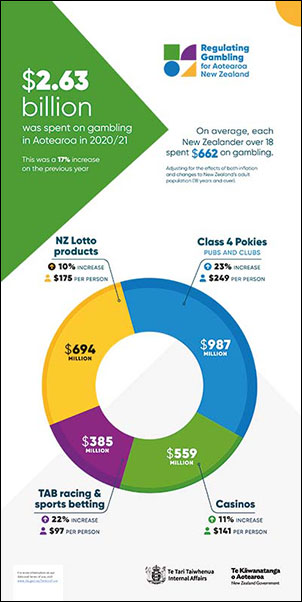
Correction to December 2020 and March 2021 GMP Data
On 24 August 2021, we corrected the December 2020 and March 2021 quarter GMP series for the Auckland Council – Franklin district and total GMP. The data was first published in February 2021. Some GMP had been excluded from reporting due to a venue licensing issue. We regret the error and apologise for any inconvenience caused.
Correction to March 2020 GMP Data
On 24 August 2021, we corrected the March 2020 quarter GMP series for the Southland, South Taranaki, South Waikato and South Wairarapa Districts. The data was first published in August 2020. It was due to a manual data error where GMP figures were swapped in these districts. We regret the error and apologise for any inconvenience caused.
Correction to December 2019 GMP Data
On 26 May 2021 we corrected the December 2019 quarter series for Hurunui/Kaikoura and total GMP. The data was first published in February 2020. It was due to a manual error where the GMP for Hurunui/Kaikoura was reported as lower than was correct. We regret the error and apologise for any inconvenience caused.
Data and StatisticsResearch and reports
2020 Business and Economic Research Limited (BERL) reports – effects of gambling on well being
DIA worked with Business and Economic Research Limited (BERL) to investigate a framework for assessing the costs, and benefits of gambling, that could be applied across the 4 main platforms (Class 4 (pokies), Lotto, TAB and Casinos). The framework was applied to Class 4 in a second stage of the research.Assessing the effects of gambling on wellbeing in New Zealand (PDF, 2MB)
Harm minimisation research
A summary of key findings has been collated to support territorial authorities when reviewing and assessing gambling policies: Earlier gambling research and reportsSummary of key findings from Ministry of Health gambling research
Gambling research and evaluation (Ministry of Health)
DIA gambling research and reports
DIA periodically commissions reports on certain aspects of the gambling sector, to support policy, operational, or corporate decision making.Contact us:
For any queries email gambling@dia.govt.nzPress Releases
A record of press releases issued by the Gambling Compliance Group of the Department of Internal Affairs.Media contact:
- Media phone: +64 27 535 8639
- Email: media@dia.govt.nz
2025
- New Zealand regulator encourages online casino operators to register interest in new regime (23 June 2025)
- Auckland man sentenced to 6 months home detention over fraudulent attempts to seek gambling grant funding (5 March 2025)
2024
- SkyCity closure highlights the importance of protecting people from gambling harm (9 September 2024)
- SkyCity Auckland to close casino for 5 days following DIA investigation (18 July 2024)
- Man and company charged with conducting illegal gambling after generating over $11 million in illegal online lotteries (May 5 2024)
- Auckland man sentenced to home detention for pokies gambling grant fraud (May 13 2024)
- Christchurch publican pleads guilty after misappropriation of over $180,000 in grant funding (9 April 2024)
- Lower Hutt man convicted of illegal gambling and money laundering charges, assets seized (2 April 2024)
- 8 people charged after DIA uncover corrupt network in Hawke’s Bay Gambling Sector (18 January 2024)
2023
2022
- Former publican found guilty after buying Audi with grant funding from pokies (18/11/2022)
- Lower Hutt man faces illegal gambling and money laundering charges (20/10/2022)
- Former club treasurer in Whakatāne convicted and sentenced for misappropriation of pokie grant funds (26/07/2022)
2021
2020
- Third quarter pokie statistics reflect the impacts of COVID 19 (23/11/2020)
- Gambling Regulator keeps watch as taverns open under Alert Level 2 (22/05/2020)
2019
- Encouraging best practice in gambling (26/6/2019)
- Things Kiwis try to raffle – and why some might be breaking the law (06/06/2019)
- Army tank raffle withdrawn (05/06.2019)
- First quarter pokie statistics (17/05/2019)
- Gambling Regulator announces first prosecution for failing to identify a problem gambler (27/03/2019)
- Fourth quarter pokie statistics released (01/02/2019)
- Gamblers spend $49 million more in FY2017/2018 (28/02/2019)
2018
- Five found guilty for the misuse of grant funding (19/12/2018)
- Third quarter pokie statistics released (9/11/2018)
- Second quarter pokie statistics (14/08/2018)
- First quarter pokie statistics (01/05/2018)
- Gamblers spent $125 million more in FY 2016/17 (20/02/2018)
2017
- Pokie spend up over the last 12 months (03/11/2017)
- Third man sentenced in pokie fraud case (27/07/2017)
- Pokie spend up over June year (27/07/2017)
- DIA welcomes pokie fraud sentences (13/07/2017)
- Gambling venues need to do more (28/06/2017)
- Pokie spending patterns continue (20/04/2017)
- New report on gambling available (10/03/2017)
- Gambling expenditure up in FY 2015/16 (23/02/2017)
- Pokie takings continuing to increase 25/01/2017
2016
- Pokie takings continue to rise 20/10/2016
- Pokie takings increase 21/07/2016
- Pokie takings up on a year ago 28/04/2016
- Gambling expenditure up in FY 2014/15 24/02/2016
- Pokie spending up over 2015 3/02/2016
- Two year investigation leads to prosecution 21/1/2016
2015
- Pokie spending rises as machine numbers fall 4/11/2015
- Sentenced for pokie grant fraud 30/09/2015
- Pokie takings down 29/04/2015
- Pokie expenditure up in last quarter of 2014 18/02/2015
- Small increase in gambling expenditure in FY 2013/14 4/02/2015
- Pokie fraud accused in court 2/02/2015
2014
- Gambling operators need to improve problem gambling identification - DIA 3/12/2014
- Updated pokie stats published 30/10/2014
- Christchurch bar loses licence to operate pokies 25/08/2014
- Home detention and more for pokie money theft 5/08/2014
- Pokie Trust obtained licence by deception - Gambling Commission 5/08/2014
- Home detention for pokie money theft 29/07/2014
- Pokie spending and numbers continue to drop 24/07/2014
- Waikato pokie expenditure figures revised 28/05/2014
- Pokie takings down 1/05/2014
- Community detention for pokie theft 17/04/2014
- $7 million increase in gamblng expenditure 2012-13 25/03/2014
- Court orders reparationin gambling society theft 18/03/2014
- Former bar manager found guilty of pokie machine money theft 12/03/2014
- Gambling trust administrator sentenced 26/02/2014
- Pokie expenditure drops in calendar year 2013 20/02/2014
- Guilty plea over pokie profits 13/02/2014
- Guilty plea for gambling society theft 11/2/2014
- Pokie money theft from Auckland hotel brings conviction 10/2/2014
2013
- Licence suspensions reinstated for pokie breaches - court decision 10/12/13
- Key individuals interviewed in pokie grants investigation 5/12/2013
- Former bar manager fined for pokie money theft 11/09/2013
- Hamilton Casino cheats penalised 27/08/2013
- Guilty plea for pokie money theft 21/08/2013
- Pokie numbers and expenditure down 31/07/2013
- Caution urged regarding the use of facial recognition technology 08/07/2013
- Casino cheats found guilty of deception 31/05/2013
- Jail and home detention for pokie grants offenders 01/05/2013
- Pokie takings down (30.04.2013)
- Guilty plea by Cook Islands promoter 01.03.2013
- Pokie grants investigation 20/02/2013
- DIA appeals High Court gambling judgement 10/02/2013
- Further drop in pokie numbers and spending 5/02/2013
- Former Maori All Black convicted for theft 25/01/2013
2012
- Spot prizes and the law 25/10/2012
- Pokie numbers and expenditure continue to fall 19/10/2012
- Galaxy loses pokie licence 20/09/2012
- Pokie operations to be suspended 12/09/2012
- Gaming machine trustee convicted for theft 19/08/2012
- Gaming machine numbers and expenditure down 27/07/2012
- Gambling trusts and venues must help problem gamblers 24/07/2012
- Gaming machines shut down 17/07/2012
- Bluegrass gambling operator's licence cancelled 04/07/2012
- Charge laid over false statement 03/06/2012
- Sentenced for defrauding community of pokie grants 25/05/2012
- Pokie expenditure drops in first quarter 27/04/2012
- Pokie spend rose in 2011 25/01/2012
2011
- Charges laid over gambling society grant 10/11/2011
- Gaming machine take lifts again 20/10/2011
- Pokie operator bows out 05/10/2011
- Running a RWC sweepstake? 09/09/2011
- Department swoops on illegal poker 26/07/2011
- Gaming machine expenditure lifts again 22/07/2011
- Gaming machine expenditure lifts 27/04/2011
- Pokie spend down over year 27/01/2011
- Integrity the priority for gambling compliance 20/01/2011
2010
- Guilty plea over gaming machine grants 21/12/2010
- Pokies allowed in smoking area 16/12/2010
- Tournament poker is gambling 17/11/2010
- Pokie spend up in third quarter 14/10/2010
- Pokie thief jailed 19/08/2010
- Casino non-payment to be investigated 06/08/2010
- Annual pokie spend continues down 20/07/2010
- System to improve gambling sector integrity 28/06/2010
- Ban on harness racing grants confirmed 28/05/2010
- Pokie operators to suspend business 05/05/2010
- Pokie expenditure down 19/04/2010
- Hamilton gambling raises concern 14/04/2010
- Leniency and co-operation policies adopted 07/04/2010
- Caversham appeal dismissed 31/03/2010
- Gamblers spent a little less in 2008/09 25/03/2010
- Pokie spend drops over year 29/01/2010
2009
- Clamp-down on pokie grants to trotting clubs 09/11/2009
- Pokie spend up in third quarter 14/10/2009
- Sport funding a non-issue for most 24/09/2009
- Art Deco Trust not focus of investigation 04/09/2009
- Pokie venues shut down 05/08/2009
- Annual pokie spend drops 5.3 per cent 14/07/2009
- Pokie spend drops 10 per cent 22/04/2009
- Gamblers spent a little more in 2007/08 17/02/2009
- Pokie spend down 28/01/2009
- House 'auction' illegal 20/01/2009
2008
- Caversham application fails 16/12/2008
- Agreement over soccer logo issue 20/11/2008
- Wine prize must be withdrawn 18/11/2008
- Pokie spend tracking down 23/10/2008
- Gaming machine licence continues 03/10/2008
- Publican fined for providing credit to gambler 28/08/2008
- Annual pokie spend drops 24/07/2008
- Bar manager convicted 03/07/2008
- Pokie spend drops 30/04/2008
- Few people say they gamble regularly 29/02/2008
- Nelson barman convicted 05/02/2008
- Spending on pokies up slightly 31/01/2008
2007
- Christchurch bar loses pokie licence 21/12/2007
- Pokie operator loses licence 20/12/2007
- Gambling spend increased in 2006/07 year 18/12/2007
- Pokie money to be repaid 06/11/2007
- Spending on pokies up again 31/10/2007
- More gaming machine money to the community 11/10/2007
- Pokies shut down for licence breaches 16/08/2007
- Guilty plea the only option 03/08/2007
- Spending on pokies up 01/08/2007
- Fewer gambling operators 18/04/2007
- Electronic watch on gaming machines 07/03/2007
- RSA fine for illegal gambling 01/03/2007
- Bookmaker convicted 27/02/2007
- Further drop in gaming machine numbers 23/01/2007
2006
- Warning to liquor stores 18/01/2006
- Gaming shop ordered to close 22/12/2006
- Pokie operation suspended 13/12/2006
- Gambling access restricted 11/12/2006
- Gambling spending drops in 2005/2006 year 08/12/2006
- ‘Pokies’ continue to decrease 20/10/2006
- Strong message to gambling operators 18/10/2006
- Gaming venue operator convicted 06/09/2006
- 'Watch and Win' an illegal lottery 17/08/2006
- Electronic monitoring of gaming machines under way 13/07/2006
- Further decline in gaming machines 12/07/2006
- Success in illegal casino prosecutions 05/07/2006
- Fewer 'Pokies' in the community 11/04/2006
- Sentinel licence cancelled 02/02/2006
- Further reduction in gambling facilities 31/01/2006
- Gambling spending drops in 2004/05 year 25/01/2006
2005
- Gambling compliance director appointed 16/12/2005
- Department applies to suspend Dunedin casino licence 10/11/2005
- Statistics suggest Gambling Act achieving its purpose to control the growth of gambling 10/10/2005
- New gambling regulations come into force 29/09/2005
- Big step towards electronic monitoring of gaming machines 08/09/2005
- Mandatory "pop-up" on gaming machines will interrupt gambling for 15 second intervals 01/09/2005
- First Gambling Act sentencing: $12,000 fine for illegal gambling 30/08/2005
- Next step toward electronic monitoring system for gaming machines, consultation on fees 27/07/2005
- Parliamentary committee dismisses complaints about mandatory messages on gaming machines 25/05/2005
- Contract signed for electronic monitoring of gaming machines in pubs and clubs 17/05/2005
- Gambling Statistics: Casino compliance with Gambling Act 21/04/2005
- Gambling Statistics: Number of operators continues to fall, machine numbers could drop more in future 05/04/2005
- What are the real odds? Department helps gambling operators with information they must provide 31/03/2005
- Ticket-in, ticket-out system at Sky Casinos 24/02/2005
- Totals reduce, but gambling operators and venues get bigger 27/01/2005
2004
- Gambling inspectors, Christmas at casinos 21/12/2004
- Rules for preventing harm caused by gambling 14/12/2004
- Court of Appeal endorses Department’s policy on how much pubs should be paid to host gaming machines 07/12/2004
- Court of Appeal decision on how much pubs should be paid to host gaming machines (PDF, 225K)* 07/12/2004
- Proposals made for electronic system to monitor gaming machines in pubs and clubs 25/10/2004
- Gaming machine regulations: more funding for community groups 21/10/2004
- First quarter of Gambling Act: limits on casinos, fewer gaming machines 08/10/2004
- Gambling operators urged to reapply or risk licences expiring 27/09/2004
- Gambling levy introduced (Media Statement from Hon George Hawkins and Hon Damien O'Connor) (PDF, 94K)* 02/09/2004
- Gambling Act rules: How much should pubs be paid to host gaming machines? 02/09/2004
- Problem gamblers barred from casinos, operators lose licences 01/09/2004
- Young people gambling, texting and the Gambling Act 18/08/2004
- Gaming machine numbers continue to decline 14/07/2004
- Gambling Act changes to all forms of gambling 29/06/2004
- Harder to get a gaming machine licence, easier to lose it 22/06/2004
- Electronic monitoring of gaming machines comes closer 17/06/2004
- New gambling fees: Most community groups no longer pay fees 03/06/2004
- Internal Affairs and Police raid illegal casino 31/05/2004
- More money for the community as High Court decision upholds Department approach to gambling sector expenses 26/05/2004
- High Court judgment endorses Department's approach to gambling sector expenses - Pub Charity v Attorney General (PDF, 176K)* 25/05/2004
- Electronic monitoring of all gaming machines comes closer 03/05/2004
2003
- Gambling Act tightens restrictions preventing children playing gaming machines 25/09/2003
- Tasman Trust vs. Attorney General - Auckland High Court decision confirming that money for charities cannot be used to subsidise pubs (PDF, 900K)* 31/07/2003
- Interim approach to dispensations for site payments (see High Court decision below) 15/04/2003
- Judgment following judicial review of gaming machine site payment policy - Pub Charity v Attorney General (High Court Wellington) (PDF, 1.5M)* 06/03/2003
