- ANNUAL REPORT
2025-2026 - SECTION 1
Our year in review - SECTION 2Progress on Strategic Intentions
- Section 3Assessment of operations
- SECTION 4
Organisational health and capability - SECTION 5
Annual and forecast financial statements - SECTION 6
Statement of Expenses and Capital Expenditure - SECTION 7
Auditor’s Report - SECTION 8
Appendices - Ministry for Ethnic Communities
- National Emergency Management Agency
- Digital Executive Board
- Trust Framework Authority & Trust Framework Board
- Non-departmental Appropriations
Go to the Contents View or download the PDF version Go to the next section

In this section:
- Our Outcomes Framework
- Outcome: New Zealand is a well-functioning democracy across central and local government
- Outcome: People can easily access the services and information they need
- Outcome: People’s sense of belonging and collective memory builds an inclusive New Zealand
- Outcome: Iwi, hapū and communities across New Zealand are safe, resilient and thriving
- Outcome: Oranga hapū, iwi and Māori is improved through an enduring, equitable and positive Māori-Crown relationship
Our outcomes framework
Our Strategic Intentions 2024-2028[3] describes our outcomes framework. This strategy includes our purpose, five outcomes and our priorities for making a difference over time for people and society. Our outcomes are encompassed by the following statement, which reinforces our commitment to and encourages better understanding and capability of te ao Māori.
Whāia te hīnātore o te mauri atua, hei oranga mō te mauri tāngata
The pursuit of environmental sustenance and potential enhances the wellbeing
and life essence of people and place.
We have five outcomes to achieve our purpose, which support and bolster each other.

New Zealand is a well-functioning democracy across central and local government
People can easily access the services and information they need
People's sense of belonging and collective memory builds an inclusive New Zealand

Iwi, hapū and communities across New Zealand are safe, resilient and thriving

Outcome indicators and performance measures
The Department uses outcome indicators to demonstrate the impact of the work we do to benefit New Zealand and those who live here. We use statistical surveys and other research from local and international sources to see whether trends over time represent good progress towards achieving the outcomes.
Medium and long-term trends
We consider the trend of results over the medium and long term (five or more years) to be more informative than minor changes from one year to the next. Indicators can only illustrate an aspect of an outcome and the partial influence of the Department.
To the extent that we can, we show the trend in movement. We use the following legend to indicate whether the outcome indicator trend is increasing, being maintained or decreasing.
Legend for outcome indicators

Trend is increasing (positive).

Trend is being maintained. Result is within 5% of the historical average over the medium to long term (five to 10 years).

Trend is decreasing (negative).
Our performance measures are reported in Section 3 - Assessment of operations - Year-end performance information on Appropriations. These performance measures assess whether we have achieved specific services or functions that collectively support the overall achievement of our outcomes.
A summary of results is below:
|
Performance measures status |
Actual |
Percentage |
Actual |
Percentage | |
|---|---|---|---|---|---|
 |
Standard has been met |
123 |
88% |
100 |
88% |
 |
Standard has not been met |
17 |
12% |
12 |
11% |
 |
Standard is on-track to be met |
- |
- |
1 |
1% |
|
|
Total |
146 |
|
113 |
|
Note 1 – In total for 2024/25, there were 150 performance measures (excluding Outcome Indicators), out of which 140 measures produced results. Three measures were reported in two Crown Entities’ Annual Reports, and the result for seven measures was not available. These 10 measures, together with seven measures relating to the Ministry for Ethnic Communities, have been excluded from the summary of results.
Note 2 – In total for 2025/26, there were 124 performance measures (excluding Outcome Indicators), out of which 113 measures produced results. Four measures were reported in two Crown entities’ Annual Reports, and the result for seven measures was not available. These 11 measures, together with seven measures relating to the Ministry for Ethnic Communities and 13 measures relating to the National Emergency Management Agency, have been excluded from the summary of results.
Reasons for measures not achieving target
The overarching reasons for measures not being met in 2025/26 are due to:
- some system and process changes temporarily affecting performance
- high demand and workload pressures impacting timeliness targets
- some stakeholder and Ministerial satisfaction results did not meet performance standards
- timing, administrative and delivery delays affecting some funding, compliance and expenditure measures.
Several examples in this section reflect work undertaken before a number of Department functions transferred to other agencies through Machinery of Government changes during 2025/26. These activities contributed to the Department's outcomes during the reporting period and are therefore included in this report. Further information on the Machinery of Government changes is provided here in Section 3.
Outcome: New Zealand is a well-functioning democracy across central and local government
About this outcome
Both central and local government have major impacts on the lives of New Zealanders and are an essential part of our democracy. Ensuring that government is accountable and transparent builds trust and confidence in central and local government and contributes to people’s willingness and ability to participate in society.
Cooperation and coordination across central and local government is critical to address complex issues that have both local and national implications and solutions.
Contributing to the achievement of this outcome we have four intermediate outcomes that represent more specifically the impact we will have:
- Executive Government functions well through support, services and advice
- Engagement between Māori and local government is strengthened
- Government transparency is upheld
- Local government works collectively to address national objectives.
For information on what our indicators are telling us for this outcome see page 17, and for further information on performance results see Section 3 – Assessment of operations – Year-end performance information on Appropriations.
The following stories and snapshots provide examples of how we contributed to this outcome during 2025/26. They demonstrate the impact of our work, the progress made during the year, and the lessons learned that will help inform future delivery.
Strengthening government recordkeeping across the care system
The Crown Response Programme is helping to strengthen government recordkeeping and address systemic failures across the care system identified by the Abuse in Care Royal Commission of Inquiry[4].
During the year, the Programme led work across government to improve how care records are managed and accessed. This included reviewing disposal authorities to better protect people’s rights to information, simplifying the personal records request process, and incorporating care recordkeeping requirements into Public Records Act audits. The Programme partnered with the Ministry of Education and Disability Support Services to progress the Care Records Framework and began improving online services to provide easier access to best-practice guidance.
Addressing long-standing recordkeeping issues across multiple agencies was a significant challenge. The Programme responded by working closely with survivors, whānau and government agencies to identify practical solutions and improve consistency across agencies.
This work reinforced the importance of sustained cross-government collaboration to improve accountability and access to information.
Digital Government Target State
The Government's digital transformation programme reached an important milestone with the transition from the Service Modernisation Roadmap (the Roadmap) to the Digital Government Target State[5].
Version 2 of the Roadmap was published in November 2025. It includes initiatives to improve digital investment alignment and progress key foundations for modern digital services, including the Govt.nz app, a platform for issuing digital credentials, a secure notifications and messaging platform, and the Public Service AI Work Programme through to 2027.
A key challenge was maintaining momentum across multiple initiatives while shifting to a longer-term strategic approach. The Department responded through clear communication and coordinated planning across government agencies.
In December 2025, Cabinet endorsed the initial Digital Government Target State, providing a long-term framework to guide future digital investment and service delivery. The transition demonstrated the importance of clear direction, shared priorities, and strong collaboration in enabling more connected and user-focused public services.
Local government reform
The Department supported a range of government initiatives to help councils focus on delivering essential services, managing costs and responding to future challenges.
The Department progressed the Simplifying Local Government programme, supported work on rates capping, advanced Local Water Done Well reforms, and administered Water Services Better Off funding to help councils invest in local priorities.
Delivering these initiatives across a complex local government system required careful coordination and engagement. The Department worked closely with councils and stakeholders to support implementation and maintain momentum across a range of changes aimed at strengthening council performance and financial management.
Together, these initiatives are intended to support more efficient service delivery while maintaining local accountability. The work demonstrated the importance of partnership, capability building and careful sequencing when implementing system-wide change. On 1 July 2026, the Department's local government functions transferred to the Ministry for Cities, Environment, Regions and Transport.
Modernising the Crown Fleet
Ministerial Services delivers 24/7 VIP transport services to the Prime Minister, Ministers, the Governor-General and other entitled users.
During 2025/26, the Department progressed modernisation of the Crown Fleet by introducing 10 low-emission vehicles to replace diesel vehicles that had reached the end of their useful life. A key challenge was balancing security, operational and customer requirements with value for money and environmental responsibility.
For the first time, approximately 75% of Crown Fleet vehicles are electrically capable. These vehicles are expected to have a longer operational life and lower maintenance costs than their petrol and diesel equivalents. The Department also continued to reduce the overall size of the fleet through improved utilisation and efficiency while maintaining service standards.
The fleet modernisation programme demonstrated that environmental and efficiency improvements can be achieved while continuing to provide safe, secure and reliable transport services for Ministers and other entitled users.
Delivery snapshots
|
COVID-19 Inquiry Phase 2 final report delivered on time and under budget. |
|
Phillips Children and Tauranga inquiries established quickly and progressing well. |
|
Delivered 26 Guests of Government visits and 450+ airport facilitations. |
|
75% of the Crown fleet is electric, cutting emissions and operating costs. |
|
Assessed all water services delivery plans by December 2025 deadline; all but one were accepted. |
|
Signed City and Regional Deals with Auckland and Western Bay of Plenty to foster economic growth. |
|
Coordinated the establishment of the Moa Point Crown Review to identify causes and prevent recurrence. |
|
|
What are our outcome indicators telling us?
▶ Perceptions of corruption are maintained or decreased
|
Metric |
2021/22 |
2022/23 |
2023/24 |
2024/25 |
2025/26 |
Trend* |
|---|---|---|---|---|---|---|
|
Score out of 100 |
88 (Rank = 1) |
87 (Rank = 2) |
85 (Rank = 3) |
83 (Rank = 4) |
81 (Rank = 4) |
|
Source: Transparency International’s Corruption Perceptions Index (see Note 1).
*The trend is measured using medium and long-term performance data, including results beyond the five years shown in this report.
▶ New Zealand’s global ranking in the Democracy Index is maintained or increased
|
Metric |
2021/22 |
2022/23 |
2023/24 |
2024/25 |
2025/26 |
Trend* |
|---|---|---|---|---|---|---|
|
Score out of 10 |
9.37 (Rank = 2) |
9.61 (Rank = 2) |
9.61 (Rank = 2) |
9.61 (Rank = 2) |
Data not available (see Note 2) |
|
Source: The Economist’s Democracy Index (see Note 2).
*The trend is measured using medium and long-term performance data, including results beyond the five years shown in this report.
▶ New Zealanders’ trust in public services based on personal experience is maintained or increased
|
Metric |
2021/22 |
2022/23 |
2023/24 |
2024/25 |
2025/26 |
Trend* |
|---|---|---|---|---|---|---|
|
% |
81% |
82% |
80% |
81% |
82% |
|
Source: Kiwis Count Survey – Public Service Commission (see Note 3).
*The trend is measured using medium and long-term performance data, including results beyond the five years shown in this report.
Note 1 – Transparency International’s Corruption Perceptions Index and results for all years can be found by visiting https://www.transparency.org/en/cpi/2025 and selecting the relevant year.
Note 2 – New Zealand was ranked second globally in The Economist Intelligence Unit's Democracy Index 2025 and continued to be classified as a Full Democracy. The Economist’s 2025 Democracy Index can be found at https://www.economistgroup.com/press-centre/economist-enterprise/eiu-democracy-index-2025-democracy-stabilises-after-eight-years-of-decline. The Economist Intelligence Unit's release does not disclose New Zealand's exact score this year.
Note 3 – The Kiwis Count Survey can be found at https://www.publicservice.govt.nz/research-and-data/kiwis-count/.
Our indicators tell us that New Zealand’s democracy and trust in public services have been maintained. This continues to be supported by The Economist’s Democracy Index as number two in the world, with a full democracy regime in place. The Transparency International’s Corruption Perceptions Index shows a decrease from previous years. Despite this decline, New Zealand remains one of the highest-performing countries internationally for perceived public sector integrity and transparency, ranking fourth globally behind Denmark, Finland and Singapore. New Zealanders continue to hold a high level of trust in public services based on their personal experiences and the trend has increased over time. In 2026, the Public Service Commission reported that 82% of New Zealanders trust public services based on their personal experience.

Outcome: People can easily access the services and information they need
About this outcome
People’s ability to access services and information affects their lives and wellbeing.
We work across government to identify opportunities to make services and information more easily accessible to those who need them.
Making it easy for people to verify their identity and reducing or eliminating digital barriers enhances people’s ability to participate in society – through jobs, education, community work and recreation.
Contributing to the achievement of this outcome we have four intermediate outcomes that represent more specifically the impact we will have:
- People’s identity can be easily and securely verified
- Barriers to digital inclusion are reduced
- People’s access to government is enhanced
- Taonga tuku iho rights are protected.
For information on what our indicators are telling us for this outcome see page 22, and for further information on performance results see Section 3 – Assessment of operations – Year-end performance information on Appropriations.
The following stories and snapshots provide examples of how we contributed to this outcome during 2025/26. They demonstrate the impact of our work, the progress made during the year, and the lessons learned that will help inform future delivery.
RealMe verified identity application process
In March 2026, the Department enhanced the Identity Verification Service to make it easier for people to obtain a verified identity and access trusted digital services. A new online portal enables more applicants to complete the process entirely online. Improved tools help RealMe better support people who apply in person at partner stores. Processing was modernised through a new platform, with greater integration and automation improving efficiency.
These changes resulted in faster service delivery, with 32% of verified identities issued on the same day as the application was received. Implementing the new system required staff to adopt new processes and ways of working.
Te Ara Manaaki improvements to customer experience
Over the past eight years, the Te Ara Manaaki programme has transformed identity services, making it easier for New Zealanders to access passports, citizenship, marriage and identity verification services. This improved both customer experience and internal processes, with more than 90% of applications for services available online now submitted digitally. Processing times for citizenship by grant applications also reduced significantly, from 200 working days in 2023 to 30 days in the first quarter of 2026.
Delivering change across multiple services while maintaining day-to-day operations was a significant challenge. The programme responded through a one-team approach, with clear accountability, strong collaboration and continuous improvement.
The changes delivered and lessons learned over the years of this project puts the Department in a strong position to continue improving our identity services and meet the needs of New Zealanders now and into the future.
Deaf Service Survivor Experience Services
The Department’s Survivor Experiences Services (SES) has improved access to support for Deaf survivors of abuse in care. SES worked closely with Deaf survivors to identify and remove barriers to accessing services. SES introduced a registration process supported by New Zealand Sign Language (NZSL) videos and developed animated resources to explain services in more accessible ways.
A key challenge was ensuring services and information met the communication needs of both Deaf survivors and Deaf kaimahi. Services were designed with Deaf survivors and adapted to meet their needs[6].
This work resulted in a more inclusive and accessible service. It was recognised through awards, for its commitment to NZSL accessibility and the NZSL community and inclusiveness.
Govt.nz app
Launched in December 2025, the Govt.nz app gives New Zealanders a new way to access trusted government information and services securely in one place. The app includes a digital wallet that allows people to store and present verified credentials, such as licences and qualifications issued by government agencies and private organisations.
More than 35,000 people downloaded the app within its first few months, demonstrating strong demand for simpler digital access to government services. A key challenge was coordinating work across multiple agencies and disciplines, such as policy, technology and service design. The Department responded by taking an iterative approach, launching a minimum viable product and building on common design standards that support privacy, information sharing and future growth.
This work demonstrated the value of delivering in stages, enabling early benefits for users while creating foundations that will support future digital government services.
Digital credentials
Legislative changes this year helped strengthen New Zealand's digital identity system and support the wider use of trusted digital credentials. Working across government, the Department supported amendments that created a clearer pathway for organisations to adopt services accredited under the Digital Identity Services Trust Framework[7].
As a result, the Anti-Money Laundering and Countering Financing of Terrorism (AML/CFT) Identity Verification Code of Practice 2026 provides a practical way for banks and other regulated organisations to accept accredited digital credentials. Changes to the Sale and Supply of Alcohol Regulations also enable digital credentials to be used for age verification and other age-restricted services.
Aligning policy, legislative and operational requirements across multiple agencies was a key challenge. We responded through close and effective cross-government collaboration. This work highlighted the importance of clear regulatory settings and coordinated implementation in building trust and encouraging the wider adoption of digital identity services. Following Machinery of Government changes during 2025/26, responsibility for this work transferred to the Government Digital Delivery Agency, which will continue supporting agencies to issue and use digital credentials.
Helping local libraries to support student learning
The AnyQuestions programme is a free, online chat service helping school-aged children with their research. It has been working to strengthen the capability of local libraries in their support for children and young people as they access, evaluate and use information.
Through nationwide training and online professional development, community librarians increased their understanding of the New Zealand Curriculum, strengthened professional networks, and built confidence supporting students to find information and use digital resources.
Delivering training across a diverse library network was challenging, with differing staff availability and levels of confidence using technology. The National Library responded with tailored one-on-one support, peer learning opportunities and flexible delivery options.
The programme increased participation and librarian confidence, helping libraries better support student learning and lifelong reading. It also demonstrated that flexible, responsive support is essential for meeting the needs of diverse communities and achieving consistent outcomes.
Delivery snapshots
|
57,267 births registered, helping establish legal identity from the start of life. |
|
19,988 marriages registered, providing legal recognition and official records for couples across New Zealand. |
|
551,072 passports issued, enabling New Zealanders to travel, work and connect internationally. |
|
8,024 official documents translated, helping people use official documents in New Zealand and overseas. |
|
2,240,000 words translated, helping people access government information and services in the language they need. |
|
91% of passport applications submitted electronically, making it easier and faster for people to access passport services. |
|
46,552,394 successful RealMe customer logins, enabling secure access to government and other online services. |
|
Our updated operating model has resulted in service improvements and enabled us to effectively manage increased demand. |
What are our outcome indicators telling us?
▶ Ease of getting passport services is maintained or increased
|
Metric |
2021/22 |
2022/23 |
2023/24 |
2024/25 |
2025/26 |
Trend* |
|---|---|---|---|---|---|---|
|
% |
89% |
89% |
86% |
91% |
93% |
|
Source: DIA Customer Experience Survey (see Note 1). For the 2025/26 survey a total of 9,493 customers were interviewed, 55,717 were invited, with a 17% response rate.
*The trend is measured using medium and long-term performance data, including results beyond the five years shown in this report.
▶ Ease of getting birth, death and marriage services is maintained or increased
|
Metric |
2021/22 |
2022/23 |
2023/24 |
2024/25 |
2025/26 |
Trend* |
|---|---|---|---|---|---|---|
|
% |
92% |
90% |
89% |
91% |
92% |
|
Source: DIA Customer Experience Survey (see Note 1). For the 2025/26 survey a total of 2,703 customers were interviewed, 24,740 were invited, with a 11% response rate.
*The trend is measured using medium and long-term performance data, including results beyond the five years shown in this report.
▶ Ease of getting citizenship services is maintained or increased
|
Metric |
2021/22 |
2023/23 |
2023/24 |
2024/25 |
2025/26 |
Trend* |
|---|---|---|---|---|---|---|
|
% |
86% |
89% |
87% |
89% |
92% |
|
Source: DIA Customer Experience Survey (see Note 1). For the 2025/26 survey a total of 1,352 customers were interviewed, 9,051 were invited, with a 15% response rate.
*The trend is measured using medium and long-term performance data, including results beyond the five years shown in this report.
▶ People’s trust and confidence in digital identity is improved
|
Metric |
2021/22 |
2022/23 |
2023/24 |
2024/25 |
2025/26 |
Trend* |
|---|---|---|---|---|---|---|
|
% |
88% |
87% |
85% |
89% |
91% (see Note 2) |
|
Source: DIA Customer Experience Survey (see Note 1).For the 2025/26 survey a total of 11,885 customers were interviewed.
*The trend is measured using medium and long-term performance data, including results beyond the five years shown in this report.
Note 1 – The DIA Customer Satisfaction Survey is run annually by NielsenIQ on behalf of the Department using a sample of customers who have used services in the previous 12 months. For the 2025/26 survey a total of 16,826 customers were interviewed (across all services being surveyed) between 1 July 2025 and 30 June 2026. Further information on this survey can be found at https://www.dia.govt.nz/Customer-Experience-Survey.
Note 2 – This indicator measures trust and confidence from customers using the Department's digital channels for births, deaths and marriages, citizenship, and passport services. It uses the following question from the DIA Customer Experience Survey: The following are some questions about the service you recently received from the Department of Internal Affairs. First of all, if you had to rate your trust and confidence in the Department, on a scale from 0 to 10 where 0 means 'no trust and confidence at all' and 10 means 'full trust and confidence', how would you rate it?
Our indicators continue to show high levels of customer satisfaction with ease of access to or use of key services from the Department. These services include issuing of passports, birth, death and marriage registration and the processing of citizenship applications. In 2025/26, ease of access increased across all major service areas. The trend for ease of getting passport services continued to improve, increasing to 93% in 2025/26, the highest result achieved over the past five years. Births, deaths and marriages services and citizenship services also recorded strong results of 92%. Trust and confidence in the Department’s digital identity services remained high at 91%, increasing from 89% in 2024/25. These results indicate that the Department continues to deliver accessible and trusted services while improving the customer experience.
Outcome: People's sense of belonging and collective memory builds an inclusive New Zealand
About this outcome
A strong sense of belonging is important for New Zealand to be a welcoming and inclusive place for everyone.
Many factors influence people’s sense of belonging and connection. When people lack a sense of belonging and feel excluded there are high social costs for individuals, communities and society.
A collective memory contributes to a sense of belonging through knowledge and understanding of our history and culture. A vibrant cultural and national identity also helps to give a collective sense of belonging. People benefit from the social capital that documentary heritage, symbols of national identity, national events and culture provide.
Contributing to the achievement of this outcome we have five intermediate outcomes that represent more specifically the impact we will have:
- Collective memory is enhanced by New Zealand’s documentary heritage
- A culture of reading enhances literacy and knowledge
- New Zealand’s national and cultural identity is fostered and respected
- Trusted citizenship and identity documents contribute to a sense of belonging
- Taonga tuku iho is preserved and valued.
For information on what our indicators are telling us for this outcome see page 26, and for further information on performance results see Section 3 – Assessment of operations – Year-end performance information on Appropriations.
The following stories and snapshots provide examples of how we contributed to this outcome during 2025/26. They demonstrate the impact of our work, the progress made during the year, and the lessons learned that will help inform future delivery.
Connecting young people with our nation’s history
In April 2026, Archives New Zealand and the National Library launched Anzac Stories[1], an interactive online resource that helps children aged 9 to 13 explore New Zealand’s history through documentary heritage. Using archival records, photographs and personal stories, the resource brings Anzac history to life through engaging visual storytelling designed for young audiences. A key challenge was creating content that would be meaningful and engaging for children while remaining historically accurate.
The team worked closely with schools, children and expert writers throughout the design process, to ensure the content was both engaging and historically accurate. Children’s ideas challenged assumptions about what young audiences find interesting and helped shape content, navigation and storytelling approaches. Engagement data from students, teachers and parents has been positive, showing the resource is connecting new audiences with New Zealand’s documentary heritage. The project demonstrated that involving children from the outset leads to better outcomes and more engaging resources for young audiences.
Pūtoi Rito Communities of Readers
National Library partnered with a primary school to help build a culture where reading is valued and enjoyed by students. Through professional development, library support and practical tools, the project strengthened teacher capability, improved access to resources and encouraged greater collaboration across the school.
As a result, student engagement with the library increased, teacher-librarian partnerships became stronger, and teachers increasingly modelled reading, read aloud for enjoyment and strengthened their own reading identities.
A key challenge was supporting teachers to engage while schools were adapting to a new curriculum. The National Library responded by working closely with staff and tailoring support to local needs. Insights from the project informed a research report[2] developed with the New Zealand Council for Educational Research, contributing to the evidence base on how reading identities are developed. The project reinforced the importance of leadership, collaboration, and a shared commitment to reading for pleasure in building strong and sustainable reading cultures.
Opening of Te Rua
The opening of Te Rua (the new Archival building) marked a significant milestone in preserving and providing access to New Zealand's documentary heritage.
Developed in partnership with mana whenua, Te Rua is part of the co-designed Heritage Campus – Te Kahu. Its name, design, lighting and landscaping reflect cultural narratives and connections to place, while shared facilities improve access to and protection of taonga.
Managing the large-scale relocation of the collections and integrating new ways of working across institutions was complex and time-intensive. Archives New Zealand responded through careful planning, phased relocation, close partnership with mana whenua and tikanga-led engagement to ensure collections were protected and the transition was successfully managed. All these considerations contributed to successfully delivering major heritage infrastructure projects and supporting the long-term stewardship of our nation’s memory.
Te Rua opened to the public in March 2026.
Delivery snapshots
|
The National Library celebrated 60 years of preserving and providing access to New Zealand knowledge. |
|
Opened Te Kahu (the new heritage campus in Wellington), which is enabling more collaborative heritage services and stewardship. |
|
87% of citizenship by grant applications were processed within 75 working days of submission. |
|
More than 46,500 people became New Zealand citizens by grant during 2025/26. |
What are our outcome indicators telling us?
▶ Satisfaction with citizenship services is maintained or increased
|
Metric |
2021/22 |
2022/23 |
2023/24 |
2024/25 |
2025/26 |
Trend* |
|---|---|---|---|---|---|---|
|
% |
90% |
84% |
87% |
90% |
94% |
|
Source: DIA Customer Experience Survey (see Note 1).For the 2025/26 survey a total of 1,352 customers were interviewed, 9,051 were invited, with a 15% response rate.
*The trend is measured using medium and long-term performance data, including results beyond the five years shown in this report.
▶ People’s sense of belonging to New Zealand increased
|
Metric |
2021/22 |
2022/23 |
2023/24 |
2024/25 |
2025/26 |
Trend* |
|---|---|---|---|---|---|---|
|
% |
88% [18] |
Date not |
Date not |
83% [19] |
Data not available (see Note 4) |
|
Source: General Social Survey – Stats NZ (see Note 3).
*The trend is measured using medium and long-term performance data, including results beyond the five years shown in this report.
Note 1 – The DIA Customer Satisfaction Survey is run annually by NielsenIQ on behalf of the Department using a sample of customers who have used services in the previous 12 months. For the 2025/26 survey a total of 16,826 customers were interviewed (across all services being surveyed) between 1 July 2025 and 30 June 2026. Further information on this survey can be found at https://www.dia.govt.nz/Customer-Experience-Survey.
Note 2 – The 2021/22 result was provided by Stats NZ as a customised data set from the Stats NZ 2021 General Social Survey covering the survey period 1 April 2021 to 17 August 2021. This measure is based on a scale where 0 is no sense of belonging and 10 is a very strong sense of belonging. The 2016/17 and 2021/22 results are based on the percentage of people aged 15 years and over who reported their sense of belonging to New Zealand at 7 or higher.
Note 3 – The 2024/25 results have been taken from the Stats NZ 2023 General Social Survey covering the survey period May 2023 to April 2024 which can be found at https://www.stats.govt.nz/information-releases/wellbeing-statistics-2023/. The Stats NZ General Social Survey is generally carried out every two years.
Note 4 – The Stats NZ General Social Survey is conducted every two years. No new survey results were available for the 2025/26 reporting period.
Citizenship is an important marker of people’s sense of belonging in New Zealand. Customer satisfaction with citizenship services increased to 94% in 2025/26, continuing a positive trend over recent years. This result reflects ongoing efforts to improve the customer experience through reduced processing timeframes, clearer information for applicants, increased automation and more efficient service delivery. The consistently high levels of satisfaction indicate that people acquiring New Zealand citizenship continue to have a positive experience of the citizenship process.
The indicator of people’s sense of belonging to New Zealand is based on the Stats NZ General Social Survey, which is conducted every two years. As no survey was undertaken during the 2025/26 reporting period, no updated result is available.
Outcome: Iwi, hapū and communities across New Zealand are safe, resilient and thriving
About this outcome
Communities are important to people’s wellbeing. People have the best opportunity to thrive and prosper when the communities they live in are safe and resilient.
Communities can be supported to manage risks and challenges and empowered to form and realise their own aspirations, despite any adversity they might face over time.
Across New Zealand there are many different communities, and we need to work with them in different and unique ways, including with iwi, hapū and Māori. The Crown can support their aspirations alongside our associated Treaty of Waitangi/Te Tiriti o Waitangi obligations and settlements. While many aspirations are common among iwi Māori, we also recognise that unique needs exist and we are working in different ways to support individual iwi.
Resilient infrastructure is important to communities and their long-term wellbeing. Addressing the planning for and funding of infrastructure ensures communities have the facilities that allow our regions to thrive and prosper.
Contributing to the achievement of this outcome we have three intermediate outcomes that represent more specifically the impact we will have:
- Regulated activities minimise harm and maximise benefits to people and communities
- Māori are supported to realise their aspirations
- Communities are supported to develop and prosper.
For information on what our indicators are telling us for this outcome see page 31, and for further information on performance results see Section 3 – Assessment of operations – Year-end performance information on Appropriations.
The following stories and snapshots provide examples of how we contributed to this outcome during 2025/26. They demonstrate the impact of our work, the progress made during the year and the lessons learned that will help inform future delivery.
Online casino gambling
Legislation
The Online Casino Gambling Act 2026 established a regulated framework for online casino gambling in New Zealand, helping to strengthen consumer protections while supporting a compliant market.
Enacted in May 2026, the Act provides for up to 15 licensed operators and includes measures to reduce gambling harm and improve consumer protections. Through the Parliamentary process, provisions for community returns and a centralised self-exclusion register were added to the legislation. The Department developed regulations covering advertising, harm minimisation, consumer protection and cost recovery.
A key challenge was balancing harm reduction objectives with the need to attract reputable operators and maintain commercial viability. By refining legislative requirements and developing appropriate safeguards, the Department established a foundation for a safer and more effectively regulated online gambling environment.
Preparing for implementation
The Department also established a new regulatory function to regulate online casino gambling. A competitive three-stage licensing process for up to 15 operators and advanced implementation of a modern, risk-based regulatory model has been designed[1]. The Department is preparing to receive licence applications and begin regulating unlicensed operators.
A key challenge was building a new regulator while legislation and regulations were still being developed for a rapidly evolving global industry. To address this, the Department generated new market data and worked closely with harm prevention organisations, industry participants, and domestic and international regulators.
One-Click Reporting of scam and spam texts
A new One-Click Reporting feature has made it easier for New Zealanders to report scam and spam text messages and help government agencies identify emerging threats more quickly.
Previously, people needed to manually forward suspicious messages to the 7726 reporting service, which limited participation. Working with Apple and mobile network providers, the Department introduced One-Click Reporting for iOS users, enabling messages to be reported directly from the messaging app.
The simpler process resulted in a more than 1,000% increase in reports, providing better visibility of scam activity and supporting earlier detection and response.
Building partnerships across government, industry and technology providers was critical to delivery. The success of the rollout demonstrated that reducing barriers can significantly improve public participation and strengthen New Zealand’s response to digital threats[2]. Work is now underway to introduce the same functionality on Android devices.
Closure of the greyhound racing industry
The Department supported the Government's decision to close New Zealand's commercial greyhound racing industry by developing legislation, to ensure an orderly transition.
During the year, a three-stage legislative programme culminated in the passage of the Racing Industry (Closure of Greyhound Racing Industry) Amendment Act, establishing a statutory pathway for the cessation of commercial greyhound racing from 1 August 2026. The legislation provided clarity and certainty for participants, communities and organisations affected by the change.
To support implementation, the existing Ministerial Advisory Committee transitioned to become the Greyhound Racing Transition Agency.
The work highlighted the importance of combining legislative change with practical transition planning to support people and communities through significant change.
Regulatory Systems (Internal Affairs) Amendment Act 2026
The Regulatory Systems (Internal Affairs) Amendment Act 2026[3] strengthened the effectiveness of the Department's regulatory systems through targeted improvements across 30 Acts administered or supported by the Department.
The legislation introduced practical changes that improve public safety, simplify administration and strengthen regulatory oversight. These include enabling passports to be cancelled when associated data has been compromised, simplifying Fire and Emergency levy administration for insurers, and preventing children from purchasing Lotto tickets.
Taupō Harbourmaster rescue and water safety
The Lake Taupō Harbourmaster operates across Taupō waters. They maintain navigational aids and infrastructure, ensure compliance of users (including for the lake aerodrome), undertake safety patrols, education, and work alongside partners and the Taupō community.
The Harbourmaster supports rescues where appropriate and requested by lead agencies. In February 2026, the team supported Police and Coastguard in the successful rescue of seven people from the Waikato River. While the rescue had a positive outcome, it highlighted the ongoing risks associated with entering the water without lifejackets.
As this section of the Waikato River is a high-use and high-risk area, the team worked with partners following the incident to strengthen safety messaging, improve signage, and install additional rescue equipment at key access points. This work reinforced the importance of combining education, infrastructure improvements and strong partnerships, to improve safety outcomes and help prevent serious incidents on the water in the future.
Delivery snapshots
|
First AML/CFT criminal prosecution of a New Zealand law firm secured guilty pleas. |
|
Largest illegal lottery case: offender sentenced; $4 million restrained from $11 million operation. |
|
Eighteen offenders prosecuted for objectionable material offences, receiving sentences up to 13.5 years. |
|
Lottery grants funded desexing 3,000 dangerous dogs, preventing an estimated 4,500 puppies annually, and reducing the incidence of dog attacks. |
|
Distributed $440 million in community funding, including $422 million from lottery profits. |
|
New iwi and Community Archivist role strengthened support for taonga and knowledge-sharing |
What are our outcome indicators telling us?
Overall life satisfaction is maintained or increased
|
Metric |
2021/22 |
2022/23 |
2023/24 |
2024/25 |
2025/26 |
Trend* |
|---|---|---|---|---|---|---|
|
% |
81% |
81% |
79% (see Note 1) |
79% (see Note 1) |
Data not available (see Note 5) |
|
Source: General Social Survey – Stats NZ (see Note 2).
*The trend is measured using medium and long-term performance data, including results beyond the five years shown in this report.
▶ People’s sense of purpose is maintained or increased (see Note 3)
|
Metric |
2021/22 |
2022/23 |
2023/24 |
2024/25 |
2025/26 |
Trend* |
|---|---|---|---|---|---|---|
|
% |
85% |
Data not available |
Data not available |
84% (see Note 4) |
Data not available (see Note 5) |
|
Source: General Social Survey – Stats NZ (see Note 2).
*The trend is measured using medium and long-term performance data, including results beyond the five years shown in this report.
Note 1 – The data for the 2022/23 and 2023/24 results were collected as part of the Stats NZ Household Economic Survey (household income and housing-cost statistics) as the General Social Survey was delayed and was not available in time for inclusion in the 2023/24 Annual Report. The Household Economic Survey has differences in its collection method, and sampled population, reporting periods, among other things, that may affect comparability. This result is not able to be directly compared with results from prior years and the current year.
Note 2 – The 2024/25 results have been taken from the Stats NZ 2023 General Social Survey covering the survey period May 2023 to April 2024 which can be found at https://www.stats.govt.nz/information-releases/wellbeing-statistics-2023/. The Stats NZ General Social Survey is generally carried out every two years.
Note 3 – Satisfaction is determined on a 0–10 scale, where 0 is completely dissatisfied and 10 is completely satisfied.
Note 4 – We use the Stats NZ General Social Survey question ‘Things you do in life is worthwhile’ for this indicator. This is rated on a 0–10 scale where 0 is not at all worthwhile and 10 is completely worthwhile.
Note 5 – The Stats NZ General Social Survey is conducted every two years. No new survey results were available for the 2025/26 reporting period.
Based on the previous year, our indicators show that people rate their overall life satisfaction and sense of purpose highly although the longer-term trend has declined slightly. The most recent Stats NZ report shows that the majority of New Zealanders continued to rate their overall life satisfaction with 79% giving a rating of 7 or higher. New Zealanders also continue to rate their sense of purpose highly with 84% giving a rating of 7 or higher.
Outcome: Oranga hapū, iwi and Māori is improved through an enduring, equitable and positive Māori-Crown relationship
About this outcome
The Department has Treaty of Waitangi (Te Tiriti o Waitangi) obligations that require strong relationships, engagement and consultation with Māori to be effective.
This outcome places our relationship with hapū, iwi and Māori at the centre of our decision-making in matters relating to Māori. It requires us to build our capability in te ao Māori, te reo me ōna tikanga and Te Tiriti to help achieve improved, enduring and equitable outcomes for Māori.
The term ‘oranga’ can be translated as wellbeing but from a te ao Māori perspective it encompasses much more, including the connection between people’s health and wellbeing and the whenua (land) and taiao (environment) around them.
Contributing to the achievement of this outcome we have two intermediate outcomes that represent more specifically the impact we will have:
- Mātauranga Māori is respected and valued
- Māori, iwi and hapū aspirations, interests and rights are understood and respected.
For information on what our indicators are telling us for this outcome see page 34, and for further information on performance results see Section 3 – Assessment of operations – Year-end performance information on Appropriations.
The following stories and snapshots provide examples of how we contributed to this outcome during 2025/26. They demonstrate the impact of our work, the progress made during the year, and the lessons learned that will help inform future delivery.
Digitisation of land records
Archives New Zealand improved access to New Zealand’s shared history by digitising 1,403 Old Land Claims files after recommencing large-scale digitisation in Wellington. These heavily used records document Māori-Pākehā land transactions before the Treaty of Waitangi (Te Tiriti o Waitangi) and are now digitally preserved and freely accessible.
Working with New Zealand Micrographics enabled the project to be delivered in a timely and cost-effective way, while establishing a strong foundation for future digitisation.
Carrying out large-scale digitisation alongside commissioning Te Rua (the new archival building) and establishing new partnerships was a significant challenge. Archives New Zealand and vendor teams worked closely together, to ensure records were effectively managed, preserved and digitised.
The project demonstrated that combining specialist knowledge across teams supports better outcomes for access, preservation and Mātauranga Māori, helping inform future digitisation work.
Increasing access to Mātauranga and taonga Māori
The National Library expanded access to Mātauranga Māori by adding two new virtual whare to Te Ao Māori Rauemi ā-Ipurangi[13], an online platform that connects students and educators with trusted digital resources and collections.
The platform brings together material from the National Library, Archives New Zealand and other age-appropriate sources, making it easier for learners and teachers to discover and use content grounded in te ao Māori.
Developing the new resources required meaningful engagement with kura kaupapa Māori and kura-a-iwi, to ensure the platform reflected the needs of learners and educators. The National Library adapted timelines and worked through established networks to support genuine collaboration.
This approach created a stronger experience and demonstrated that early engagement and flexibility help deliver resources that are culturally relevant, accessible and valuable for learners.
Strengthening relationships with iwi and Te Tiriti settlement obligations
The Department strengthened its approach to Māori-Crown relationships by improving oversight and reporting of Iwi-Crown Accords, Te Haeata commitments and engagement with Māori communities.
The work has increased visibility of relationship activities, statutory obligations, risks and opportunities across the organisation, supporting more coordinated engagement with iwi, hapū, marae and Māori organisations.
Oversight of Te Tiriti o Waitangi and Treaty settlement obligations has also been strengthened. Through Te Haeata, the Department monitored and reported on statutory and settlement obligations, introduced new reporting tools, and supported business groups to improve performance reporting and compliance activities. This included preparing for the transfer of 29 Treaty settlement commitments to the Ministry for Cities, Environment, Regions and Transport from 1 July 2026.
This work has improved visibility of obligations across the organisation and reinforced the importance of clear accountability, consistent monitoring and strong relationships in supporting enduring Māori-Crown partnerships and meeting Crown commitments.
Delivery snapshots
|
Provided $350,000 to strengthen Te Rūnanga o Ngāti Whātua resilience following Cyclone Gabrielle. |
|
Community & Volunteering Capability funding helped Takitimu Māori Wardens recruit 20 volunteers and strengthen resilience. |
|
Upgraded water supplies at 120 rural marae, papakāinga kōhanga reo and kaumatua housing, which helped displaced people in recent weather events. |
What are our outcome indicators telling us?
The Department has two foundational indicators for this outcome. The first one focuses on lifting the capacity of Māori leadership at tier 4 level and above. The second indicator shows how our Treaty commitments and obligations are understood and upheld across the organisation.
▶ Māori leaders in the Department at tier 4 level and above is maintained or increased (see Note 1)
|
Metric |
2021/22 |
2022/23 |
2023/24 |
2024/25 |
2025/26 |
Trend* |
|---|---|---|---|---|---|---|
|
% |
14.3% |
13.1% (24 people leaders) |
14.5% (28 people leaders) |
13.3% (22 people leaders) |
19.8% (24 people leaders) |
|
Source: DIA.
*The trend is measured using medium and long-term performance data, including results beyond the five years shown in this report.
In 2025/26, 19.8% of leaders identified as Māori, consistent with the Department’s five-year average and meeting the indicator for maintaining the trend. The trend is calculated based on percentage reported.
Note 1 – Tier 4 and above is defined as the top four tiers of managers and leaders that lead people within the Department with the Chief Executive being tier 1.
▶ The Department’s settlement commitments as reported in Te Haeata is maintained or increased
|
Metric |
2021/22 |
2022/23 |
2023/24 |
2024/25 |
2025/26 |
Trend* |
|---|---|---|---|---|---|---|
|
% |
New indicator |
|
50% |
51% |
64% |
|
Source: Te Puni Kōkiri – Ministry of Māori Development.
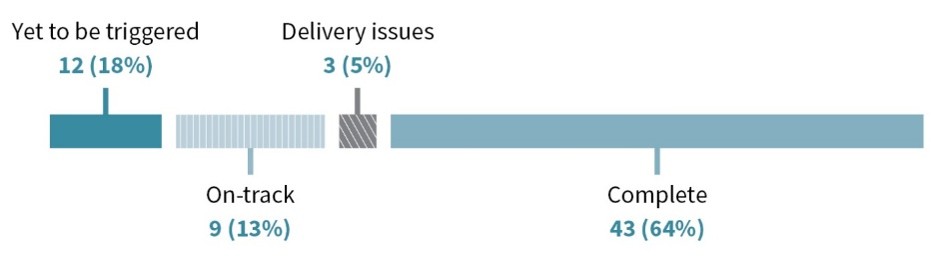
The Department has continued to make strong progress in implementing Treaty settlement commitments during the financial year. Overall, 43 out of 67[14] commitments were completed, representing a completion rate of 64%. Performance improved significantly, with the number of commitments experiencing delivery issues reduced from 12 to 3. Commitments classified as Yet to be Triggered and On Track remained stable, demonstrating sustained progress in meeting settlement obligations.
The following infographic provides a progress update on our 67 Treaty of Waitangi/ settlement commitments for 2025/26:
[3] 2025/26 is the final reporting year under the Department’s Strategic Intentions 2024-2028. This can be found at https://www.dia.govt.nz/Strategic-Intentions.
[5] More information can be found at https://www.digital.govt.nz
[6] https://survivorexperiences.govt.nz/share-your-experience/deaf-survivors
[7] https://www.publicservice.govt.nz/about-the-commission/government-digital-delivery-agency/trust-framework-for-digital-identity/about-digital-identity-services/trust-framework-legislation
[8] View the Anzac Stories on https://natlib.govt.nz/history-explorer/anzac-stories
[9] View the report on https://natlib.govt.nz/about-us/collaborative-projects/communities-of-readers/putoi-rito-communities-of-readers-reports/students-as-readers-building-reading-identity-in-one-full-primary-school
[10] View the online casino gambling implementation updates on https://www.dia.govt.nz/Online-Casino-Gambling
[11] View the Transparency Reports on https://www.dia.govt.nz/Spam-Transparency-reports
[12] View the legislation on https://www.legislation.govt.nz/act/public/2026/26/en/latest/#LMS1437989
[13] https://natlib.govt.nz/schools/rauemi-a-ipurangi
[14] 29 Treaty settlements commitments with Local Government will transfer from the Department to the Ministry for Cities, Environment, Regions and Transport from 1 July 2026.
Go to the Contents View or download the PDF version Go to the next section
