
Public Inquiry into the Disappearance of the Phillips Children
Report | July 2026
The report of the Public Inquiry into the Disappearance of the Phillips Children was presented to the Governor-General in July 2026. To avoid prejudicing the administration of justice and to comply with the statutory protection of Family Court proceedings in section 11B Family Court Act, a small amount of information has been withheld from the tabled report.
The Inquiry would like to express its deep gratitude to Te Rūnanga o Te Rarawa, Rangatira Mike Te Wake, for the gift of the whakataukī.
This whakataukī is offered with love to the whānau.
We were advised the proverb is still heard in Te Hiku o Te Ika, and serves as a reminder to us all to lead with love in our intentions.
Kia ū ki te whakapono, me aroha tētahi ki tētahi
Holdfast to your beliefs, love one another
A reminder to lead with love in our intentions.
Report of the Public Inquiry into the Disappearance of the Phillips Children I He Pakirehua Tūmatanui ki te Ngaronga o ngā Tamariki o te whānau Phillips Published July 2026. © Copyright 2026.
This document is available online at: www.dia.govt.nz/Public-Inquiry-into-the-Disappearance-of-the-Phillips-Children
ISBN 978-0-473-79157-5 (Paperback)
ISBN 978-0-473-79156-8 (PDF)
Contents
Introduction
1. Introduction
1.2 Setting
1.3 Key dates
2. This Inquiry
Before
3. Before the second disappearance
3.1 Police
3.2 Oranga Tamariki – Ministry for Children
3.3 Ministry of Education and Education Review Office
Recovery
4. Recovering the children – Police actions
4.1 The first four months – “softly bring him out”
4.2 Operation Curly – an overview
4.4 The aggravated robbery and the shopping trip
4.5 October 2024 – a “game changer” sighting
4.6 Surveillance
5. Recovering the children – other agencies
5.1 Oranga Tamariki – Ministry for Children
Firearms
6. Firearms
Interagency
7. Concluding comment – interagency coordination
Recommendations
8. Recommendations
Appendix
Glossary
Terms of reference
Reading this report This report refers to the “disappearances” of the Phillips children as this is the language used in our terms of reference. The report also at times describes the events by reference to Tom Phillips’ actions in taking the children and concealing them in the bush, away from their family and authorities. We believe these terms reflect the deliberate and serious actions involved.
Foreword
For nearly four years, a large area of rugged wilderness on the west coast of the North Island was the focus of an intense search. Missing were three children and their father, Tom Phillips. The search ended when Tom Phillips was fatally shot by Police on 8 September 2025. Questions have properly been asked around the circumstances of the disappearance of the children, how it was that they were not found earlier and whether there were measures which might have been taken by government agencies to avoid their disappearance. Those questions informed the terms of reference which have shaped this Inquiry’s report.
It is notable that no agency, organisation or person the Inquiry dealt with was anything other than fully co-operative. In some cases, the Inquiry placed significant demands on agencies and their staff to deliver large volumes of documentary material within short time frames. All requests to interview were willingly met. The Inquiry extends its sincere gratitude to all who spoke with us and shared their expertise and experiences.
It is a truism that without the support and co-operation of so many the completion of this report would have been impossible.
Some participants, however, deserve special mention. Police, Oranga Tamariki and NZDF impressed with their openness, honesty and candour throughout the process.
All three agencies helpfully set up dedicated teams to operate as liaison points to assist the Inquiry. The families of the children likewise impressed as genuine and motivated to assist us.
The Inquiry must also acknowledge the talented and hardworking team which supported its work, especially Sarah Jerebine KC and Danielle Kelly who, as counsel assisting, brought their combined experience in public law and inquiry work to the task of managing the various challenges encountered and choreographing the many workstreams into a cohesive final product. They, in turn, were supported by a small team of legal researchers and analysts to whom the Inquiry extends its gratitude. The Inquiry also acknowledges the expert guidance and support of the secretariat led by Kelley Reeve.
Finally, the Inquiry’s report makes findings and recommendations some of which are wide-ranging and detailed. While the circumstances of this particular case are exceptional, and as such unlikely to be repeated, lessons must, nonetheless, be learned, particularly how agencies should work and operate together. Interagency co-operation is essential in large scale and complex operations where no single organisation possesses all of the necessary skills and capabilities.

The Honourable Simon Moore KC
Executive summary
1 From December 2021 to September 2025, Tom Phillips concealed his children in the bush around Marokopa, on the west coast of the North Island. During the nearly four years of the children’s disappearance Police attempted to find them. They deployed various methodologies as well as utilising the skills of specialist units within Police. At times they were assisted by New Zealand Defence Force (NZDF) with some input from Oranga Tamariki. However, it was not until a Police encounter with Tom Phillips on 8 September 2025, when he was fatally shot, that the children were finally located and safely recovered.
2 As the Inquiry’s terms of reference expressly state, the circumstances of this case are exceptional, if not unique. However, that is the backdrop to this report. What the Inquiry was set up to establish is whether government agencies could prevent or resolve similar situations more quickly and effectively in future. Separate, but related, this report also addresses how Tom Phillips came to hold and maintain a firearms licence, and how he managed to acquire and possess weapons and ammunition.
3 As set out elsewhere in this report, the Inquiry interviewed staff from the three key agencies to identify what steps were taken, and to assess whether more could have been done. The Inquiry was impressed with the care, diligence and commitment shown by Police, Oranga Tamariki and NZDF. Even so, the Inquiry finds that more could have been done to mitigate the risk of the children being taken away and to recover them earlier.
Critical themes: harm and cross-agency work
4 In the course of the Inquiry, two clear themes emerged which are centrally relevant to the work the agencies undertook.
a. The harm caused by Tom Phillips isolating the children from family, friends and society was underplayed, minimised or overlooked by agencies for significant periods. So too were concerns of the maternal whānau, which were often minimised as being part of a parenting dispute.
b. That, while agencies worked well together at times, over the period from 30 September 2021 (when the children returned from the first disappearance) to 8 September 2025 (when the children were recovered), a more consistent and collaborative interagency approach could have prevented the children’s disappearance and brought them back sooner. So too were concerns of the maternal whānau, which were often minimised as being part of a parenting dispute.
Before December 2021
5 Tom Phillips disappeared with the children for 18 days in September 2021. He abandoned his ute on Kiritehere beach, south of Marokopa, below the high tide mark. The keys were left in the vehicle. This discovery sparked a significant search and rescue operation. On his return, Police charged Tom Phillips with wasting Police resources. In relation to the welfare of the children, they also made a report of concern to Oranga Tamariki.
6 Police’s report of concern was detailed and made promptly. Yet, it lacked key and critical explanations for the concerns it raised. Police, at that time, appeared to consider that Tom Phillips had staged his and his children’s death by how he had left the ute on the beach. They were also seriously concerned that he might take the children away again. These concerns were not sufficiently conveyed to Oranga Tamariki.
7 In turn, Oranga Tamariki acted promptly on the report of concern. It treated it with appropriate urgency and conducted a home visit within a matter of days.
8 However, in assessing the question of risk posed to the children by Tom Phillips, Oranga Tamariki appeared to be largely dismissive of multiple concerns raised by the maternal family. On 6 October 2021 Oranga Tamariki reported to the Family Court that the children were “completely fine” and that, in the circumstances, there may not be need for further Oranga Tamariki involvement. Oranga Tamariki did not inform the Court of the concerns of the maternal family, or the ongoing Police investigation and concerns. It should have.
9 Had Police and Oranga Tamariki worked more closely and collaboratively during this early stage, the taking of the children by Tom Phillips a second time could have been prevented or, at least, made more difficult.
10 During this time the Ministry of Education and the Education Review Office could also have made inquiries of Tom Phillips and his ongoing suitability to home educate the children.
After December 2021
11 When the children were taken a second time, Police did not initially launch a search and rescue response or a CIB investigation as occurred following the first disappearance. Intentionally they adopted a low-key approach by engaging with the local community. This strategy appears to have been predicated on the misconceived view that there were no concerns for the children’s welfare, despite their isolation in dense bush segregated from family and friends. This view also overlooked information Police held suggesting that Tom Phillips was highly motivated to keep the children hidden to avoid the Family Court proceedings.
12 This approach led Police to miss key opportunities early in the disappearance to identify or discover evidence that may have led to the children’s earlier recovery.
13 Instead, Police should have developed a proactive investigation strategy, including more Criminal Investigation Branch (CIB) staff, and a Police-led multi-agency response from the outset.
14 To Police’s credit, extensive resources and investigative skills were applied to the task of trying to locate the children during the second disappearance. Police deployed a wide range of investigative methods, techniques and technologies, including area canvassing, public appeals, the offer of a reward, searching and clearing locations of interest, aerial searches, and electronic surveillance. And Police took prompt and targeted steps, together with NZDF, in response to, and following, the October 2024 and April 2025 sightings.
15 However, some of these steps could and should have been adopted earlier. Police should have:
a. obtained surveillance device warrants before August 2023.
b. made earlier use of covert intersection and road cameras.
c. offered a reward prior to June 2024.
d. worked with NZDF to develop a strategy to narrow the area of interest at an earlier stage.
16 There were also avoidable delays in identifying some specific information that could have led to locating the children sooner.
a. A member of the public called Police in May 2023 with a credible sighting of Tom Phillips and the three children. But Police delays meant this sighting was not properly followed up in a timely way.
b. Police could and should have linked the May 2023 Te Kūiti bank robbery to Tom Phillips much more promptly than they did; instead this took some three months.
17 During the second disappearance, Oranga Tamariki could also have done more. It should not have closed the report of concern in February 2022. It did so in the face of compelling concerns raised by the children’s older sisters as to the risk and harm to the children of being isolated from family and society.
18 Throughout the second disappearance Oranga Tamariki should also have maintained communication with Police, particularly in relation to the risks posed to the children. This would have better informed the Police response, and the urgency required in recovering the children. Oranga Tamariki should also have informed the Family Court of the risks to the children.
19 During the second disappearance, NZDF provided Police with specific and exemplary assistance on request. That said, NZDF should also have met with Police at an early stage to discuss the range of options and capabilities which NZDF could have provided, in terms of support and strategies (subject to NZDF constraints and resourcing). The elite and highly specialist skill-set held within NZDF, if used, could have materially assisted in locating the children sooner.
Firearms
20 Turning next to firearms, Police did not take all practicable steps to respond to allegations by Tom Phillips’ former spouse about firearm safety in early 2021. Police did not, but should have, identified and seized firearms after his licence was suspended and considered Tom Phillips’ access to other firearms in the home where he was required to reside. Those additional steps could have contributed to recovering the children sooner.
List of findings by agency
Before the second disappearance |
Paragraph reference |
|---|---|
Police |
|
|
Police had limited options to impose constraints on Tom Phillips to mitigate the risk of a second disappearance |
159 |
|
Police report of concern to Oranga Tamariki was commendable, but Police should have ensured all information was provided and critical discussions were ongoing |
162 |
Oranga Tamariki |
|
|
When preparing a s 132 report in 2019 Oranga Tamariki could have identified, and advised the Family Court of the risk of Tom Phillips isolating the children’s mother from them |
186 |
|
Oranga Tamariki did not take all practicable steps to fully understand concerns raised by Police after the first disappearance |
245 |
|
Oranga Tamariki did not take reasonable steps to understand concerns raised by the maternal whānau after the first disappearance |
253 |
|
Oranga Tamariki should have more carefully considered Tom Phillips’ mental health |
266 |
|
Oranga Tamariki’s initial response to the report of concern was appropriate and reasonable |
273 |
|
Oranga Tamariki did not adequately engage with, and did not accurately inform, the Family Court at the hearing on 6 October 2021 |
278 |
Ministry of Education and Education Review Office |
|
|
Ministry of Education should have required more information on applications for home education |
310 |
|
Ministry of Education and the Education Review Office should have reviewed Tom Phillips’ applications for home education after the first disappearance |
314 |
|
Ministry of Education could have contributed to a multi-agency response |
317 |
After the second disappearance |
Paragraph reference |
Police |
|
|
Police should have identified the serious risk to the welfare of the children from the time they were taken |
|
|
Police should have developed a proactive investigation strategy at the outset, including a Police-led multi-agency response |
370 |
|
During the first two months, Police missed specific opportunities to gather more information about where the children might be |
|
|
Police applied extensive resource and investigative skill to the task of trying to locate the children over the course of an almost four-year investigation |
|
|
Operation Curly could and should have involved more CIB staffing from the beginning |
|
|
Police should have established a multi-agency working group to guide response throughout |
|
|
Police should have taken some steps much earlier |
|
|
In response to a sighting of Tom Phillips and the children on 28 May 2023 near Te Anga Rd:
|
|
|
In response to other sightings in 2023:
|
592 |
|
In response to a sighting of Tom Phillips and the children on remote farmland in October 2024:
|
|
|
Police rightly pursued electronic surveillance of persons of interest from August 2023 onwards |
|
|
Police could and should have pursued surveillance device warrants before August 2023 |
|
|
Police could and should have made earlier use of intersection/road cameras |
|
|
The delay in use of surveillance had potential significance |
|
Oranga Tamariki |
|
|
Oranga Tamariki should not have closed the report of concern in February 2022 |
|
|
Oranga Tamariki continued to minimise the concerns of the sisters after the second disappearance |
|
|
Oranga Tamariki should have informed Police of the risk to the children, and had ongoing contact with Police |
|
|
Oranga Tamariki missed an opportunity for engagement with the Family Court |
|
|
From August 2023 Oranga Tamariki treated the children’s disappearance as a risk of harm, however this should have occurred from December 2021 |
|
|
From August 2023 to September 2025 Oranga Tamariki took appropriate steps to prioritise the welfare of the children |
|
|
Oranga Tamariki took steps to protect the privacy, welfare and the safe recovery of the children on 8 September 2025: actions were commendable |
845 |
NZDF |
|
|
For those requests that NZDF accepted to fulfil, the support provided by NZDF to Police was exemplary |
|
|
NZDF as an entity should have communicated better with Police to understand the investigation team’s requests for support and discussed appropriate and available capabilities |
|
|
NZDF could have encouraged the setting up of a multi-agency working group early in the investigation |
|
|
NZDF capabilities could have been utilised more fully and earlier to help in finding the children |
|
Firearms |
|
|
Tom Phillips obtained and renewed his firearms licence in the usual way |
980 |
|
Maintaining a firearms licence: Police did not take all practicable steps to respond to allegations by former spouse about gun safety |
981 |
|
Police did not, and should have, served suspension notice sooner, and identified and seized firearms on licence suspension |
|
|
Police should have considered Tom Phillips’ access to other firearms in the home where he was required to reside |
|
|
Tom Phillips likely purchased firearms and ammunition himself or obtained them from family members |
996 |
 364
364 374
374 496
496 502
502 509
509 516
516 548
548 646
646 706
706 710
710 727
727 730
730
 807
807


 841
841 901
901 903
903 910
910 916
916 987
987 994
994Reading this report
21 This report is about what government agencies knew, did, and could have done, to protect the welfare and safety of the Phillips children: to prevent Tom Phillips from taking the children, and to locate them and return them.
22 In chronological order it considers the role and involvement of those agencies over three discrete periods, being before Tom Phillips first took the children into hiding in September 2021 (the first disappearance); between their return in late-September 2021 and mid-December 2021; and after Tom Phillips took the children a second time, from 9 December 2021 to 8 September 2025 (the second disappearance).
23 Chapters 1 and 2 set out introductory information. They include the background facts and setting in which these events took place and agencies became involved, and describe how this Inquiry has gone about its task.
24 Chapter 3 of the report focuses on the period before Tom Phillips took the children a second time, in December 2021. It describes the knowledge Police, Oranga Tamariki and Ministry of Education had, and the steps those agencies could have taken to protect the welfare of the children and prevent their disappearance.
25 Chapters 4 and 5 focus on the period after the children were taken for the second time. Chapter 4 sets out in detail the knowledge Police had, and the steps they took and could have taken to locate and recover the children. Chapter 5 considers the involvement of Oranga Tamariki and NZDF in that same period.
26 Chapter 6 addresses how Tom Phillips obtained and maintained a firearms licence, weapons, and ammunition.
27 In Chapter 7, the Inquiry addresses how agencies worked together to protect the welfare of the children, and how this could have been improved.
28 Each section concludes with findings based on the Inquiry’s assessment of all the evidence presented and received. Where the Inquiry has identified recommendations about practicable steps that government agencies should take in future situations of a similar nature, or power or authorities that should be in place that might prevent or improve the response to similar situations in future, these are set out at the end of the relevant chapter and in Chapter 8.
29 No individuals are named in this report, other than Tom Phillips. This is for two reasons. Firstly the Inquiry is required under its terms of reference to restrict access to Inquiry information to protect the identity of witnesses and other persons.
30 Secondly, the Inquiry’s focus is on what government agencies knew and did. Thus the Inquiry did not consider it necessary to identify individual people or staff.
31 Further, and importantly, the report has been written with regard to the central principle that the welfare of the children is not further threatened. The Inquiry must respect the privacy and welfare of the children. Wherever possible, the Inquiry has omitted information about the children or their circumstances.
32 We have used fictitious names or general terms for some family members. This is to support the principles described in the preceding paragraphs. When that device has been used the report notes it.
33 The report at times describes the relevant events as the “disappearance” of the Phillips children as this is the language used in our terms of reference. Where this report refers to just “the disappearance” it is referring to the second, almost four- year disappearance that took place from December 2021. Where it is necessary to distinguish, it refers to the 18-day disappearance in September 2021 as the “first disappearance”, and the almost four-year disappearance from December 2021 – September 2025 as the “second disappearance”.
34 The report also at times describes the events by reference to Tom Phillips’ actions in taking the children and concealing them in the bush, away from their family and authorities. We believe these terms reflect the deliberate and serious actions involved.
Introduction
1.1 Agency involvement
35 In September 2021, Tom Phillips took his three children from the Phillips family farm in Marokopa. Tom Phillips’ ute was found on a nearby beach below the high tide mark, with the keys inside. These events led to the initiation of a large-scale air and land-based search and rescue response. After 18 days, Tom Phillips emerged with the children. He claimed that they had been “camping” in the bush.
36 After their return, Police charged Tom Phillips with wasting Police resources and reported their concerns to Oranga Tamariki. Oranga Tamariki began investigating these concerns, and made a report, at short notice, to the Family Court.
37 Then, in December 2021, Tom Phillips took the children into the bush for a second time. They would not be found for almost four years.
38 During both disappearances family reported to agencies that Tom Phillips may have taken the children to avoid a parenting dispute, and to avoid the Government’s response to the COVID-19 pandemic.
39 For the first 18 months or so after the second disappearance there were a handful of reported sightings of Tom Phillips and the children in Marokopa and the surrounding area. But overall, very little was known of their movements or where they were.
Then, in August 2023, Tom Phillips was seen by his family on CCTV at his parents’ farm, and the following day he was seen at Bunnings in Hamilton and on Kawhia Road. These events also led to him being identified as the offender in an armed robbery which was committed several months earlier. There then followed a surge of activity in the Police investigation. But despite this little more was seen or heard of Tom Phillips and the three children until October 2024, when all four were photographed by pig hunters traversing open farmland near Marokopa. After that there were some limited sightings from a drone in April 2025. Four months later, in August 2025, there were several burglaries in the area. These were attributed to Tom Phillips. On 8 September 2025, following another burglary, Tom Phillips was fatally shot in a confrontation with Police. The three children were safely recovered that day.
Our focus: the involvement of government agencies
40 The focus of this Inquiry is not on Tom Phillips’ actions. It is on the knowledge and actions of government agencies.
41 The Inquiry is required to examine whether those agencies took all practicable steps to safeguard the safety and welfare of the children, on the basis of what they knew at the time.1 This includes steps taken to engage with the Family Court, and to find and recover the children.
42 This report details the knowledge of and actions taken by four government agencies: New Zealand Police, Oranga Tamariki, New Zealand Defence Force (NZDF), and the Ministry of Education. The relevant periods in question cover both before and after Tom Phillips took the children in December 2021.
43 Where relevant, this report also makes recommendations about practicable steps that government agencies should take in future situations of a similar nature, and what powers and authorities might operate to prevent or improve the response in any future similar situations, including by addressing legislation, policy, and practices.
44 Although this report finds that there were some key deficits in the actions of the principal agencies, there is also a certain and inevitable sense that at least some of the findings of the Inquiry are made with the great benefit of hindsight. That is necessarily correct and unavoidable where the inquirer is retrospectively tasked to review and judge past events armed with a knowledge and understanding of subsequent events. Conscious of that dynamic, the Inquiry approached its task informed by the need to apply a practical and realistic lens to its analysis and conclusions rather than engage in a counsel of perfection.
Police
45 The first major involvement Police had with Tom Phillips and the children was when they were reported missing for the first time on 13 September 2021. Police initiated and led a major search and rescue operation, at first believing they may have been swept out to sea. The operation was known as Operation Marokopa. Police carried out a full investigation into the circumstances of the September 2021 disappearance, which continued after Tom Phillips returned with the children on 29 September 2021. On 5 October 2021, Police charged Tom Phillips with wasting Police resources. Then, on 8 October 2021, they issued a notice suspending Tom Phillips’ firearms licence.
46 When Tom Phillips took the children for a second time in December 2021, Police led the efforts to locate and recover the children. They launched an investigation which became known as Operation Curly. The investigation involved assistance from a range of internal specialist groups within Police, as well as external agencies. The investigation continued until the children were found in September 2025.
47 Prior to 2021, Police were also involved with Tom Phillips in regard to his firearms licence. Police issued him with a 10-year firearms licence in 2003, when he was 16-years-old. His licence was then renewed for a further 10 years in 2013. After Tom Phillips took the children for the first time in September 2021, Police suspended his firearms licence and seized at least some of his weapons. They later revoked his licence.
Oranga Tamariki
48 A primary role of Oranga Tamariki is to support and protect the wellbeing of children.
49 Prior to 2021, Oranga Tamariki had very limited involvement with Tom Phillips and the children.
50 The agency’s involvement, under its care and protection legislation, began after Tom Phillips and the children returned in September 2021, when Police lodged a report of concern about the children. Oranga Tamariki then commenced an investigation to determine whether there were care and protection concerns.
51 During this period, Oranga Tamariki made an oral report to the Family Court on 6 October 2021.
52 In December 2021 the children were taken away again. This was before
Oranga Tamariki had completed their assessment of the Police report of concern. In February 2022, Oranga Tamariki closed the file, but told Police they could make a new report when the children were found.
53 Oranga Tamariki had limited involvement in efforts to locate and recover the children. But they did have contact with Police and the Family Court from time to time through that period.
NZDF
54 NZDF comprises the New Zealand Army, Navy and Air Force (the Armed Forces), as well as its civil staff. Armed Forces may be deployed domestically, “to perform any public service” or to “provide assistance to the civil power in time of emergency”.
55 NZDF provided assistance to Police in the search for Tom Phillips and the children during the first disappearance in September 2021. NZDF also provided assistance during the second disappearance, including geospatial intelligence support, advising on the use of satellite and aerial imaging, and technical assistance in relation to cameras. In 2024 and 2025, NZDF’s Special Air Service (SAS) provided specialist tracking assistance to Police.
Ministry of Education and Education Review Office
56 Prior to taking the children into the bush, Tom Phillips obtained exemptions from enrolment of the children in school, to educate them at home.
57 The Ministry of Education approved his applications for those exemptions in 2020 and 2021.
58 Neither the Ministry nor the Education Review Office reviewed those exemptions after the children’s disappearances in September and December 2021.
1.2 Setting
Marokopa
59 Marokopa is a small, coastal town in the western Waikato region. It has a close-knit population of around 40 people,2 primarily made up of farmers and forestry workers. In addition to permanent dwellings there are a number of holiday baches. Marokopa is situated approximately 60 km from the nearest town, Ōtorohanga, and 120 km from Hamilton. The location of the nearest Police Criminal Investigation Branch (CIB) office is, for example, in Te Awamutu, some 90 km away. That town is also the location of the nearest Police Criminal Investigation Branch (CIB) office. Police District Headquarters is in Hamilton. The drive between Hamilton and Marokopa is not easy. Although sealed, parts are steep and windy. The driving time is around two hours.
60 At an early point in its work, the Inquiry visited Marokopa, undertaking both a land-based and aerial survey of the township and the Marokopa Valley and its surrounding areas. This proved an invaluable exercise. Without the advantage of viewing the geography first hand it is impossible to properly appreciate, let alone describe, the vastness of the area in question, the steepness of the topography and the impenetrability of the enormous expanses of bush which stretch from the rugged west coast to well inland. The following description draws heavily from that experience.
61 Marokopa is isolated. It is situated at the end of the main access road. In that sense it is more of a final destination than a town which one might pass through. Heading east, out of town, the road links with more populated rural areas inland. Another road heads south down the coast. Marokopa gets few visitors. The local roads are not busy. Activities, particularly those which involve unfamiliar people or vehicles, or are at unusual hours, tend to be noticed by locals. Strangers and non- locals are also noticed. For Police and other agencies attempting to engage in covert activities, this isolation made those operations particularly challenging.
62 The area is a mix of farmland adjacent to expanses of dense bush over very steep and rugged terrain. The Phillips family farm is near Marokopa beach and the Tawarau Forest which covers some 3,350 ha to the east of Marokopa, the Herangi Range to the South, and Kawhia Harbour to the north. The wider area surrounding the farm comprises Department of Conservation land, Māori land, privately-owned land, and large farming stations.
63 The Inquiry ventured a short distance into the bush via a rough track not far from one of the campsites known to have been occupied by Tom Phillips and the children. Off the track, the density of the vegetation was such that sight was lost of anyone beyond four to five metres away or even less in some places. In most of the forested areas, the bush canopy is so dense that it does not allow sunlight to penetrate the forest floor below. Police and NZDF told the Inquiry of the difficulty of making any observations from the air, including of heat signals. Having experienced the environment at first hand it is easy to understand why that was.
Social context
64 In late 2021, when Tom Phillips took the children for the second time, New Zealand was gripped in the midst of the COVID-19 pandemic. This included extended lockdowns throughout the Waikato region. These restrictions were hard on communities. Workplaces, including government agencies, were dealing with staff shortages and distancing requirements.
65 In response to lockdowns and vaccine mandates, strong anti-government sentiment grew in pockets of New Zealand society. In January 2022 this led to a 23-day protest/occupation of Parliament. In this social context, some members of the New Zealand public were sympathetic towards Tom Phillips, perceiving his actions as harmless, or even justified on the basis that he was evading state authority or protecting his children from perceived state and judicial over-reach.
66 Many people the Inquiry spoke to suspected that this state of mind led to some turning a blind eye to suspicious activity, thus adding to Police’s difficulty in finding the children.
Highly motivated individual
67 We now know that during the almost four years Tom Phillips kept the children concealed, they moved between different camps in the bush around Marokopa, some 20 km or more apart, and significantly further if following roads and tracks, across hilly terrain.
Illustration of distance between suspected campsites
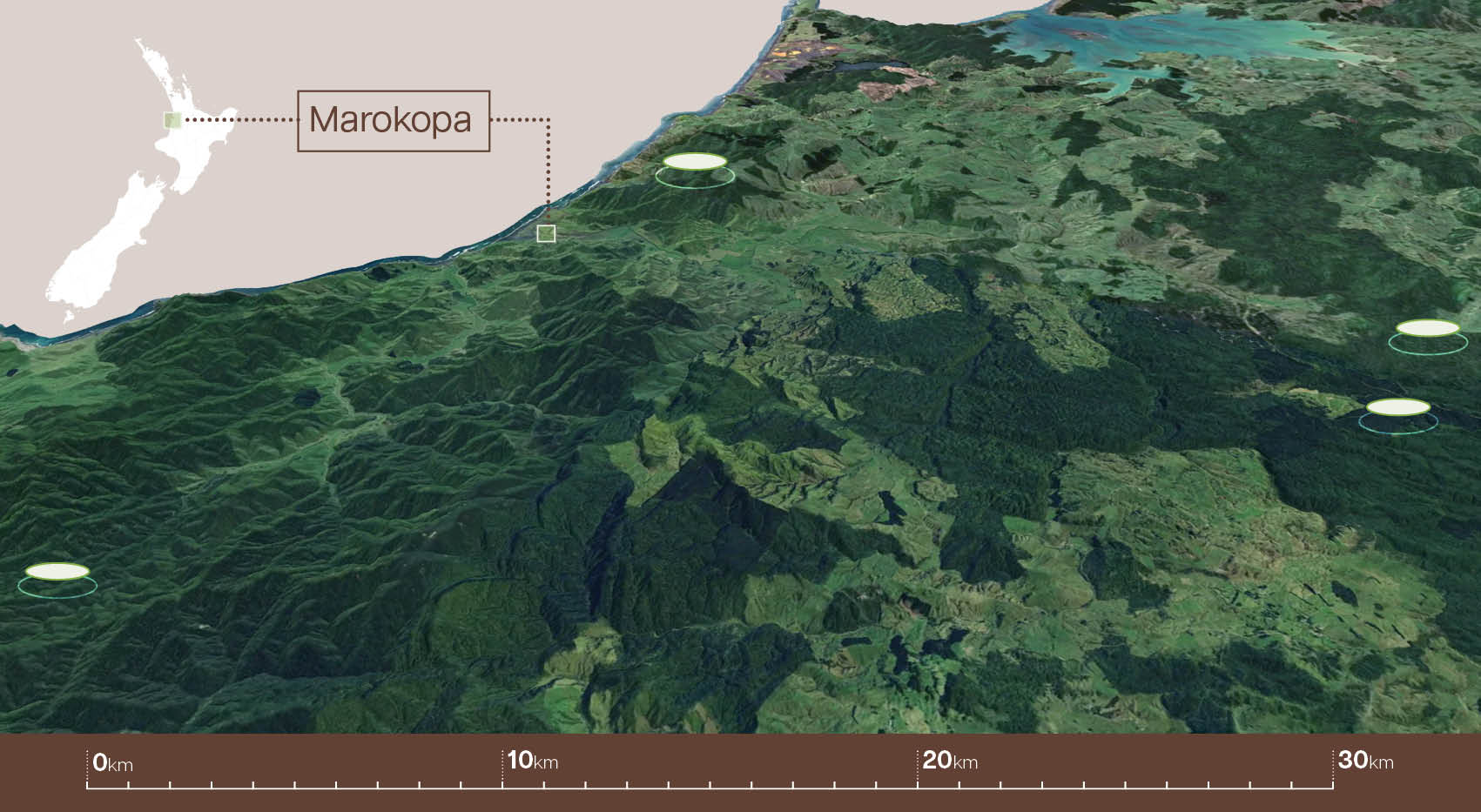
Source: NZ Police
Map: LINZ Basemaps. © CC BY 4.0 National Institute of Water and Atmospheric Research – Waikato 0.3m Rural Aerial Photos (2023–2024) & others (2016–2025).
68 This was an area which Tom Phillips knew very well. He had grown up hunting in the bush and working in and around Marokopa as a fencer. In some ways it was his backyard.
69 Tom Phillips went to considerable efforts to ensure he and the children remained undetected throughout the four-year period. He had the bush skills to do so. He also did not use cell phones or bank accounts or anything else that might be traced.
70 To the extent he was assisted by others, the evidence the Inquiry has seen suggests any assistance was minimal. He was also careful to conceal his identity. For example, he covered his face on the occasions he went out in public. He also took extensive measures to conceal the campsites and tracks he and the children used. And, as we now know, he was armed.
Consequences for family and government agencies
71 This setting reflects the environment that agencies operated in during the relevant periods. It provided particular challenges to the actions agencies could take to prevent the children’s disappearance, and to locate and recover them.
72 For the family of the children, those four years represented a long and harrowing ordeal. Every day that the children were missing added to a catalogue of fear and worry borne by the children’s mother and older sisters. At times they wondered whether they were even alive. But they were not the only ones. The Inquiry also heard from Tom Phillips’ family of the significant toll the disappearance had on them.
73 The ripple effect caused by this uncertainty also spread to those connected to the efforts to recover the children, especially Police and Oranga Tamariki staff. That recovery of the children took four years should not belie the sincerity and commitment of those men and women who dedicated so much time and energy to completing the recovery mission successfully. Several of the senior police officers the Inquiry spoke to were visibly upset when speaking of the children, adding that not a night went by without them pondering on where the children were and how they were faring.
1.3 Key dates
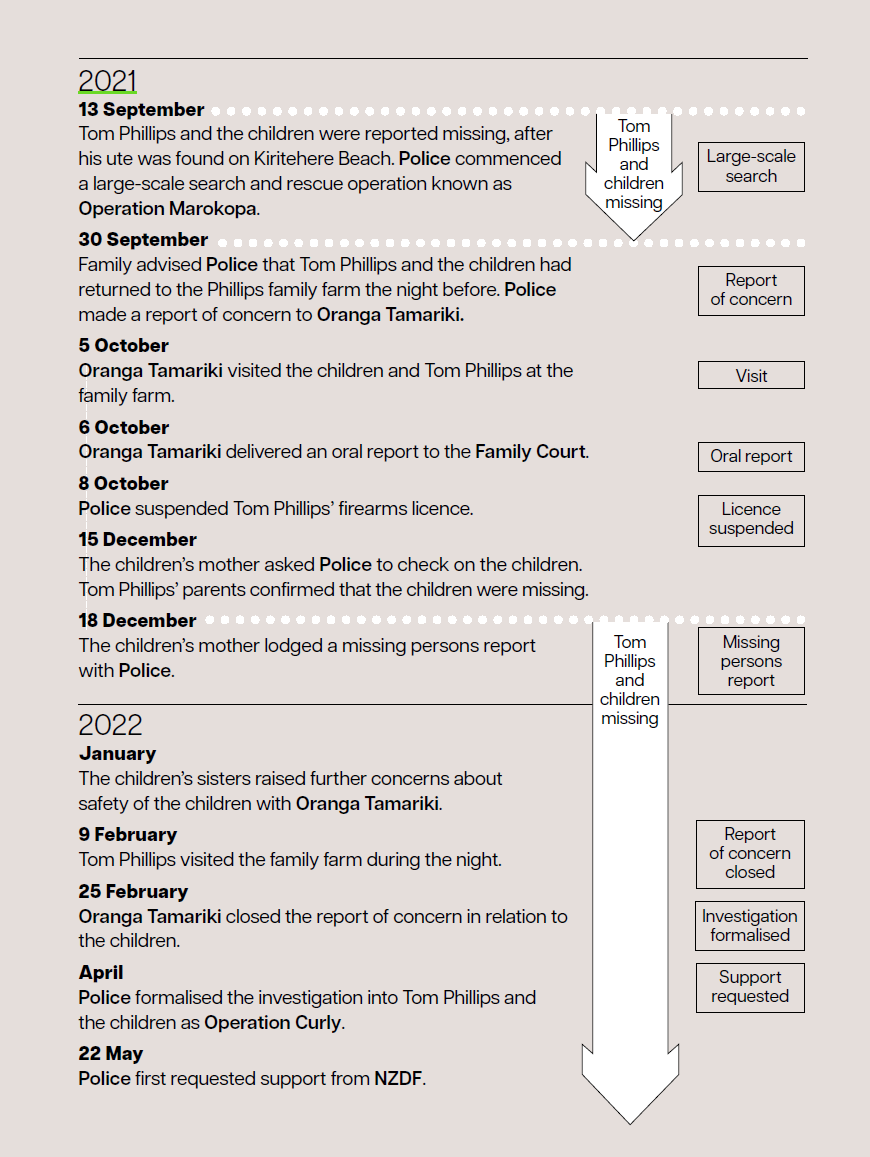
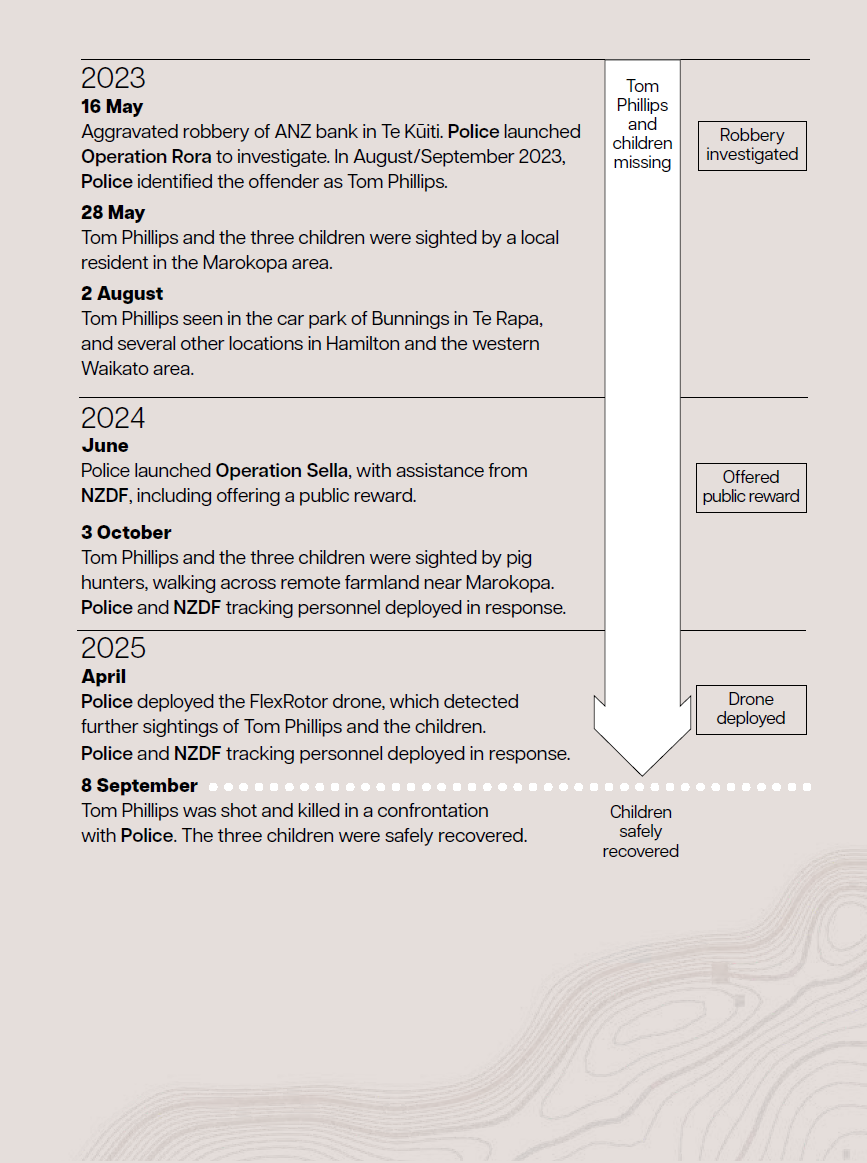
2.0 This Inquiry
74 Her Excellency the Governor-General, the Right Honourable Dame Cindy Kiro, GNZM, QSO made an Order in Council on 24 November 2025 under section 6(2) of the Inquiries Act 2013 establishing the Public Inquiry into Disappearance of the Phillips Children.
75 When Tom Phillips took his children into the bush in September 2021, and again in December 2021, it attracted significant public attention and concern. There was widespread media coverage throughout the almost four-year period which followed.
76 Establishment of a Public Inquiry under the Inquiries Act 2013 is one means by which the Government can examine and address matters of public importance. In this case, the matters of public importance were whether government agencies took all practicable steps to protect the safety and welfare of the Phillips children, including steps to prevent the children’s disappearance; and whether they responded appropriately and in a timely way to locate the children once they had disappeared.
77 The Inquiry was directed to make findings addressing these matters, including whether agencies engaged appropriately with the Family Court.
78 The Inquiry was also tasked to investigate how Tom Phillips obtained and maintained a firearms licence, weapons, and ammunition.
79 Former High Court Judge, the Honourable Simon Moore KC was appointed as the sole member of the Inquiry.
80 The Inquiry was authorised to begin considering evidence from 21 January 2026 and was instructed to deliver its final report by 21 July 2026.
81 The terms of reference for the Inquiry may be found in the Appendix and are available online https://www.legislation.govt.nz/secondary-legislation/pco-drafted/2025/267/en/latest/#LMS1550781.
What the Inquiry could not cover
82 The terms of reference made it clear that the Inquiry could not inquire into government agency involvement with the children after they were located on 8 September 2025.
83 In undertaking its work, the Government directed the Inquiry to respect the independence of the courts, including the Family Court, and not to comment on or enquire into judicial decisions concerning the children. Compliance with all suppression orders was expected.
84 The Inquiry was further instructed not to investigate legislative, administrative, and policy settings for the New Zealand firearms licensing system.
85 Finally, in accordance with section 11 of the Inquiries Act 2013, the Inquiry has no power to determine the civil, criminal, or disciplinary liability of any person but may, in exercising its powers and performing its duties, make findings of fault or recommendations that further steps be taken to determine liability.
Agencies we have looked at
86 For the purposes of this Inquiry, government agencies expressly included New Zealand Police, Oranga Tamariki-Ministry for Children, and any other public sector agency that –
a. had an actual or potential role to play in proceedings before the Family Court in respect of the children; or
b. had an actual or potential role in locating the children after their disappearance; or
c. otherwise had a role or responsibility in respect of the children’s safety or welfare during the period from 2018 until they were located.
87 For the purposes of the Inquiry, these other public sector agencies were The New Zealand Defence Force and the Ministry of Education and Education Review Office. We also looked into and considered the involvement of the Ministry of Health, Te Whatu Ora and Department of Conservation.
Central principle: privacy and welfare of the children
88 This Inquiry has been conducted with regard to the central principle that the welfare of the children is not further threatened.
89 The Inquiry must respect the privacy and welfare of the children and relevant court decisions, including suppression orders. The Inquiry engaged specialist legal advisors to address these requirements, and this report has been reviewed with the aim of protecting their privacy and wellbeing.
90 The Inquiry also took steps to ensure the children were given the opportunity to safely participate in the Inquiry. This accords with the United Nations Convention on the Rights of the Child, which provides that children have the right to have the opportunity to participate in matters that affect them.
How the Inquiry operated
91 The Inquiry was required to undertake its work in private without conducting public hearings. It gathered evidence through:
a. formal notices to produce issued by the Inquiry requiring government agencies and others to provide the Inquiry with documents, records, and other evidence,
b. interviews with agency staff and other relevant and connected witnesses, and
c. documentary evidence and written submissions provided by interviewees, counsel and other individuals with knowledge of the relevant events.
92 The Inquiry conducted formal interviews with participants including senior and front-line staff from Police, Oranga Tamariki and NZDF, as well as other private individuals with particular involvement in or knowledge of events.
93 The Inquiry also received an expert demonstration from NZDF on search methods in complex terrains.
94 The Inquiry team travelled to Marokopa, Te Awamutu, Hamilton, Auckland and Wellington. The team visited the Marokopa area, including the remote farmland where Tom Phillips and the children were seen by pig hunters, as well as one of the campsites. The team also undertook a flyover of the Marokopa valley, the shoreline, and the surrounding area, including another of the campsites.
95 The Inquiry then reviewed this information, and followed the processes in the Inquiries Act 2013 with respect to natural justice and other matters.
3. Before
96 This chapter discusses the involvement of government agencies with Tom Phillips and the children before he took them for a second time, in December 2021.
97 In general, agencies had relatively little involvement with Tom Phillips and the children prior to September 2021. Oranga Tamariki had a limited role. [redacted].3 The Ministry of Education was involved in considering and granting applications made by Tom Phillips for enrolment exemptions so that he could home school the children.
98 Then, in September 2021, Tom Phillips took the children into the bush for the first time. Police led an extensive multi-agency search and rescue operation code-named Operation Marokopa. It was initially suspected he and the children may have been lost out at sea. The Police investigation continued after Tom Phillips returned with the children on 29 September 2021.
99 Oranga Tamariki became involved after the group’s return when Police made a “report of concern” about the children, which Oranga Tamariki investigated. Oranga Tamariki also reported to the Family Court during this time.
100 This chapter addresses the knowledge and involvement these government agencies had before Tom Phillips took the children in December 2021. It makes findings about practicable steps that the agencies could or should have taken to prevent the taking of the children a second time or otherwise to protect their welfare, including whether those agencies could have engaged more effectively with the Family Court.
101 The first part of this chapter sets out the involvement of Police, in particular the efforts in Operation Marokopa to search for Tom Phillips and the children after their disappearance in September 2021, and the subsequent Police actions and investigations Chapter 3.1.
102 The second part describes the involvement of Oranga Tamariki, including both its limited involvement prior to September 2021, and its involvement and actions after receiving the report of concern from Police in September 2021 Chapter 3.2.
103 The third part describes the role of the Ministry of Education and Education Review Office in approving and reviewing the applications for enrolment exemptions for the children, which allowed Tom Phillips to home school the children Chapter 3.3.
3.1 Police
Operation Marokopa and knowledge of Tom Phillips
104 Tom Phillips and his three children were reported missing on 13 September 2021. He had left, leaving his ute, with keys, on Kiritehere beach below the high tide mark. An extensive Police-led multi-agency search and rescue commenced called Operation Marokopa. He reappeared with the children 18 days later on 30 September 2021. This period is referred to in this report as the first disappearance.
105 The story of Tom Phillips and his missing children was the subject of intense media and public interest at this time.
106 During Operation Marokopa, Police built an extensive and comprehensive profile of Tom Phillips. Police did not appear to accept Tom Phillips’ assertion that the first disappearance was simply an impromptu camping trip. They appeared to see it for what it was; a father prepared to put his children at risk, and likely to have staged his own death and that of his children by accidental drowning, to defeat the Family Court’s processes and deny their mother access.
107 Police understood him to have significant mental health issues related to this, and to his alcohol use and anti-state and conspiracy views. They also considered he was unsafe to hold a firearms licence.
108 On his return, Police promptly made a report of concern to Oranga Tamariki raising some, but critically not all, of their concerns as to his safety with the children. Because of this, Oranga Tamariki did not have the full picture of Tom Phillips.
109 This Inquiry must consider whether Police, and other government agencies, took all practicable steps to prevent the children’s disappearance in December 2021. This chapter sets out what was known to Police prior to December 2021, through Operation Marokopa and the weeks following, and identifies steps Police could have taken that may have prevented, or made more difficult, the second disappearance.
A limited picture: late 2017 to 13 September 2021
110 Police have minimal notable records for Tom Phillips prior to 2017.4 Between 2017 and September 2021, he had some interactions with Police, although never to the point of generating an extensive Police history. Some of these interactions are listed in this report’s firearms Chapter 6.
Operation Marokopa and the response to the first disappearance: 13 September 2021 to 30 September 2021
111 On 8 September 2021, Tom Phillips, who was then living in Ōtorohanga, visited the family farm in Marokopa with his children.
112 On 13 September 2021, a family member of Tom Phillips called Police to report Tom and the children missing. This call was made after his ute was found on Kiritehere Beach. Tom Phillips’ mother told Police she last saw Tom and the children on the family farm on 10 September 2021. His father last saw them on 11 September 2021.
113 Operation Marokopa initially commenced as a search and rescue operation, first with the Police Search and Rescue members arriving in Marokopa shortly before 3.00 pm on 13 September 2021. By this time, the CIB and local front-line Police staff had begun conducting initial inquiries. Police also used external resources in the immediate response, including the deployment of Land Search and Rescue (Land SAR) teams from Hamilton and Waitomo.
114 The preliminary assessment, formed by experts, was that the most likely scenario had Tom Phillips and the children lost to the sea. This informed the Police response over the following days.
115 The next day, on 14 September 2021, a comprehensive coastline search using the Police Eagle helicopter was conducted stretching from Kawhia Harbour to Tirua Point. Land SAR teams were again deployed, together with Fire and Emergency (FENZ) staff, and drone searches. Northern Regional Coastguard Auckland Air Patrol (Coastguard) added their support, supplemented by desperately worried family and friends who spent extensive hours assisting with the search.
116 Police searched Tom Phillips’ Ōtorohanga home and seized a number of shotgun cartridges. Police later returned to uplift Tom Phillips’ firearms licence card, five firearms, and ammunition.
117 Five days after the disappearance, the search and rescue component of Operation Marokopa scaled down. However, the Police investigation continued, together with a scaled-back search.
a. Police engaged with the media, including providing releases, messages from the family, and images, all designed to maintain interest in the case and to encourage the provision of any information which might have assisted the investigation.
b. Police contacted Tom Phillips’ telephone provider to ascertain whether any cellular activity had been recorded.
c. Police undertook a forensic analysis of Tom Phillips’ ute on 16 September 2021.
d. Police obtained statements from those in the community who had seen or otherwise interacted with Tom Phillips in the days prior to the disappearance, and those who had been on and around Kiritehere Beach that day.
e. On 17 and 21 September 2021, Police gained access to particular documents from the Family Court file.
f. Land SAR, FENZ, Surf Life Saving, and Coastguard teams were deployed numerous times across the search period.
g. On 24 September 2021, Police asked NZDF to provide its views on a “rest of world” scenario — that is, the possibility Tom Phillips was not lost at sea, and was “hiding out” somewhere beyond the area of search.
h. Family, friends and members of the Marokopa community assisted in the search. A rāhui was placed over the search area for the majority of the operation.
118 Then, on 30 September 2021, while en route to clear further areas south of Kiritehere, Police received a call from Tom Phillips’ parents, who advised their son and the children had returned from the bush the previous night. The search and rescue component of Operation Marokopa ended.
119 Over the 18-day search, the marine search area comprised coastline approximately 33 km in length and extending three nautical miles offshore. Police estimated that, in total, the search operation involved over 151 personnel across Police and other agencies, spending an estimated total of 2,636 hours, with a minimum quantifiable cost of $200,000.
Key locations and search area of first disappearance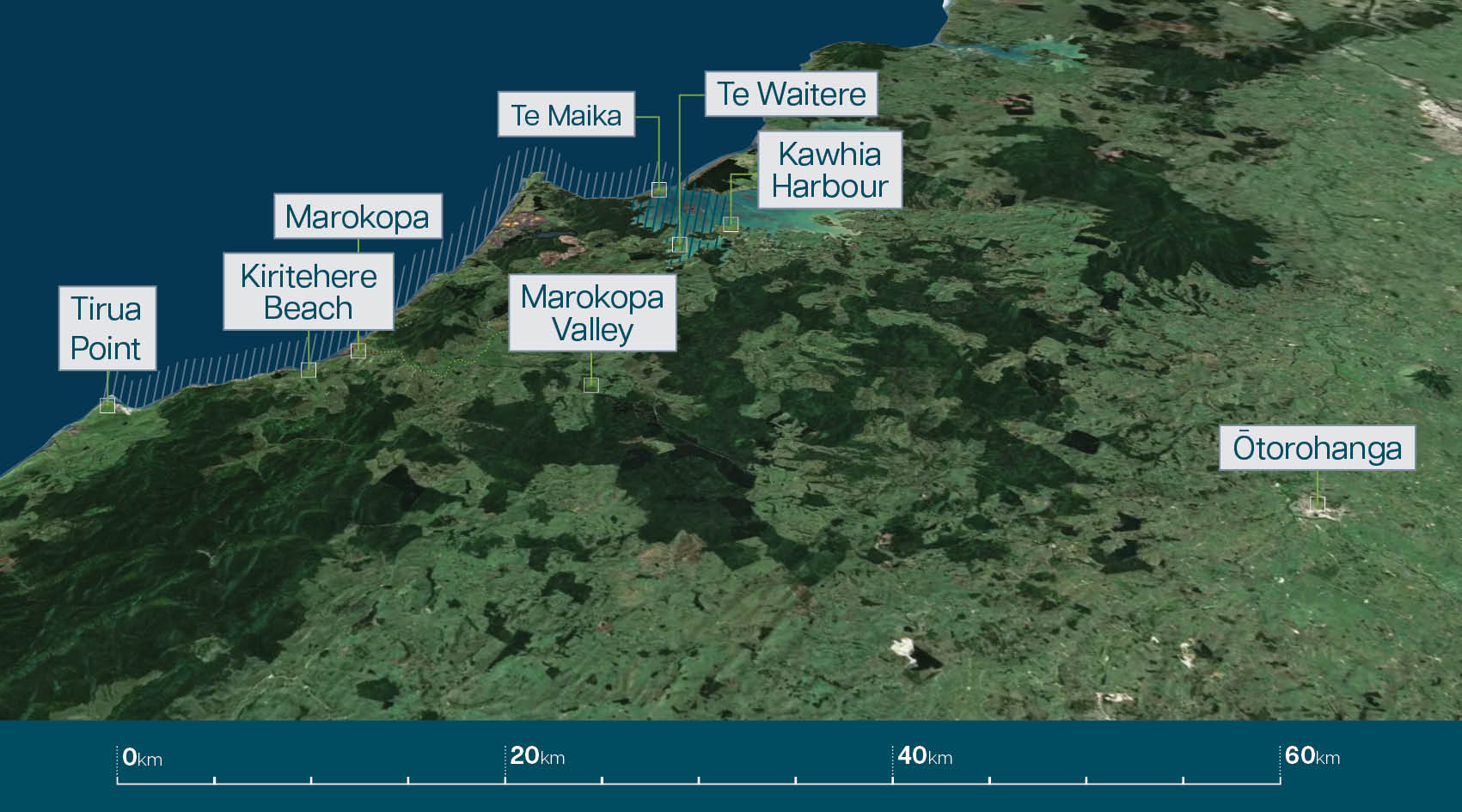
Map: Source: LINZ Basemaps. © Planet – New Zealand 10m Satellite Imagery (2024–2025) and GEBCO Gridded Bathymetry (2020).
120 The first disappearance had taken place in spring, during a period of rainfall and temperatures dropping as low as 5 degrees Celsius.
The profile of Tom Phillips
121 From the first day of Operation Marokopa, Police began to build the profile of Tom Phillips. They did this by, among other things, speaking to close family and friends, searching the properties where he and the children had been living, and receiving expert reports. The profile included a consideration of the following.
a. The keys to the ute were found inside it. The ute was left below the high tide mark. Some close to Tom Phillips, including both his father and the children’s mother, Ms Smith, informed Police they considered this was a “ruse” or a “decoy”, that he and the children had not drowned; instead, they had gone into the bush.
b. A person close to Tom Phillips told Police that they believed he had taken the children “bush”; that he had recently been looking into how to survive on the resources available to him in the bush; and that he likely would have taken a rifle with him if this was the case. They thought there may have been signs that Tom Phillips had been planning to go bush for a while.
c. There were concerns about his alcohol use. Police found empty bottles of vodka in the shed next to the cabin at the family farm, and empty bottles of alcohol were seen in the Ōtorohanga home and the cabin.
d. The Ōtorohanga home was described by Police as “very untidy” and “very dirty”.5 Police told the Inquiry it was “not an environment where you would want children [to live]”. The small cabin which Tom Phillips had built on a trailer at the family farm, in which he and the children had lived before moving to Ōtorohanga and still occasionally used,6 was made of plywood, was windowless and without insulation. It was also untidy and dirty.
e. Tom Phillips was in a parenting dispute with the children’s mother, Ms Smith, and this had been a stressor for him. His father told Police that, a day or two before the disappearance, Ms Smith had “threatened to get Oranga Tamariki out to the farm”, and that this might have been what made his son disappear.
f. Police formed the view that he had been difficult to live with and was controlling. This was considered an indicator for intimate partner and family harm.
g. A person close to Tom Phillips said they were concerned that, if cornered, he would turn “violent”.
h. Another person close to him told Police he had a dislike of government agencies, “meaning anyone that might try and remove his children from him”.
i. He had anti-vaccination, anti-mandate views. A neighbour reported he had said “[i]f [COVID-19] gets any worse I’m going to the bush”. On 10 September 2021, he had gone into Ōtorohanga to purchase alcohol wearing “a full face army-style gas mask”.
122 Police Search and Rescue and NZDF experts assessed the following likely scenarios.
a. The preliminary assessment involved scenarios of “a despondent or suicidal type profile and a misadventure on the beach”.
b. A further scenario analysis assessed the risk of Tom Phillips being despondent at 27%, and the risk of him being both despondent and suicidal at 16%.
The return: the account of what happened
123 Naturally, the safe return of the children came as a huge relief to Ms Smith, the children’s siblings, Tom Phillips’ family and friends, and to the Police. But that was not the end of the matter. Apart from the fact that the disappearance had attracted massive public attention and consumed significant resources, Police had information suggesting Tom Phillips posed a risk to the welfare of the children. Police also needed to understand the reasons behind the disappearance and how the children had fared over the 18 days while they were separated from family.
124 On 30 September 2021, the day they were notified of the children’s return, Police interviewed family members. They did not interview the children.7
125 Although he initially refused to speak to Police, Tom Phillips gave a statement on 30 September 2021. He claimed that the 18-day disappearance was a spontaneous camping trip, and “not a deliberate act to take the kids away and avoid the Family Court proceedings”. He also said it was the “first time [he] had taken the kids camping like that”.
126 He stated he had returned because he “had a little supplies left… but couldn’t [have] stayed for too much longer”. He refused to disclose to Police the precise location of where he had taken the children during the first disappearance. However, Police were able to confirm it was in a dense area of bush.
127 Police also learned he had returned to the family farm home on 28 September 2021, between about 10.00 pm and 5.00 am, before returning again to the home with the children the following night on 29 September 2021. On the night of his return, Tom Phillips’ father helped Tom retrieve some of his camping gear from the bush.
128 Police were informed that Tom Phillips left the children alone for a period on the evening he took the children into the bush on 11 September 2021.
Police action: October 2021 to December 2021
129 On 1 October 2021, Police developed a “safety plan” to be followed by Tom Phillips. The plan stated he would not leave the family farm, would have another family member present at all times, and that Police were to be advised of any plans to leave the farm. Police also contacted Oranga Tamariki during this time.
130 On 2 October 2021, Police visited Tom Phillips. Police were live to the risk of Tom fleeing again and noted “there were no indications or comments from Tom that he would go bush again with the kids”.
131 During this time the children’s mother and older sisters contacted Police to raise concerns as to the safety of the children remaining in their father’s care.
132 On 5 October 2021, Tom Phillips was charged with making a false report to Police.8
133 On 7 October 2021, a member of the Operation Marokopa investigation team completed a report addressing Tom Phillips’ suitability to hold a firearms licence. The report noted the following factors.
a. Tom exhibited “bizarre” behaviour prior to the disappearance, including wearing a full military gas mask around Ōtorohanga township. He also mentioned Doomsday prepping, saying to family members that he would “just take the kids and disappear” from authorities.
b. During Operation Marokopa “a number of concerns were identified that related to Tom’s mental health”. These included that Tom Phillips had previously told the children’s mother that she would never get the kids; his views as to COVID-19 vaccinations and that he had told family he and the children would “just disappear” if there was another lockdown; and that he did not want “big brother” watching.
c. He was an alcoholic and drank vodka and orange juice from a plastic coffee cup during the day. His alcoholism was identified in family harm reports where it was recorded he would drink a box of beer and a bottle of vodka in a day; and to fulfil the craving he had turned to brewing his own vodka.
d. That his drinking was a contributing factor to Ms Smith leaving him.
134 The report concluded:
The facts mentioned above have raised concerns for the enquiry team on Operation Marokopa as to whether Tom PHILLIPS is a suitable person to hold a firearms licence. The ongoing matters before the family court are clearly causing Tom stress and anxiety. He has demonstrated that he is prepared to put the children’s wellbeing at risk by hiding them to deny [SMITH] having access to them. His large and regular consumption of alcohol and his irrational thinking are ingredients of a man willing to do anything to keep his children in his care.
135 On 8 October 2021, Police recommended temporary suspension of Tom Phillips’ firearms licence on the basis that he was not a fit and proper person to hold such licence.9 Police issued the notice suspending his licence on 8 October 2021, although this was not served on Tom Phillips until 2 December 2021.10
136 On 3 November 2021, Tom Phillips’ first appearance on the false statement charge was adjourned to 12 January 2022 as a result of COVID-19 restrictions.
137 Police also told the Inquiry that, during this time, they were concerned to ensure Tom Phillips reengaged, and remained engaged, with the Family Court proceeding. This was because the Police assessment was he had hidden his children in the bush to avoid the proceeding, and evidence he was engaged in the proceeding provided a degree of assurance he would not disappear again.
138 Police were also concerned to ensure that he had mental health support, to address the various aspects that might place the children at risk during this period. However, the Inquiry has not seen evidence that any such support was explored or provided by Police.
139 Police did not visit the family again until after the second disappearance on or around 10 December 2021.
The Inquiry’s view: a “camping trip” an unlikely story
140 Tom Phillips told Police the 18 days had been a “spontaneous camping trip” and was not designed to take the children away from their mother.
141 That explanation sits uncomfortably with the known facts. It is incapable of belief for a variety of reasons. The plain inference to be drawn from all of the known facts is that Tom Phillips went into the bush with his children with the intention of not being found. The Inquiry’s reasons follow.
142 First, he told no one in advance of his intentions to go into the bush, or where he was intending to go. Had this been the spontaneous camping trip he claimed it was, there would have been no need to withhold that information from everyone.
143 Secondly, the circumstances surrounding the abandonment of his ute on the beach are diagnostic of his intention to create a subterfuge. He left it unlocked with the keys in the vehicle. That is not something a father embarking on a camping trip with his children would ordinarily do. It is more consistent with someone seeking to create the impression he was intending to return to the ute in relatively short order.
144 Similarly, leaving the ute below the high tide mark is not something which someone would do if they were planning to go camping. There are countless other safer spots where he could have parked his ute which would not have risked inundation by the sea. His intention was to stage a precursor to tragedy; that he had gone down to the beach with his children for a walk or something similar but had been swept into the sea with tragic results. And that, of course, is what most believed had happened in those first few days of the disappearance.
145 Thirdly, he did not take his phone or any electronics with him. He told Police that it was impossible to track his phone because he had “taken the battery and SIM card out and it [was] hidden in the wall in the toilet” of his Ōtorohanga home. The inference is that he had no intention of being contactable and that he wanted to avoid the possibility of having his movements and whereabouts tracked.
146 Fourthly, he refused to disclose the location of the campsite or where he and the children had been. Had this been a spontaneous camping trip as claimed, what harm would have been caused by being more co-operative with Police? The reasonable inference is that his reticence was due to either concealing his intention to repeat the exercise in the future or wanting to keep secret the location in the event he might later return.
Informing Oranga Tamariki – 30 September 2021 to 1 October 2021
147 Police contacted Oranga Tamariki to make a report of concern on 30 September 2021. This was initiated by a phone call, followed by a written report of concern and a further call the next day.
148 Oranga Tamariki’s record of the first phone call notes Police as saying:
Thomas has not said anything to Police about what happened while he was away with the children. There are concerns that Thomas has the potential to do this again and questions as to why his ute was stuck in the sand under the tideline. There are questions around Thomas’s mental state.
149 Of particular note, in the written report Police recorded they had “no immediate concerns for the childrens (sic) safety”. However, Police also signalled that they harboured concerns arising out of the circumstances around the disappearance, and in particular “…concerns regarding the last 18 days”, including “where the children have been staying in that time, were they given their essential needs (clothing, food etc)”.
150 The report also recorded that the children had been left alone in the bush for an estimated one hour. The report noted that at “this point in time Police do not have enough information to comment on the last 18 days, this will be followed up”.
151 The report also raised concern over alcohol use, including that a “number of empty Vodka bottles” were located throughout the Ōtorohanga home.
152 As to concerns over the home, Police expanded on this description in a phone call with Oranga Tamariki on 1 October 2021. They described the house as a “mess”, and the cabin at the farm property as “unliveable”. During this call Police also advised Oranga Tamariki that they were not satisfied with the level of information and detail they currently had.
153 However, the Oranga Tamariki file note of the call records Police repeating Tom Phillips’ account that the 18 days was camping, and that his reason for the location of the ute was that he “just parked it there”. It does not record Police saying whether they believed this account.
Informing Oranga Tamariki — what Police didn’t say
154 There is no evidence during early October (or at any time) Police explained or elaborated on the significance of the matters noted in their report of concern, including explaining the significance of:
a. Tom Phillips’ refusal to disclose or discuss where he had been, suggesting it was not “just camping”,
b. the location of the ute, the inference being he had intended to stage the accidental death of him and his children,
c. the mental health “questions”, and the reasons for those, including alcohol use, staging his own accidental death and that of his children in total disregard for how this would impact others, and his conspiracy and anti-state beliefs, and
d. the Police concern that the children were not provided for appropriately in the bush, and an explanation of the harshness of those conditions.
155 As one officer involved in Operation Marokopa insightfully told the Inquiry:
…in terms of him parking the vehicle on the – leaving it on the beach for everyone to see, like that for me... that’s a concern as to, does he have proper state of mind to look after the children? Is he in the right mindset to look after them given the fact that he’s done that and then also, you know, taking [them] into the bush? It’s like, I guess what I’m trying to say is that [it] is not a normal person [that] would do that, put their children through that and also their family.
156 And as to his mental health, the Inquiry was told by one officer who had been involved in Operation Marokopa:
We start profiling him as a person and the history that he’s got, the alcohol, the commentary, I think there was some commentary about not wanting to go or not wanting the Family Court orders to change and therefore, could he ultimately, could he turn on us? And he had that anti-establishment or anti-authority, anti, you know, COVID-19, but also conspiracy theory, the mental health side of stuff.
157 It also appears Police did not convey to Oranga Tamariki the following matters.
a. Police did not accept Tom Phillips’ explanation that the 18 days was a camping trip.
b. Police considered he was willing to put his children’s wellbeing at risk by hiding them to deny their mother seeing them.
c. His apparent mental instability gave rise to concerns as to the children’s safety in the care of their father.
d. Police deployed an armed, tactical response the day Tom Phillips emerged from the bush, such was their assessment of his risk of harm to others.
e. He had dismantled and hidden his cell phone to avoid detection during the first disappearance, and not taken it with him.
f. Police considered he was not safe to hold a firearms licence.
158 However it is viewed, it is difficult not to conclude that the absence of this type of detail from the report to Oranga Tamariki was a material omission. The provision of this detail to Oranga Tamariki would have better informed its investigation of the report of concern.
Findings
Police had limited options to impose constraints on Tom Phillips to mitigate the risk of a second disappearance
159 The Inquiry has examined whether Police should have given closer consideration to whether or not a more serious charge, such as neglect, was available following Tom Phillips’ return on 30 September 2021. The Inquiry heard that conditions across the 18 days in the bush were miserable, cold and wet. Tom Phillips himself indicated that conditions were difficult. However, on the children’s return Police considered they did not present with the form of health or wellbeing issues that might warrant a more serious charge of that nature. The Inquiry finds a charge of neglect in the circumstances which presented at that time would not have been readily available.
160 When a person is arrested and charged with an offence, Police may impose bail conditions pending their first appearance in court.11 These might include conditions such as requiring the defendant to reside at a particular address. In this case, Police made the decision to summons Tom Phillips to the District Court rather than arresting him and releasing him on Police bail. The offence he was charged with was minor, and the Inquiry finds that the decision to summons rather than arrest was reasonable.12
161 In any event, Police bail would not have served as any sinecure against Tom Phillips absconding. And neither would it have prevented him taking the children with him if he was determined enough to do so, as the benefit of hindsight now reveals. The Inquiry cannot put it any higher than that.
Police report of concern to Oranga Tamariki was commendable, but Police should have ensured all information was provided and critical discussions were ongoing
162 Police provided a detailed report of concern, promptly on 30 September 2021, both in writing and by phone. The officer followed up with further detail by phone on 1 October 2021. These actions were commendable. On 30 September and on 1 October 2021. These actions were commendable. On 30 September and 1 October 2021 the officer told Oranga Tamariki they were concerned Tom Phillips had “the potential to do this again”, and identified various risk factors such as his alcohol use, non-co-operation with Police, and concerns as to his mental state, and – importantly – that the Police investigation was ongoing. This was an important, and critical step, to seek to protect the children’s safety and welfare and to prevent them being taken a second time.
163 However, from 1 October 2021 until after the second disappearance in December 2021, Police and Oranga Tamariki did not communicate again.
164 On examination, there are other practicable steps Police could and should have taken after 1 October 2021.
165 Police could and should have:
a. discussed further, and elaborated, the concerns with Oranga Tamariki to ensure both agencies had a shared understanding of the concerns. Concerns Police raised about, for example, that he had staged his death, and that of his children, by leaving the ute on the beach warranted greater explanation, and
b. ensured discussions with Oranga Tamariki were ongoing to provide relevant and updated information. By 7 October, Police had concluded Tom Phillips was a man who was “prepared to put his children’s wellbeing at risk by hiding them to deny” their mother access. This was not conveyed to Oranga Tamariki.
166 Police officers the Inquiry spoke to agreed that more information could have been included in the report of concern. The Area Commander at the time said:
I think in context, … seeing what we provided in that firearms revocation [on 7 October 2021] and what we’ve provided to OT [on 30 September 2021], there’s definitely more in that firearms revocation. …I don’t want to surmise why we’ve held off some of that information, but … there’s probably an opportunity to provide more to them …
167 And:
… naturally, I’d point there and go, right, what did our report of concern say. Did we give enough? And we’re always open to feedback … [And, on review of the report of concern] [i]f you talk about opportunities to prevent this, then that naturally looks like one for us [Police] – how robust was our information sharing in terms of everything …
168 Another officer who worked on Operation Marokopa told the Inquiry, in response to whether there was a “gap” between what Police knew and what was conveyed to Oranga Tamariki:
… 100% …. there’s concern for the kids and Tom’s mental state [by Police] and maybe just a breakdown in communication or processes or … I don’t know, but definitely there seems to be … [a] lack of understanding between the two [organisations].
169 The same officer accepted the report of concern was “based on the children’s background, where they’re sleeping, etc. There’s… not much detail about the vehicle and Tom’s mental state”. Police further accepted it would have been helpful for Oranga Tamariki to know of, for example, the use of gas masks and storing of his phone in the wall (to avoid detection).
170 Police also accepted, in hindsight, it would have been useful for the Police investigation team to keep Oranga Tamariki updated, and to give them the Police “view of what’s going on”. Stating further:
In hindsight it would have benefited from both organisations sitting down with each other and ... going over some things, you know, concerns, where to now, what the plan in the future is.
171 This is particularly so where Police have, like Oranga Tamariki, statutory obligations to investigate reports of concern regarding the safety or wellbeing of children,13 and are empowered to disclose any information to Oranga Tamariki for the purpose of preventing, reducing, or assessing the risk of harm to children.14
172 The Inquiry considers that ongoing communication should have included Police telling Oranga Tamariki about the Police safety plan, and working together to ensure the mental health concerns were discussed with Oranga Tamariki, and referrals for mental health assessments put in place.
173 The Inquiry further finds that better information sharing would have allowed Oranga Tamariki and if needed, Police, to engage more effectively in the Family Court process, to the benefit of the children, including the hearing on 6 October 2021. Clear and ongoing communication between the two entities may have prevented, and would likely have made more difficult, the second disappearance.
Findings
1 Police had limited options to impose constraints on Tom Phillips to mitigate the risk of a second disappearance
2 Police report of concern to Oranga Tamariki was commendable, but Police should have ensured all information was provided and critical discussions were ongoing
Recommendations |
|---|
|
1. The Inquiry recommends that Police review their existing policies and practices regarding making reports of concern to Oranga Tamariki to ensure that: 1.1 Police fully explain their concerns and the reasons for them, and establish a shared understanding of concerns. This should include meeting if appropriate and possible to do so, and 1.2 Police and Oranga Tamariki have ongoing and regular discussion and disclosure of relevant information, particularly where there is an ongoing Police investigation or involvement into matters that are related to the report of concern or that may be related to the child’s safety, including a parent’s conduct. |
3.2 Oranga Tamariki – Ministry for Children
174 Oranga Tamariki held, and had the ability to access, significant and important information about Tom Phillips prior to his second disappearance.
175 Importantly, after Tom Phillips took the children the first time in September 2021, Oranga Tamariki received, and was required to respond to, information from Police in a report of concern, and information from family members concerned for the safety of the children in Tom Phillips’ care.
176 The Inquiry has found that, while Police provided Oranga Tamariki with a detailed report of concern, Police should have worked more closely with Oranga Tamariki to discuss and elaborate on those concerns, and should have provided updated and critical information arising from their ongoing review and investigations. However, in turn, Oranga Tamariki did not take all practicable steps to obtain all relevant information from Police, including on an ongoing basis. Had they done so, this would have enabled them to provide more accurate information to the Family Court.
177 Oranga Tamariki told the Inquiry it accepts it could and should have been more proactive in seeking information from Police, including asking more regular and probing questions to prompt further exploration of the children’s wellbeing.
Oranga Tamariki – role overview
178 A primary role of Oranga Tamariki is to support and protect the wellbeing of children by preventing children from suffering harm (including to their development), abuse, neglect, ill treatment or deprivation. This role is established under the Oranga Tamariki Act 1989.15 In this role Oranga Tamariki must support children, young people and their families to achieve the safest and best outcomes for them. This includes responding where a person has raised concerns as to the safety and wellbeing of a child or young person.16 Oranga Tamariki may bring matters to the Family Court under this legislation, where there are care and protection concerns.
179 The Family Court may also ask Oranga Tamariki to be engaged in other matters, including in disputes between parents, by reporting on matters such as to suitability of each parent to care for their children.17 The Family Court does this by providing a brief to Oranga Tamariki identifying matters it wants Oranga Tamariki to address. Another role Oranga Tamariki has is to act as agent of the Court for any purpose.18 These roles exist under the Care of Children Act 2004.
180 With respect to Tom Phillips and the children, Oranga Tamariki was engaged with each of these aspects at various times between 2018 and 8 September 2025.
2019: Oranga Tamariki addresses parenting “suitability”
181 Tom Phillips and Ms Smith separated in December 2017. Ms Smith told the Inquiry she had left what she described as an abusive and controlling relationship. She obtained seasonal work to support herself and the children. From the end of 2018, Tom Phillips had day-to-day care of the children. [redacted].
182 [redacted].
183 Ms Smith told the Inquiry of Tom Phillips’ controlling behaviours, and his actions to keep her from, and to isolate her from the children. However, Ms Smith told the Inquiry that, when she met with the social worker who was preparing the report, Tom Phillips’ behaviours towards Ms Smith were not fully addressed by or discussed with the social worker. Instead, it appears the social worker considered these types of matters to be a “diversion”.
184 Ms Smith is Māori. As such the children are also tāngata Māori. Ms Smith’s counsel told the Inquiry that the social worker did not make any enquiries of Ms Smith on this. She said that, at no time, did the social worker acknowledge, or reflect on, the importance of recognising the children’s whakapapa. The Inquiry agrees with the submissions of counsel that this omission inevitably led to a deficit of information.
185 Relatedly, there appears to have been no enquiry made as to the role the wider maternal whānau might have played in maintaining relationships with the children. Other key family members, such as the children’s older siblings, were not interviewed by the social worker. The latter two were close to their younger siblings. Furthermore, they lived with Tom Phillips, Ms Smith and the children for some years. They were uniquely placed to comment on the family home and dynamics.
Finding – Oranga Tamariki involvement before September 2021
When preparing a s 132 report in 2019 Oranga Tamariki could have identified, and advised the Family Court of the risk of Tom Phillips isolating the children’s mother from them
186 Oranga Tamariki could have taken steps to better understand and address the concerns raised by Ms Smith in relation to what she described as the controlling and isolating behaviours of Tom Phillips towards her in preparing the s 132 report.
187 It is well-documented, both in academic writings and in case law, that in parenting disputes, parents can and do use Family Court processes as a tool to exclude or alienate another parent.
188 A Deputy Chief Executive19 told the Inquiry that, more generally, social workers do have “frame of reference” around parental alienation being a type of serious harm under the Oranga Tamariki legislation, but that this framing isn’t necessarily in mind when social workers prepare s 132 reports for the Family Court in disputes between parents.
189 She said the organisation could do more to assist social workers here, within the confines of being a s 132 report writer. The Deputy Chief Executive explained that the Court-directed brief has had the effect, rightly or wrongly, of constraining broader social work assessment and analysis. However, she said this is something the organisation can consider or improve on. She confirmed to the Inquiry that, in her view, currently social workers are not acting contrary to the Court’s direction, or Oranga Tamariki policy, by maintaining a narrower social work lens when preparing these reports that are to be used in disputes between parents (rather than in care and protection cases).
190 The Deputy Chief Executive, speaking in general terms, confirmed there is currently no policy in place to address the possible scope for social work when preparing a s 132 report. She described the absence of policy, as to the role of social work in preparing s 132 reports, as a “gap”. She assured the Inquiry that Oranga Tamariki will be doing work in relation to its s 132 reports, in terms of the practice guidelines and tools, to ensure a clear understanding of issues.
191 Oranga Tamariki also acknowledged that there was more work to be done in relation to recognition of cultural identity in the context of s 132 reports; that the absence of observations about the ability of either parent to uphold a child’s whakapapa and identity was also a “gap” in terms of its policies. The Inquiry agrees.20
192 [redacted].
193 Had Oranga Tamariki made greater inquiry into parental exclusion or alienation, and the importance of the children’s whakapapa, and reported this to the Court, that may have assisted in the mother retaining a closer, and more safeguarding, role. The erosion of her role, through parental isolation or alienation, likely contributed to the ability of Tom Phillips to take the children in December 2021.
October 2021 – reports of concern following the first disappearance
Police report of concern
194 On the morning of 30 September 2021, a police officer phoned Oranga Tamariki to make a report of concern.21 Police raised several significant concerns with Oranga Tamariki, which included the following.
a. Tom Phillips took the children away for 18 days. They were reported missing, resulting in “many search parties”.
b. His car was found stuck in the sand below the high tideline.
c. Despite the search parties, Tom Phillips and the children were able to “allegedly avoid detection for some time”.
d. Police had concerns about the living conditions of the children in Tom Phillips’ Ōtorohanga home, and the place they stayed on the Phillips family farm, and found both to be untidy, with food left on the table and benches.
e. He and the children returned to his parents’ Marokopa home on Tuesday night and were reported found “only yesterday” (the day after they had returned) to Police.
f. He had not said anything to Police about what happened while he was away with the children. Police were concerned he had the potential to do this again and had questions as to why his ute was stuck in the sand below the tideline, and “questions around Thomas’s mental state”.
g. The children’s mother was seeking day-to-day care of the children and asking Police to do more to support her. Police confirmed they were limited in what they could do.
195 That same day, Police formalised this by filing a written report of concern with Oranga Tamariki. This said:
a. there were no immediate concerns for the children’s safety,
b. Police did have concerns regarding the last 18 days: where were the children staying in that time, were they given their essential needs (clothing, food etc)?,
c. at this point Police did not have enough information to comment on the last 18 days, and this will be followed up,
d. the home address was in a “very messy condition”, and a “number of empty Vodka bottles” were located by Police throughout the house, and
e. Tom Phillips had left the children alone in the bush, without an adult, for about an hour.
f. the report of concern also recorded “Police believe the children will be safe to reside with Thomas, in the care of his parents.” However, the report noted this was in relation to the “Frontline Safety Plan” and noted there will need to be a plan in place.
196 Police spoke to Oranga Tamariki by phone for a second and final time on 1 October 2021, during which the police officer told Oranga Tamariki the following.
a. Police were not satisfied with the level of information and detail they had from Tom Phillips, and intended to meet with him the next week. He had not said why he didn’t tell anyone where he went. He was not currently being co-operative with Police.
b. He was currently stating it was a camping trip, and he had enough food and warm clothing with him to meet their needs, and that they had been staying in a tent, and that he “just parked” the car where he parked it with the keys left in it.
197 It appears that Police and Oranga Tamariki did not speak to each other about the children or Tom Phillips again. Contact between the two agencies resumed only after he took the children and disappeared a second time.
Concerns raised by Jane
198 In addition to Police reporting concerns, each of the children’s older siblings, Anna and Jane,22 also raised concerns with Oranga Tamariki as to the children’s safety.
199 Anna and Jane advocated for their younger siblings’ best interests throughout. They had all lived together, with Tom Phillips as stepfather to the oldest two, for some years. The closeness of the bond between the siblings is visible in their dealings with Oranga Tamariki.
200 Jane, then in her early 20s, first made contact with Oranga Tamariki the day after the children returned with their father. She had flown from where she was living at the time, specifically to check on the children. Between 1 and 5 October 2021, Jane contacted Oranga Tamariki a number of times to express her concerns about the safety of the children. Details of some of those conversations follow.
201 On the evening of Friday 1 October 2021, the day after Tom Phillips and the children had been reported as having returned, Jane made an after-hours call to Oranga Tamariki. The conversations were recorded by the call-taker in a file note. Jane was insistent that Oranga Tamariki should visit the children during the weekend, rather than the following week as scheduled. She expressed her deep concerns for the children’s welfare and safety. These included that:
a. the children had been taken away by their father for three weeks during which time their older siblings and their mother had “no idea where they were”,
b. she was concerned with how the children presented when she visited them, and
c. she was extremely concerned the children may have been emotionally affected by the events.
202 After speaking to a supervisor, the call-taker advised Jane that an after-hours safety check was not warranted on the basis of the information provided. Jane repeated her concern that the children may have been affected by their three-week absence.
203 The next morning, Saturday 2 October 2021, Jane called the National Contact Centre of Oranga Tamariki. She said she understood Oranga Tamariki was to visit the children early the following week but asked that they be visited that day. Jane told the call taker the following.
a. She has safety concerns for her siblings. She is worried their father will disappear with them again. She is also worried their father would tell them what to say to social workers.
b. She asked if Oranga Tamariki “would be held responsible if the children went missing again”.
c. She said she would continue to contact Oranga Tamariki until something was done.
204 On Monday 4 October 2021, Jane called Oranga Tamariki again, this time the local branch. She told the social worker:
a. she has been unable to visit her siblings, as the gate [to the Phillips’ home] was padlocked when she tried to visit,
b. during another attempt to speak to them, this time by phone, she was told the children were too busy to come to the phone. She was told [by Tom Phillips] she would only be allowed to visit the children on Wednesday and for one hour,
c. she was upset she was being kept from her family, and
d. she was concerned that her siblings may be coerced into what to say and may forget everything if not spoken to soon.
205 Despite Jane’s repeated concerns about the children, Oranga Tamariki did not meet with Jane at any time during this period, from 1 October 2021 to December 2021. Nor did Oranga Tamariki take any additional steps to seek to understand either the immediacy of her concerns or explore the foundation for them. More significantly in the Inquiry’s view, Oranga Tamariki did not consider whether to treat Jane’s concerns as a report of concern.
Concerns raised by Anna
206 Jane was not the only sibling to report her concerns about the children at this time. Their sister, Anna, also made contact with Oranga Tamariki.
207 On Monday 4 October 2021 a social worker supervisor phoned Anna after she had left a message. Anna said she wanted to talk about Tom Phillips’ character based on the years she had lived with him. She said she had made a statement detailing this, which she later also provided to the Inquiry. It is styled as an affidavit and was affirmed by Anna before a Justice of the Peace on 4 October 2021, but Anna told the Inquiry she was not able to file it in the Family Court.
208 The supervisor told Anna that Oranga Tamariki were not the right people to use to submit the affidavit to the Court, and suggested she seek independent legal advice. Anna responded by saying she would like Oranga Tamariki to have a copy as part of Oranga Tamariki’s assessment. She was given the supervisor’s email address.
209 Anna emailed a copy of the affidavit to Oranga Tamariki. The Inquiry has viewed this. It contains details of her controlling and abusive experiences with Tom Phillips.
210 The supervisor, who was overseeing Oranga Tamariki’s investigation, told the Inquiry she could not recall reading Anna’s affidavit, commenting that “we can’t react to every piece of information”, but noted that everything is generally — over the course of an investigation — taken into consideration. The Inquiry accepts that Oranga Tamariki resources are finite. At any time, social workers are managing multiple files of varying urgency and complexity.
211 However, after reviewing its contents, the supervisor candidly and responsibly acknowledged to the Inquiry that Anna’s allegations against Tom Phillips “read terribly”, and that if the social workers had read the affidavit at the time, it is likely they “would have challenged Tom” on the issues raised in it.
212 Oranga Tamariki did not meet with Anna at any time during this period. Nor did it take steps to try to understand her concerns.
213 Concerningly, it seems that no one in Oranga Tamariki read the affidavit. Had they done so, it seems likely, if not inevitable, that the allegations it contained would have, at the very least, informed the Phillips’ family interview process, which took place the following day. It is also notable in this context that despite the gravity of Anna’s allegations around Tom Phillips as a parent, Oranga Tamariki did not treat her concerns as a report of concern under the relevant legislation.
Concerns raised with Oranga Tamariki by the children’s mother
214 Ms Smith told the Inquiry she made several attempts to raise her concerns with Oranga Tamariki from September 2021, but she said the area manager “was constantly unavailable”.
215 Oranga Tamariki has not been able to identify if or when these calls occurred, but its records indicate that they called Ms Smith on 4 October 2021 to advise her of the report of concern and their investigation. The record indicates that Ms Smith spoke to them “at length”. Ms Smith apparently confirmed she was happy for Oranga Tamariki to be involved but said the children should not be in Tom Phillips’ care. She told Oranga Tamariki that “…she also felt that because she was Māori and the Phillips were white this was also to her disadvantage” when seeking access to the children through the courts or government agencies”.
216 The Oranga Tamariki notes of this call record Oranga Tamariki undertaking to make contact with Ms Smith again to make a time to meet. Regrettably this did not occur prior to the second disappearance.
The response to the Police report of concern
An “urgent” investigation
217 On receiving a report of concern, Oranga Tamariki is required to commence an investigation as soon as practicable, “if it appears that an investigation is necessary or desirable”.23
218 Oranga Tamariki must then determine a timeframe in which to complete the first assessment phase.24 This may be within 24 hours for “critical” matters, 48 hours for “very urgent” matters, or 10 working days for “urgent” matters.25 The investigation in this case was allocated urgent status, allowing 10 days to complete an assessment of the children.
219 To its credit, Oranga Tamariki in fact completed the initial assessment of the children within five days (the report of concern was made on Thursday 30 September 2021 and the home visit completed the following Tuesday 5 October 2021).
220 Oranga Tamariki commenced its process with an initial assessment, which recommended a pathway to “protect… the children from future incidents, explor[e]… safety options and minimis[e].. the impact this incident has had on them”. It said:
…The children have been missing for a[n] extended period of time while in their father Thomas’s care. There were concerns that during this period missing, that the children were living in concerning conditions which could have compromised their safety. There is a concern that Thomas will also do this again and that he was not in a good state of mind during this incident.
221 It recorded that there was “no information to suggest there were concerns for the children in Thomas’s care” prior to the disappearance, noting that his alcohol and cannabis use was “not current”. There was no mention of, for example, the number of empty vodka bottles referred to in the Police report of concern.
222 It went on to note that Tom Phillips’ decision to take the children away was unexplained and was “centred around his own needs” rather than those of the children. It noted the children had “missed out on school and interaction with other family members”. However, this initial assessment concluded that there were “no concerns for the children’s immediate safety” given the presence of adults who could oversee their wellbeing.
The visit: Tuesday 5 October 2021
223 On Tuesday 5 October 2021, that is five days after the children’s return, both a social worker and the social work supervisor who had spoken to Anna, visited the children at the Marokopa home of his parents. Tom Phillips, the three children, his parents, and two other family members were present. The social workers noted the family home was tidy and well-maintained. They also visited the cabin where Police reported the children had lived for a year, and assessed it as unsuitable for long term living, but fine for camping.
224 Tom Phillips told the social worker he “had no idea” a search and rescue operation was taking place while he was in the bush. He said he had been wanting to go camping for a while, and it was not uncommon for him to do so. He said the trip was “spontaneous but somewhat planned”. Both he and his parents outlined his bush skills and experience. Tom Phillips assured the social workers that his actions were unconnected to the Family Court proceedings, and emphasised that he “would never harm his children nor did he intend to”.
225 When challenged as to why he would do this in the “middle of winter”, he said he just “wanted to get away”. He denied leaving the children alone at any point during the three-week period. When questioned about his ute, he said he parked it on the beach because he “decided it would be safer”, and had thought it was well above the high tide line. Tom Phillips also assured the social workers that he had no mental health issues and provided a medical certificate from his GP to support this. It recorded that he did “not present as though he had mental health” issues. He agreed to participate in a mental health assessment if required. Oranga Tamariki questioned him on other matters raised in the report of concern.
226 At the conclusion of the home visit, Oranga Tamariki recorded:
The family presented well, Tom did not present out of the usual, there were no obvious signs of drug use or mental health. Family was co-operative … Tom appeared to be upset when discussing the court process, but relieved that his family would support him and the children if the children needed to be placed elsewhere.
227 The supervisor who attended at the home visit told the Inquiry his responses to their questions allayed their concerns, because he was “working with [them]”. Oranga Tamariki explained to the Inquiry that this would have been in the context of an initial visit, and establishing the children’s immediate safety.
228 In its safety and risk screen, the social worker assessed the children as “safe” and described Tom Phillips as “a very capable and loving father” who was “well supported by his parents”.
229 The internal briefing document in relation to the children was updated on 6 October 2021 to include details of the family visit, noting that “Dad is sticking to his story about deciding to take the kids camping and not thinking to let anyone know”. It also recorded that the cabin “where they stayed some of the time” had “very good facilities with bunks, heating and kitchen facilities”. In addition, Tom Phillips and the children had “good subzero equipment and clothing” while camping in the bush.
Oranga Tamariki’s engagement with the Family Court
230 On 6 October 2021 Oranga Tamariki provided an oral report to the Family Court. The Inquiry has seen the transcript of what was said at the hearing.26 The lawyer for Oranga Tamariki gave the following update.
a. Counsel told the Court the Oranga Tamariki social worker and supervisor met at the family home yesterday with the children, Tom Phillips, and his parents and spoke to them for around two hours. The supervisor had, at that visit “questioned Mr Phillips extensively about the situation and the unusual circumstances”.
b. Counsel then confirmed to the Court that the supervisor had seen the children and found them to be “completely fine”, that Tom Phillips’ suggestion it was a camping trip appeared to be founded, and that there was “nothing particularly sinister about his trip, despite the unusual circumstances”.
c. Counsel informed the Court that the Oranga Tamariki investigation is going to continue “simply with discussions with the children”. Counsel further confirmed that, with the extensive support that Tom Phillips has from his family, “we’re not sure if we have any further involvement or whether there is a need for further involvement for Oranga Tamariki here”.
d. Counsel noted, when the report of concern was received, and with the unusual circumstances, Oranga Tamariki was worried. But that, “…what we uncovered is actually quite a very normal situation …. and their wellbeing hasn’t been jeopardised”.
231 The social work supervisor then gave an oral report stating the children presented well, the family is very supportive and is willing to participate in any form of assessment.
232 In response to a question from the Court as to whether there were any care and protection concerns, the supervisor responded:
No, no, definitely not on the surface of things, no. No, … I found him to be very attentive to what the kids’ needs were.
233 Oranga Tamariki told the Inquiry this update was given at short notice, in the context of “immediate” concerns.
Status of Tom Phillips: parenting
234 On 6 October 2021, the parenting orders were varied [redacted].
Limited further action
6 October 2021: Jane tries again
235 On Wednesday 6 October 2021, Jane called Oranga Tamariki and asked to speak to someone who “wants to take the time to talk to me, and listen, about my siblings”.27 She was put through to the supervisor who had attended the home visit, and who had given evidence in the Family Court the day before.
236 Jane asked the supervisor if she “knew much about what was going on”, then, sounding distressed, said:
I don’t really know what to say but I’ve just heard … that they’ve gone to Court and what’s happened, and I just don’t understand. He disappeared, he parked his vehicle in a place where it would make people worry, he disappeared for three weeks in terrible weather, he’s refusing to tell the Police where he was, where he stayed, and you guys are saying that they’re in no real danger.
237 The supervisor replied:
Well at the end of the day [Jane], the Judge has made his decision. And nobody can change that. And [at] the end of the day it is the Judge’s final decision.
238 However, the supervisor omitted to say that Oranga Tamariki had not referenced, at any point in its submission to the Court, the concerns of the children’s older siblings.
239 Furthermore, there was an active report of concern, under which Oranga Tamariki could have taken further steps through the Family Court to ensure the best placement and safety of the children. Telling Jane the Judge’s decision is “final” wasn’t wholly accurate in that context.
240 In response to the supervisor’s explanation, Jane emotionally observed:
Please really take the time on this because [things aren’t as they may seem]…. And I just want to be able to see the kids, I miss them so much, because we just get cut-off.
241 Jane said they were reported missing, but that wasn’t the first time she hadn’t known where they were.
242 The supervisor gave Jane the space to speak, expressed herself empathetically, and assured Jane she would keep her involved in the Oranga Tamariki processes in the future. The supervisor confirmed to Jane that the investigation was ongoing, and that any new information would be fed back to the Court.
243 However, the supervisor did not appear to question or explore the pattern of isolation and associated distress, as a form of harm, that Jane had repeatedly raised.
The second meeting between Oranga Tamariki and the children: 1 December 2021
244 On 1 December 2021, Oranga Tamariki met with the children for individual interviews. This was in response to the Police report of concern that had been made some two months prior. Oranga Tamariki states the delay was due to restrictions imposed at the time in response to the COVID-19 pandemic.
Findings
Oranga Tamariki did not take all practicable steps to fully understand concerns raised by Police after the first disappearance
245 Oranga Tamariki spoke to Police twice, on 30 September 2021 and on 1 October 2021. Police informed Oranga Tamariki on both occasions that they did not have “enough information” to comment on the last 18 days.
246 The Inquiry finds Oranga Tamariki should have taken steps to obtain further updates from Police on the reasons for the 18-day disappearance.
247 The Inquiry also finds Oranga Tamariki should have sought further information from Police as to any significance of the placement of the vehicle on the beach; the empty vodka bottles; the fact he had left the children alone in the bush; and any other comments on or insights into the concerns as to his mental state. Instead, Oranga Tamariki accepted what was largely his own self-report on these issues.
248 Had Oranga Tamariki engaged effectively with Police, it would have learned the reasons behind the mental health concerns (including his anti-government and conspiracy theories, the wearing of a gas mask to shop, the hiding of a phone in the wall), greater detail of his alcohol use, and the fact of, and reasons for, suspension of his firearms licence.
249 The Inquiry was told that, ordinarily when Police make a report of concern, and further information is required, an open line of communication between Oranga Tamariki and Police occurs. The Inquiry was informed that “there would be some further engagement with the person who’s made that report of concern”, in this case being Police.
250 However, this did not happen with the Phillips children. It should have. The report of concern required explanation, and this should have been sought from the notifier.
251 Oranga Tamariki fairly and properly acknowledged to the Inquiry that they “could have done better in [their] social work analysis of what was going on and pulling all the information together”. The Inquiry agrees.
252 As one senior Oranga Tamariki staff member put it, there needs to be hardwiring of “cross-agency levers” into policy.
Oranga Tamariki did not take reasonable steps to understand concerns raised by the maternal whānau after the first disappearance
253 The Inquiry was impressed by Anna and Jane at their interviews. Both were intelligent, articulate, and credible.
254 During the relevant period, Jane and Anna were available for and willing to be interviewed by Oranga Tamariki. It is regrettable the agency did not meet with them and explore their concerns. The Inquiry is left with the clear impression that their concerns were largely minimised.
255 As a specialist organisation, Oranga Tamariki has the particular skill-set to take seriously, identify and understand, and give proper weight to the concerns of a distressed sibling.
256 The Inquiry met with the social workers who had carriage of the Phillips children’s file. They impressed the Inquiry as caring, dedicated and well qualified staff. They care deeply for the wellbeing of those tamariki who come to their attention.
257 Had Oranga Tamariki met with Jane, or taken time to properly understand her concerns, further relevant and material information would have been obtained that may well have changed what happened later. Oranga Tamariki may have understood and recognised the three-week disappearance as a significant escalation in a pattern of isolating or alienating the children from their whānau. And, Jane raised specific concerns that he would take the children away again.
258 The same comments equally apply to Anna. It is deeply unfortunate that the contents of her affidavit did not appear to have been read. She and her sister had lived with Tom Phillips for some years. They had witnessed at first hand his behaviour in a domestic setting. Oranga Tamariki, as part of its core skill-set is trained and experienced in listening to both sides of a parenting dispute involving allegations and counter-allegations. Why in this case was only one side of that equation considered? And why were Anna’s specific concerns as to his parenting not considered?
259 The Inquiry finds that Oranga Tamariki should have taken steps to obtain further information from the sisters, and to critically and objectively review the information provided. They should have considered treating these concerns as a separate report of concern or, at the very least, as raising separate matters that required investigation within the open report of concern.
260 Had this occurred, the sisters would have been kept informed of what steps Oranga Tamariki was proposing to take, and the nature of the information it intended to present to the Family Court. It may also have contributed to the quality of the information presented by Oranga Tamariki to the Court.
261 A senior Oranga Tamariki staff member was asked by the Inquiry if it would be best practice to meet with Tom Phillips’ stepchildren. With reassuring insight and candour, she agreed, noting that social workers “should have brought [Jane] in and talked to her … earlier”, and questioned whether the “narrative around [the] maternal whānau” may have impacted on how she was perceived by Oranga Tamariki. We cannot but agree.
262 In addition, the failure of Oranga Tamariki to meaningfully engage with the maternal whānau was reflective of a broader failure to recognise and promote the connection of the children to their whakapapa, in accordance with the principle of whanaungatanga. Oranga Tamariki did not appear to take into account the particularly significant cultural impacts of the children being isolated from their mother and other maternal family members.
263 As with her daughters, the Inquiry met with Ms Smith. Over the course of two lengthy interviews the Inquiry was impressed by her intelligence and resilience; she was articulate and responsive. She also impressed as a committed, hardworking, caring and loving parent to her children. Oranga Tamariki were less dismissive of the children’s mother than they were of her daughters. Oranga Tamariki went so far as to say it would keep her informed and meet with her again. Unfortunately, this did not occur prior to the second disappearance.
264 The Inquiry further finds that, had Oranga Tamariki taken into consideration the concerns of the sisters, and the significance of the concerns of the maternal side, and connections to whakapapa, the resulting safeguarding of the children may have differed, including through more accurate information being provided to the Court, and may have prevented or made more difficult the second disappearance of Tom Phillips.
265 Oranga Tamariki has informed the Inquiry that, since 2022, it has updated its practice approach to address, among other matters, improved engagement with tamariki, rangatahi and whānau for whānau to feel better supported and to create better quality practice, assessments and plans. It said the approach includes a focus on whakapapa connections. And staff are encouraged to reflect on their own practice and any blindspots or biases that may influence how they see and relate to those they are working with.
Oranga Tamariki should have more carefully considered Tom Phillips’ mental health
266 Police raised a concern as to the “mental state” of Tom Phillips with Oranga Tamariki on 30 September 2021 and 1 October 2021. In response, Tom Phillips showed Oranga Tamariki, on 5 October 2021, a certificate from his general practitioner confirming he “did not present as though he had mental health” issues, and confirmed that he would participate in a mental health assessment if required.
267 Oranga Tamariki told the Inquiry that generally it is not the agency with the professional skills and knowledge to undertake mental health assessments. At best, it can refer to the public health service for a mental health assessment or access an independent psychological assessment. That is what it should have done, yet it does not appear to have taken that step.
268 A family member of Tom Phillips told the Inquiry they wished that the “whole approach had been a little more wraparound”. They noted that Police had made assumptions resulting in a decision to remove Tom Phillips’ firearms licence, in large part on the basis of mental health concerns, but that they did not tell family of these concerns, and neither Police nor Oranga Tamariki provided any mental health support to him.
269 Anna told the Inquiry that she had seen the negative sides of Tom Phillips’ character prior to the first disappearance, but had not thought he would go so far as to take the children, unannounced, into the bush. She told the Inquiry that, when he did that, she thought “well, he has lost the plot”. She said of him disappearing with the kids: “I cannot see why a person in their right … mind would do that”. Anna said:
Police also told us that while he was missing the first time that they found a phone in the wall, which to me is more … than just losing the plot because that’s actively … hiding something or thinking that somebody’s going to be watching you or whatever.
270 Jane too expressed her concerns in this regard, asking what sort of person would leave a vehicle on the beach and not tell anyone where they were going, given what this would put their family through. She felt Oranga Tamariki should have made a referral for an assessment of Tom Phillips’ mental health. She told the Inquiry she could not understand why they would fall for his cover story of it being a camping trip.
271 The Inquiry agrees with these observations. Oranga Tamariki should have spoken to Police to better understand the mental health concerns in relation to Tom Phillips and listened to the sisters after the first disappearance. Oranga Tamariki should have carefully considered mental health issues, and a possible referral, for Tom Phillips on his return on 30 September 2021, during its investigation.
272 The Inquiry finds that, based on the information before it, Oranga Tamariki did not take all practicable steps to protect the welfare of the children. It should have spoken to Police and family, and prioritised possible referrals for mental health assessments.
Oranga Tamariki’s initial response to the report of concern was appropriate and reasonable
273 To its credit Oranga Tamariki initially moved with urgency. It classified the case as “urgent”, requiring a safety and risk screen to be completed within 10 working days.28 Oranga Tamariki responded within five days.
274 The Inquiry acknowledges the competing and limited resources Oranga Tamariki manages, together with the challenges of geography and distance which travelling to the Phillips family farm on an urgent basis presented. It further acknowledges that, in the intervening period (from the time of the Thursday report of concern to the Tuesday visit) the presence of the children’s grandparents was seen as a protective factor. That, together with the comment in the Police’s report of concern that there were no immediate concerns for the children, necessarily introduced some element of comfort that the children were safe in the paternal setting for the “immediate” time, noting Police suggested a plan needed to be developed.
275 The Inquiry considers that the “urgent” status allocated to the report of concern, and the response time of five days (including the weekend), were reasonable, if not commendable, in the circumstances.
276 Oranga Tamariki’s practice guidelines state that an assessor should spend “face-to-face time, alone where possible, with each tamaiti”.29 In this case, individual interviews were not conducted until December 2021.
277 The Inquiry accepts Oranga Tamariki’s explanation that each case presents unique challenges and in some cases it can be more distressing for the child and counter-productive to the end result, to attempt to separate children from family in the home. In fact, children can be significantly less likely to speak freely in the home environment if separated. In that event the ordinary practice is to speak to children at school. Given that they had been removed from school Chapter 3.3 that was obviously not a viable option here.
Oranga Tamariki did not adequately engage with, and did not accurately inform, the Family Court on 6 October 2021
278 The Inquiry acknowledges the difficult circumstances and time pressures which operated on 6 October 2021, including the various restrictions in place due to the COVID-19 pandemic. In that context, the Inquiry finds that Oranga Tamariki, without any intention to mislead, did not accurately, fairly or fully inform the Family Court of the risks to the children.
279 This includes confirming to the Court, either erroneously or with critical context omitted, the following.
a. The children were “completely fine”, without stressing to the Court that the maternal whānau had raised concerns that had not yet been addressed or considered, and that the Police investigation was ongoing.
b. The claimed innocence of the camping trip appeared to be founded, and that was nothing particularly sinister about it without informing the Court the Police investigation was ongoing, and that Police remained concerned, and Tom Phillips was refusing to co-operate with Police.
c. That the camping situation was normal without reference to the various concerns raised by Police as to placement of the vehicle on the beach, mental health, alcohol use, the state of the home; and the distress and concerns of older siblings.
d. That Oranga Tamariki was “not sure” whether there was a need for its further involvement, other than “simply” meeting with the children, given the support of the paternal family. This gave the impression that, while the investigation was ongoing, Oranga Tamariki was close to closing its investigation without informing the Court that no one from the maternal side of the family had yet been met, and their concerns had not been considered.
280 The Inquiry finds that Oranga Tamariki should not have informed the Court the children were “completely fine” without also providing the Court with the counter-narrative, which included the crucial factors listed above.
281 The Inquiry finds that, as a result the Family Court was not provided with all relevant information by Oranga Tamariki.
Findings
3 When preparing a s 132 report in 2019 Oranga Tamariki could have identified, and advised the Family Court of the risk of Tom Phillips isolating the children’s mother from them
4 Oranga Tamariki did not take all practicable steps to fully understand concerns raised by Police after the first disappearance5 Oranga Tamariki did not take reasonable steps to understand concerns raised by the maternal whānau after the first disappearance
5 Oranga Tamariki did not take reasonable steps to understand concerns raised by the maternal whānau after the first disappearance
6 Oranga Tamariki should have more carefully considered Tom Phillips’ mental health
7 Oranga Tamariki’s initial response to the report of concern was appropriate and reasonable
8 Oranga Tamariki did not adequately engage with, and did not accurately inform, the Family Court on 6 October 2021
Recommendations |
|---|
|
2. The Inquiry recommends that Oranga Tamariki review the role and operation of s 132 reports, in terms of scope, guidance, and facilitation of its interaction with the Court. This should include: 2.1 a particular focus on developing guidance and training for staff, to ensure staff are well-equipped to recognise exclusion and alienation behaviours when they arise, and take these into account in s 132 reports provided to the Family Court, 2.2 raising staff awareness, where needed, of the use of proceedings to exclude, isolate or alienate a parent, and 2.3 guidance to ensure consideration is given to the requirements of section 5 of the Care of Children Act 2004, including section 5(e) |
|
3. The Inquiry recommends that in its ongoing policy implementation and updates, Oranga Tamariki ensures: 3.1 Police reports of concern – Police concerns and evaluations are understood, rather than listed; and that there is a pathway for Oranga Tamarikiand Police to take a joint or collaborative approach to reports of concern where there is an active Police investigation into matters directly relevant to the report of concern,30 3.2 sibling reports of concern – parental and sibling exclusion and alienation is identifiable as a form of harm under s 14 of the Oranga Tamariki Act, 3.3 ongoing training and support is provided to staff, where needed, to better understand and identify the causes for distress of notifiers; including that Oranga Tamarikiencourages and supports staff to engage effectively, preferably in person, with distressed family members to understand the full context and dimension of their concerns, 3.4 staff consider making referrals for mental health assessment when concerns about mental health of a parent have been raised in the context of safety to children, and 3.5 reporting to the Family Court – that when reporting to the Family Courtabout reports of concern, Oranga Tamariki makes the Family Court aware of all concerns raised by the relevant parties, including unresolved concerns by family members, and the fact of any ongoing and related Police investigation. |
3.3 Ministry of Education and Education Review Office
282 The Ministry of Education and the Education Review Office (ERO) are separate government agencies. As the agencies which regulate education, including home education, they had a potential role in respect of the Phillips children’s safety and welfare.
Home education following the first COVID-19 lockdown
283 From May 2020, Tom Phillips removed his school-aged children from attending primary school. He did not inform their mother, Ms Smith, that he had done so. When she found out, Ms Smith strongly opposed this decision. However, Tom Phillips did not return the children to school.
284 Prior to May 2020, New Zealand had been in its first lockdown due to the COVID-19 pandemic. The primary school that the children had attended was physically closed and providing education online only from 25 March 2020 to 13 May 2020. 31
285 Attendance Service staff spoke to Tom Phillips in June and July 2020. According to Ministry records, he stated he still had concerns relating to COVID-19 and was deciding whether to return them to school in Term 3 or to educate them at home. The Attendance Service provider closed the referrals.
286 During Term 3 of 2020, he decided not to return them to school.
Tom Phillips seeks exemption for the children from enrolment
287 In August 2020, Tom Phillips submitted applications to the Ministry of Education for exemptions from school enrolment to educate the children at home. The application form required him to answer a number of questions. These included how he would meet the requirement to educate the children at least as well and as regularly as a registered school, what resources he intended to use, whether he would be delegating any teaching responsibility, what the education goals were for the children for the next 12 months, his vision and goals for his children’s long-term education achievement, and a detailed description of a special project or topic plan. Other than contact details, the application form did not require Tom Phillips to set out any information about himself, such as any qualifications or experience.
288 A home education consultant helped him with the applications, as provided for by Ministry guidance. That consultant told the Inquiry that, after speaking with Tom Phillips about the children’s education and receiving information from him, she drafted the applications, and sent these to Tom Phillips for him to complete and submit, as permitted.
289 The Ministry of Education also received correspondence from the principal of the children’s primary school, stating that they had no concerns regarding Tom Phillips’ ability to educate the children.
290 There is no record that the Ministry contacted Tom Phillips, at any stage, regarding his application, whether by phone, email, or face-to-face. This is, apparently, consistent with normal practice. Ministry guidance provides that staff need only to contact an applicant if insufficient information is provided.32
291 The Ministry also did not have any contact with or from Ms Smith or any other government agency when considering the applications for the Phillips children.
292 The applications were approved, and the Ministry issued certificates of exemption for the children, on 16 September 2020.
293 In June 2021, Tom Phillips applied to the Ministry of Education for an exemption from school enrolment for another child. That application was very similar to his earlier applications, and was prepared with the assistance of the same home education consultant. It was approved, and a certificate of exemption was issued to Tom Phillips, on 24 June 2021. The home education consultant advised the Inquiry that she was told by Tom Phillips that he wished to expedite the application for an exemption for the child. He told the consultant that was because he was concerned about the ongoing Family Court proceedings and that the children’s mother might oppose home education for the children, and that he considered the Court-appointed experts to be biased against home education.
294 There does not appear to have ever been any review of the home education of the Phillips children, even after their high-profile disappearances in September or December 2021. The Ministry advised the Inquiry that “no complaints were received regarding the Phillips children prior to (or since) the family going missing”.
295 The Ministry submitted to the Inquiry that it could not have reviewed the children’s home education after the disappearance, because that “would have required engagement with the children and their father which was not possible if they had disappeared”.
296 The Inquiry disagrees. When carrying out a review, the ERO “may” engage with the parent or the student.33 However, it is not required to do so, and this was an exceptional case. Engagement with parent and student was impossible because they had disappeared, which is precisely why there was cause for considering whether the children were being educated at least as well and as frequently as in a registered school.
How Tom Phillips was able to teach his children at home:
home education applications and approval – law and process
297 In New Zealand the law requires students from six to 16 years of age to be enrolled at a registered school.34 However, a parent may apply to the Ministry of Education for an exemption to this requirement.35 A significant number of children and young people have exemptions: as at 31 October 2025, there were 11,276 home educated students from 6,703 families in New Zealand.
298 Before the Ministry may grant an exemption, it must be satisfied that the student “is to be taught at least as regularly and well as in a registered school”.36
299 The Ministry may decline an application for an exemption for reasons including that “there are child wellbeing issues that impact on [the legal requirement] to be taught at least as regularly and well”.37 The Ministry informed the Inquiry that these issues and concerns may be identified through a variety of sources including school principals or through information obtained from external sources such as members of the public, hospitals, and local Oranga Tamariki staff. However, the application form does not require information about child wellbeing issues to be provided. The Inquiry also understands that the Ministry does not have a practice of seeking this information from other agencies.
Home education declarations and allowance
300 The Ministry of Education provides a home education allowance, to assist with supervision and resources for their education, of $769 per annum for the first child; $654 for the second child; $538 for the third child; and $385 for subsequent children.38
301 To receive the payment, a parent who is home educating their children must complete a declaration every six months, stating that they “have been home educating the [named] children in accordance with [the Education and Training Act] i.e. the children will be taught at least as regularly and as well as in a registered school”. According to the Ministry, the declaration “provides the Ministry with assurance that the child is being schooled at least as regularly and as well as at a registered school”.39
302 Tom Phillips submitted declarations in October 2020 and April 2021.
Home education reviews
303 Education in the home may be subject to review from the ERO, either on their own initiative or as directed by the Minister of Education.40 If, following a review, the Ministry is not satisfied that the student is being taught at least as regularly and well as in a registered school, the Ministry may revoke an exemption.41 However, the Ministry and ERO do not have any published policy or guidance as to when, how or why education services being provided by a parent in the home under an exemption could or would be reviewed.
304 Ministry funding for ERO to conduct “regular reviews” was removed in 2009. The Ministry informed the Inquiry that, since then, its practice is to request ERO to carry out a review “when a complaint has been received (usually by a member of the public) or when there are concerns that requirements under s 38 are not being met (either through an additional application from the same family or through other relevant and verified sources of information)”. The ERO “now carries out approximately 10 reviews a year”.
305 The Ministry advised the Inquiry that it has been progressing proposals to strengthen its oversight of home education. According to an internal audit commissioned by the Ministry, it has “no visibility” of whether children in home education are being taught at least as well and as regularly as in a registered school on an ongoing basis. The ERO appears to agree. When it did conduct home education reviews more recently, the ERO found among other matters, learning environments that are not fit for purpose, and critically, for present purposes, safety and wellbeing risks to children.
306 The Ministry has recommended that the Government reinstates funding for ERO reviews of home education, and that the Minister requires updated information from home educating families at key transition points.
Joint decision: both parents
307 There is currently no requirement in the Education and Training Act 2020 that both parents or guardians must agree to opting children out of the school system. The Inquiry considers this to be an anomaly given that education is a core component of guardianship and both Tom Phillips and Ms Smith were the children’s joint guardians.
308 Ms Smith did not agree to the children being removed from school, and took formal steps to oppose this. But she was not involved in any aspect of the exemption applications made in respect of the children she shared with Tom Phillips. Indeed, as set out in paragraph 293, it appears that Tom Phillips wished to exclude Ms Smith from the process and to secure exemptions for the children, before Ms Smith could take steps to oppose these.
309 That one parent, to the exclusion of the other, may unilaterally apply for an exemption is wrong in principle. It also appears to be contrary to the requirements of the Care of Children Act. Under that Act, the duties, powers, rights and responsibilities of a guardian include determining questions about important matters affecting a child, which include where, and how, the child is to be educated.42 A guardian must act jointly with any other guardians in exercising their duties, powers, rights and responsibilities, except in relation to the provision of day-to-day care.43
Findings
Ministry of Education should have required more information on applications for home education
310 The Ministry’s application form for an enrolment exemption seeks very little information about the parent who will be undertaking the home educating. This is especially the case in respect of potential wellbeing or safeguarding concerns. Exempting a child from enrolment can, in some cases, provide an opportunity for a parent to isolate their children from other supports. This is particularly so when the consent of only one parent is required for a parent lawfully to remove children from school. In the context of a parenting dispute the potential for harm is obvious.
311 In the present case, the Inquiry considers that by withdrawing the children from school, and obtaining exemptions for home education, Tom Phillips was able to not only perpetuate their isolation from their mother but also continue what we now recognise was a pattern of isolating them more generally.
312 The Inquiry finds that the Ministry could and should have taken steps to require more information in Tom Phillips’ applications for exemption, and to review the exemptions, in the light of the above risk factors. The type of information that could be required may include information about the applicant’s previous criminal convictions (if any), interviewing the applicant, and conducting a risk assessment.44
313 The Ministry submitted to the Inquiry that information relating to a parent’s previous convictions “are not relevant to the provision of education to their child”, because even children in registered schools must still go home to their parents. The Inquiry disagrees. If a parent poses a risk to their child, that risk may be compounded by allowing the parent to remove their child from school (and the monitoring and opportunities for reporting it entails) and isolate their child. Information relating to previous criminal convictions may be relevant to assessing that potential risk.
Ministry of Education and the Education Review Office should have reviewed Tom Phillips’ applications for home education after the first disappearance
314 The Inquiry notes with concern that, after the first disappearance, the Ministry did not review or revoke the exemptions from enrolment that allowed Tom Phillips to educate the children at home, despite widespread publicity that he had disappeared with them into the bush in September 2021. The Ministry and ERO were the only agencies that could have determined if he was suitable to teach his children under an exemption.
315 The Inquiry finds that following the children’s return after the first disappearance and before their second disappearance in December 2021, the Ministry or ERO could and should have taken the practicable step of initiating a review of both Tom Phillips’ suitability to continue home education as well as the quality of the home education he was providing.
316 If the ERO detected safety or wellbeing concerns during that review process, which seems possible or even likely, then the ERO could and should have made a report of concern to Oranga Tamariki.
Ministry of Education could have contributed to a multi-agency response
317 The Inquiry finds that the Ministry of Education could have meaningfully contributed to any interagency or multi-agency response, had one been established.
318 Any contribution the Ministry made to a multi-agency response after the first disappearance would likely have been reported by Oranga Tamariki promptly to the Family Court, as it concerns the wellbeing and education of the children. The Family Court would then have been better placed to make a determination in respect of parenting with all relevant information before it.
319 After Tom Phillips took the children a second time, it should have been obvious to the Ministry that the education needs of the children were not being met. It should also have been obvious to the Ministry that the wellbeing of the children was at risk as a result. And yet the Ministry has confirmed that at no time did it raise or discuss any concerns with any other government agency, during the four-year period the children were missing.
320 Had Police established a multi-agency, Police-led response to the second disappearance, the Ministry also could have meaningfully contributed to such a response at times, for the same reasons.
Findings
9 Ministry of Education should have required more information on applications for home education
10 Oranga Tamariki did not take all practicable steps to fully understand concerns raised by Police after the first disappearance5 Oranga Tamariki did not take reasonable steps to understand concerns raised by the maternal whānau after the first disappearance
11 Ministry of Education could have contributed to a multi-agency response
Recommendations |
|---|
|
4. The Inquiry recommends that the Ministry of Education requires additional information when considering applications for, or reviewing, exemptions from enrolment 4.1 The Inquiry recommends the Ministry continues to progress its review of law and policy to address the information gaps in the exemption application and review process. The Ministry should consider: 4.1.1 requiring additional information about the parent proposing to home educate their child to assess any safety and wellbeing concerns, 4.1.2 establishing policies and processes to obtain information from other agencies, including Oranga Tamariki and Police, regarding applicants and home educators, and any current wellbeing concerns relating to the children,45 and 4.1.3 ensuring home educators are subject to regular review to provide an opportunity for education and wellbeing issues to be reviewed after the exemption is granted. |
|
5. The Inquiry recommends that the Ministry of Education requires consent from all parents and guardians 5.1 The Inquiry recommends the Ministry considers review of s 38(1) of the Education and Training Act 2020 to require the consent of all parents or guardians to an application for exemption. |
4. Recovering the children – Police actions
321 After Tom Phillips took the children for the second time in December 2021, Police were the primary agency leading efforts to locate and recover the children. This chapter of the report describes the involvement of Police during that period. It assesses whether Police responded appropriately and in a timely way to locate the children, and whether there were other practicable steps that Police could or should have taken to locate them sooner, or should take to protect children caught in any future similar situations.
322 Police efforts were extensive and spanned the duration that the children were missing – from the disappearance in December 2021 until the recovery on 8 September 2025. That involvement is addressed in this chapter as follows.
a. Firstly, by addressing the first four months of the Police response, between December 2021 and April 2022 Chapter 4.1.
b. Secondly, by describing key stages in Operation Curly, the Police operation to locate the children and apprehend Tom Phillips Chapter 4.2.
c. Thirdly, by setting out in more detail the Police response to several sightings of particular significance: a sighting of Tom Phillips and the children in May 2023 on Te Anga Road Chapter 4.3, the May 2023 aggravated robbery of the ANZ Bank at Te Kūiti and the August 2023 sighting of Tom Phillips shopping in Hamilton Chapter 4.4; and the sighting of Tom Phillips and the children on remote farmland in the Marokopa area in October 2024 Chapter 4.5.
d. Fourthly, by addressing a specialist strand of the Police investigation: surveillance, and especially electronic surveillance, on Tom Phillips and other locations and persons of interest Chapter 4.6.
323 The Police investigation and efforts to locate the children described in this chapter was led throughout and coordinated by officers from the Waikato District. Initially, it was managed by Police staff from the Western Waikato Public Safety Team based at Ōtorohanga. Later, it was headed by a Detective Senior Sergeant from the Criminal Investigation Branch (CIB) at Te Awamutu. Finally, from May 2023, the investigation was led and staffed by CIB officers from the Waikato Major Crimes Team at District Headquarters in Hamilton.
324 Many other Police leaders and units were involved in the investigation at various times and are referred to throughout this chapter. In briefest summary that involvement is described below.
a. Police National Headquarters through Assistant Commissioner and Commissioner were involved in oversight and approvals at various stages throughout the investigation.
b. Public Safety Team are a local team of sworn front-line police officers and were leading the efforts over the first 15 months of the disappearance.
c. Criminal Investigation Branch (CIB) are Police who specialise in criminal investigations across a wide range of policing. CIB officers from Te Awamutu were involved in leading the investigation from May 2022 – May 2023 and were also involved in investigating the armed robbery from May 2023. CIB officers from the Major Crimes Team in Hamilton led the investigation from May 2023.
d. Police Search and Rescue (Police SAR) were consulted on proposals to conduct a search and rescue effort (which ultimately were not carried out). Note Police SAR were also extensively involved during the first disappearance, as set out in Chapter 3.1.
e. Special Tactics Group (STG): STG is a national Police unit, staffed with full-time members, with a mandate to support Police across the country in matters such as counterterrorism, responding to critical incidents, and covert surveillance. STG assisted the Police investigation team by: (among other things) searching and observing locations of interest; supporting Police surveillance efforts; liaising with and accompanying NZDF personnel in tracking operations after sightings on 3 October 2024 and 24 April 2025; and locating and successfully retrieving the children from the bush on 8 September 2025.
f. Technical Operations Group (TOG): TOG is another specialised national Police unit, which provides covert support for the installation of equipment such as listening devices, tracking devices, and cameras. The investigation team requested assistance from TOG on five occasions between 2022 and 2025. TOG assisted in the installation of: cameras on public intersections, covert cameras covering other locations of interest, and cameras covering bush trails; tracking devices on vehicles and other items; and listening devices in a home belonging to persons of interest. TOG also designed and built specialised equipment allowing Police to intercept radio transmissions.
g. Geospatial intelligence: Police specialists in geospatial intelligence assisted the investigation team and STG with satellite imagery and maps, including investigating and advising the investigation team on various forms of aerial and satellite imaging, and hyperspectral imagery.
h. Armed Offenders Squads (AOS): There are 17 Armed Offenders Squads around the country, made up of part-time members from other branches of Police. AOS personnel supported efforts to locate Tom Phillips and the children in many ways, including by: searching and observing locations of interest; supporting the deployment of planes and boats undertaking searches; supporting police officers servicing cameras installed in the bush; and deploying and providing support on 3 October 2024 following sightings and on 8 September 2025.
i. Surveillance: Surveillance squads are established across a number of main centres. The squads support major and serious investigations through the observation of people, vehicles, places or objects in order to obtain information about the activities and identities of individuals. In November 2022, the investigation team made a request to the Waikato surveillance team for surveillance of a person of interest in the community of Marokopa. That request was declined because the remote location made covert surveillance impossible.
j. Undercover Programme: The Police Undercover Programme supports major serious and organised crime investigations by deploying undercover police officers to gather evidence or intelligence. The programme offered assistance to the investigation. The investigation team declined, on the basis that undercover Police could not be successfully deployed given the very small number of persons of interest, living so remotely and in such a small community.
k. Behavioural Science Unit (BSU): The Police Behavioural Science Unit are staffed by registered psychologists, an analyst and support staff. They provide operational psychology advice in regard to investigations. The BSU prepared a Risk and Threat Analysis report for the investigation dated 12 December 2024, which created a profile for Tom Phillips.
l. Police Air Support Unit: The Police Air Support Unit provide operational air support to Policing Districts, providing a service to support crime investigation, harm prevention and other key policing activities. The investigation team frequently received support from the Police Air Support Unit through the use of the Eagle helicopters, which conducted flyovers of a number of locations of interest, participated in Operation Sella, responded to the sightings on 3 October 2024 and 24 April 2025, and responded on 8 September 2025.
4.1 The first four months – “softly bring him out”46
The children are reported missing
325 On Wednesday 15 December 2021, Ms Smith rang the Phillips family farm for a scheduled call with the children. When she could not get through, she called Police, and requested a welfare check on her children.
326 Police visited the family farm that evening. They spoke to Tom Phillips’ parents, who confirmed that their son and grandchildren were not at the address, and they did not know where they were. [redacted].
327 Police reported back to Ms Smith immediately. They advised her to contact her Family Court lawyer. Ms Smith told the Inquiry that she tried to make a missing persons report immediately but Police told her that the children had not been gone long enough.
328 On 17 December 2021, Ms Smith’s lawyer contacted Police to [redacted]. The Police record of the contact noted the call but concluded: “No further action at this time, incident dealt with and noted for future reference”.
329 On 18 December 2021, the children’s older sister, Jane, called Police to lodge a missing persons report. Police advised that the report should be made in person. Ms Smith went to the Te Awamutu Police Station to lodge a formal missing persons report.
330 The matter was assigned to the Public Safety Team which operated out of Ōtorohanga and Kawhia.47
“No concerns” for the children following their disappearance
331 Some officers told us that they were worried for the children from the moment they were taken again. The then District Commander told the Inquiry of his sense of “foreboding” on learning that Tom Phillips had disappeared into the bush again with the children. In fact, such was his level of concern that he wondered whether Tom Phillips had caused himself and the children harm.
332 Jane told Police on 18 December, that it seemed to her that the first time he had planned not to come back, and this time she was worried he wouldn’t. She also expressed concerns about his alcohol use, mental health, and access to weapons. But Police noted in the record of this call that there were “no specific fears for safety of [Tom Phillips and the children] at this time”.
333 It seems that the dominant view held by Police on the ground at the time was that there were no immediate concerns for the children’s safety.48
334 Officers told the Inquiry that this assessment was based on the fact that in September 2021, Tom Phillips had taken the children into the bush and had returned with them seemingly unharmed. They assessed that he would likely return again on this occasion too. The senior officer originally assigned to the matter told the Inquiry:
the information that I had and the assurance that I sought… from staff that were working on the [first disappearance investigation: Operation Marokopa] was that the kids being away for the first period, there was no major concerns with them being in the bush…. So, I made the assessment at that point given that it had been a short period of time that there was no risk to their health and safety at that point.”
335 This assessment was reflected throughout Police communications and notes over the next few months.
336 On 21 December 2021, the senior officer who was assigned the matter at the time noted: “This is not a 2M [missing person] as it is very clear there are no concerns for safety. The family have spent a lot of time in the bush…”.
337 And on 17 January 2022, a Sergeant in the team reported to his superiors that: “Despite the 2M [missing person] report, there is no evidence to indicate that the children are at any risk if PHILLIPS has gone bush with them again,” and that “given the lack of evidence indicating any concern for the welfare of the children, the need to act or direct resources into locating/arresting Phillips from a risk perspective is low”.
338 Several officers involved at this early stage in the investigation told the Inquiry that they believed heading into the bush was normal for these children. They (incorrectly) understood that the children regularly went hunting with their father for days or even weeks on end. They believed that Tom Phillips had “done it again and he is going to come out and they’re going to be fine”.49
339 Officers did not adequately review, assess or appreciate the material gathered during Operation Marokopa to assess the soundness of this view. Some of the available evidence directly contradicted any benign impression around the children’s welfare. For example, following his return after the first disappearance, Tom Phillips, himself, told Police that September 2021 “was the first time I had taken the children camping like that”. Police knew that he was motivated to keep the children from their mother and avoid the Family Court proceedings, and during the first disappearance he had put the children at risk so that he could avoid detection.
340 Nor do Police appear to have taken any additional steps at this time to further build on their understanding of Tom Phillips, including his mental state, risk factors, and his motivations to remain in the bush, or to look further into the concerns expressed by the children’s mother or older sisters. Ms Smith and the children’s two older sisters told the Inquiry they were deeply worried from the moment the children went missing. It was distressing when the children were missing for Christmas day, and they found it difficult to comprehend why more wasn’t being done as 14 days became 30 days.
Initial Police approach: “softly bring him out”
341 Unlike when the children went missing in September, Police did not launch a search and rescue response, or direct the matter to the CIB to run an investigation.50
342 The Area Commander at the time told the Inquiry that he felt that in the circumstances, the most effective response was to “softly bring him out” by the use of local staff who knew the rural community they lived and worked in, rather than bring in a Police team from outside the area. At the same time, the Te Awamutu CIB was heavily committed investigating a spate of very serious crimes including a series of homicides. The Inquiry fully understands that Police resources are not unlimited and there will always be times when the investigation of serious crime must be prioritised over what might reasonably be considered less urgent work. No criticism can be made of Police in this regard.
343 Instead, Police assigned the matter to local front-line staff of the Western Waikato Public Safety Team based at Ōtorohanga. The investigation was overseen by the acting Western Waikato Response Manager for the region, with further oversight from the then Area Commander for Waikato West. The work was carried out alongside the Public Safety Team’s primary role of maintaining public order and responding to emergency and non-emergency calls.
344 During the first few weeks of the disappearance, Police action primarily focussed on maintaining contact with Tom Phillips’ family, particularly his parents.51 The parents’ view, repeated on each occasion they were spoken to by Police, was that the children were not at any risk of harm.
345 Police did not make any public appeals, and there was limited media coverage of the disappearance. The then Area Commander told the Inquiry that this was a deliberate strategy so as not to “scare Tom because this is a guy that doesn’t like the limelight”. Instead, the strategy was to work softly within the community to get him and his children back. The sense was that Tom Phillips was likely fearful of the ramifications of a second disappearance and that escalating public interest might be counterproductive to a safe and voluntary return.
346 But Tom Phillips did not reappear. Despite the expectations of many, including his own family, he did not come out at Christmas. Nor did he answer his summons and appear at court on 12 January 2022, in relation to the charge of wasting Police resources. As a result, the Court issued a warrant for his arrest. By this time, the children had been gone for more than four weeks.
347 Police took some further actions. From about mid-January, they:
a. revoked Tom Phillips’ firearms licence,
b. asked the Ministry of Social Development to suspend his benefit,52 and
c. conducted enquiries with his neighbours in Ōtorohanga following a possible sighting, and with family and known associates of Tom Phillips.
348 However, despite the passage of time, they, and others, maintained their view that the children were not at risk of harm. This was supported by contact from an Executive Manager at Oranga Tamariki who informed Police on 13 January 2022 that “from our perspective and thresholds, the concerns for the tamariki are minimal so we wouldn’t ordinarily report nationally on a case with these presenting risk factors.”
January and February 2022: two key sightings
Discovery of the vehicle
349 In January and early February there were two key sightings which confirmed that Tom Phillips was very likely somewhere in the broader Marokopa area, and confirming that he, and very likely the children, were alive.
350 On 13 January 2022, that is about a month after the disappearance, Police received information that Tom Phillips’ silver Toyota Hilux ute was parked on a secluded turnoff on Mangatoa Road, 17.9 km south of Marokopa. Police went out to locate it six days later. The cab was locked but the rear canopy door was able to be accessed. Police photographed the ute and left a note in a marked envelope inside the driver’s side window storm guard. The note requested that he contact Police or his parents.
351 Police considered what response was required following the discovery of the ute. Among other options, they contemplated launching a search and rescue response. Internal correspondence noted, among other things, two contrary positions:
Given that lack of evidence indicating any concern for the welfare of the children, the need to act or direct resources into locating/arresting PHILLIPS from a risk perspective is low. Given the public interest in the disappearance (media) and ongoing concerns from the children’s mother, there may be an organisational need to consider action to locate/apprehend PHILLIPS.
352 The Area Commander made it clear that his expectation was that “some work is done to strengthen the sighting of the ute and to determine if it is a location [Tom Phillips] could be”. However, after discussing potential options, and the risk involved, officers concluded that the response should be “low key” in light of the continued assessment that the children were not at risk:
Given the low risk situation involved, we feel that trying a low key resolution may be the best way forward and will prevent any unnecessary use of resource.
353 Police decided not to undertake a land-based search or place cameras at the location of the ute, and not to undertake an aerial search with the Eagle helicopter. The reasons noted included that Eagle deployments were: “lower priority... unless there are concerns for the children’s safety”, and there was “no starting point” for a land-based search.” This assessment took into account that previously, Tom Phillips had used the vehicle location as a decoy and may have done so again; and also that he likely again had access to a motorbike, and so could travel some distance from the ute.
354 The confirmed investigation approach was instead to continue seeking information from the family and responding to sightings or positive lines of enquiry, and for the vehicle to be checked again the following week.
A visit to the family farm
355 Two months into the second disappearance, on 9 February 2022, at approximately 12.30 am, Tom Phillips visited his parents’ home alone. At 3.30 pm the following day, his parents drove to the Te Kūiti Police Station to report the visit.
356 His parents told Police that the children were not with Tom Phillips when he visited. They said that their son did not disclose the whereabouts of the children but assured them they were safe. Tom Phillips asked his parents for cash, and he took a significant amount of food from the pantry. He told them he was concerned about the charges against him, and about the children’s mother having access to the children. He asked whether Police had picked up his ute. His father told him that Police had found it. They had left it where it had been parked and left a note on it for him. They heard their son leave on a motorbike, heading east on Marokopa Road towards Te Anga (the opposite direction from the location of the ute). A local resident had also posted on Facebook that they saw a 4x4 or farm bike without lights traveling along the road towards Te Anga in the early hours of the morning.
357 Police did not formally interview Tom Phillips’ parents, or the author of the Facebook post, or otherwise follow up on this sighting.
358 Rather, Police appeared to approach this as potentially supportive of the view that Tom Phillips would at some stage return voluntarily. In March 2022, Police made contact with Tom Phillips’ parents to develop a plan to “see if the matter can be resolved informally if/when Phillips makes another appearance”, for example, through encouraging him to voluntarily return.
April 2022: Creation of “Operation Curly”
359 Through March and April, the children’s mother and older sisters continued to make pleas to Police to increase their efforts to find the children. Ms Smith recalled being told by one of the officers that they were “waiting for [Tom Phillips] to rejoin civilisation in his own time”. Anna asked if Police could use the Waikato Facebook page to seek information from hunters.
360 Frustrated by what they considered a lack of effort on the part of Police, the mother and sisters set up a petition on change.org in an attempt to put pressure on Police and others to do more.53
361 They also asked the Armed Offenders Squad (AOS) to conduct a land search for Tom Phillips and the children. AOS declined because the request did not meet the AOS deployment risk threshold. AOS had assessed the risk Tom Phillips posed as “very low and would have been negligible if not for the recent statement of [Ms Smith]”. The investigation team agreed that more enquiries were required with family and community before a large-scale ground search should be conducted.
362 On 13 April 2022, four months after the second disappearance, Police reassessed their approach. At a meeting that day, they formalised the investigation. They gave the operation a name and confirmed a dedicated team of four with a reserve to call upon in the event more resource was needed. They set up a collaborative online space for regular updates, and identified tasks, including liaising with family and local iwi leaders, seeking legal advice on possible offences, briefing the Eagle helicopter Inspector, and preparing a media release.
363 This is how Operation Curly began.
Findings
Police should have identified the serious risk to the welfare of the children from the time they were taken
364 The Inquiry finds that, based on the information held at the time, Police should have immediately recognised that Tom Phillips’ actions in taking the children a second time created a serious risk for the welfare of the children.
365 Tom Phillips’ actions in taking the children and leaving the vehicle as he did in September 2021 were alone alarming. The investigation Police carried out in relation to those actions in Operation Marokopa raised more concerns about Tom Phillips and his motivations to hide himself and the children from authorities. This is discussed more fully in Chapter 3.1.
366 The most comprehensive, contemporaneous document prepared by Police was the report prepared in support of suspending Tom Phillips’ firearms licence. This was in early October 2021. Unequivocally it concluded that Tom Phillips posed a serious risk to the safety and wellbeing of the children. After detailing the supporting evidence, the report concluded that Tom Phillips was “willing to put his children’s wellbeing at risk by hiding them to deny [their mother] access”, and raised significant concerns about his mental health and alcohol use.
367 But this concern did not appear to be maintained when he took the children a second time.
368 The Inquiry considers that Police should have recognised the second disappearance represented a significant escalation of the earlier behaviour. The stakes were much higher this time. He was now facing a criminal charge. He failed to appear on the first appearance and would have known that this would have consequences. He knew that taking the children again would likely result in him losing day-to-day care; an outcome he appeared to be determined to avoid.
369 Police took appropriate steps, including engaging with Tom Phillips’ parents, to prepare for the possibility that he would voluntarily emerge again with the children, unharmed, as he did in September 2021. But on the information available, this was not the only or even the most likely outcome. Rather, the more reasonable inference on the available evidence, even at the outset but certainly as time passed, was that Tom Phillips was highly motivated to hide the children from their mother, their siblings and maternal whānau, and all government agencies and services for as long as possible. Such conduct inherently placed the children at serious risk of harm, regardless of how familiar with the bush they may have been.
Police should have developed a proactive investigation strategy at the outset, including a Police-led multi-agency response
370 There were good reasons not to deploy a full search and rescue effort of the sort used in Operation Marokopa in September 2021. That kind of response would have been ineffective in finding someone who was committed to not being found in such a vast expanse of impenetrable bush. Significantly, it was also possible, even likely, that Tom Phillips was armed54 and might be aggressive if confronted, a factor which significantly heightened the risks to anyone involved in a land-based search. The risk level was simply unacceptable and particularly inappropriate for the large numbers of volunteers and civilians usually involved in a search and rescue effort.
371 It was also a reasonable, strategic decision to use local community Police to undertake area enquiries, and to focus on working with Tom Phillips’ parents who were among the most likely people for him to contact. As the then Area Commander told the Inquiry, these were staff who “live and breathe that [western Waikato] community”, know the farmers and the rural context, and “had the trust of the family”. While the area is both wide and remote, the communities are tight. The access in and out is limited to a few roads. Residents tend to be vigilant and observant, especially of anything unusual. To have local eyes and ears on the ground alert to what Tom Phillips might be up to represented an invaluable resource.
372 However, this is not a binary choice. It was not the only strategic option available at that time. The local enquiries phase should also have operated in conjunction with other strategies. Given the serious risk to the children, the Inquiry finds that Police could and should have developed in parallel a strategy to proactively gather information to narrow the field in which Tom Phillips might be hiding. This should have included, for example, detailed interviews with Tom Phillips’ siblings to document their knowledge of the area and of their brother, and try and identify places he may be most familiar with.
373 The Inquiry’s view is that, given the child safety concerns, and the fact the children were thought to be hidden in dense, impenetrable bush, which Police are not used to operating in, this strategy should have involved convening an multi-agency group including, NZDF and Oranga Tamariki, to ensure all information about the children and potential approaches to locating them could be explored.
During the first two months, Police missed specific opportunities to gather more information about where the children might be
374 During the first two months of the second disappearance Police had in their possession potentially valuable intelligence. For example, they had located Tom Phillips’ ute, the same vehicle in which he had left the family farm with the children. There was also the confirmed sighting of him at the farm.
375 These offered particular opportunities for Police to gather more information that might have assisted in narrowing the area of interest and gaining valuable insights into where the group might have been living, or in understanding their patterns of behaviour and movement.
376 The Inquiry considers that the decision not to deploy any search team in response to the discovery of the vehicle in January 2022 was a significant missed opportunity. We note a similar view was reached by a Senior Officer who reviewed the investigation in March 2023.
377 After all, an abandoned vehicle had been the starting point used in relation to the first disappearance. By the time the ute was found, Tom Phillips and the children had been missing for a month. In the wider scheme of things this was not a particularly long period. The Inquiry accepts that as with the first disappearance, the abandonment may have been intended as a ruse or decoy, and the group may have travelled some distance from the vehicle. But irrespective of that, scoping the environs may have uncovered helpful information about the group’s movements or habits. It might even have revealed a campsite. The discovery of the ute might also have provided a start point for specialist tracking deployments. While the Inquiry accepts these are all conditional “ifs”, and some may be even remote possibilities, we cannot escape the conclusion they were, nevertheless, worthy of deeper consideration.
378 A similar conclusion arises from Tom Phillips’ nocturnal visit to his parents. Police could and should have taken additional investigative steps after learning about this. In particular, Police could have:
a. investigated the scene, including for example, searching for signs such as tyre tracks indicating direction of travel and type of vehicle,
b. asked Tom Phillips’ parents to participate in a formal interview process about the circumstances of the visit and what was said. This would have had the advantage of creating a close to contemporaneous record of events. In that context we note that Police did much later learn of further significant information about the 9 February 2022 visit,
c. interviewed nearby residents and those living on local roads, including the person who posted on Facebook, about whether they had heard or seen a motorbike that evening, when and in what direction it was heading, and
d. considered surveillance strategies such as cameras or even a surveillance device warrant to capture any future visits (see discussion at Chapter 4.6).
Findings
12 Police should have identified the serious risk to the welfare of the children from the time they were taken
13 Police should have developed a proactive investigation strategy at the outset, including a Police-led multi-agency response
14 During the first two months, Police missed specific opportunities to gather more information about where the children might be
4.2 Operation Curly – an overview
379 Over the duration of Operation Curly, Police never gave up on trying to find Tom Phillips and the children. They followed up on most reported sightings, even where the likelihood of obtaining a useful lead might have seemed tenuous. They tried to generate leads through media campaigns, area canvasses and, later, the offer of an $80,000 reward for information. They examined phone records, bank accounts and social media in an effort to identify any signs of activity. They actively investigated persons of interest who might have some knowledge of the whereabouts of Tom Phillips or who might be assisting him in one way or another. They initiated aerial flyovers and searches. They looked into satellite and infrared imagery and other types of imaging.
Key locations and sightings, second disappearance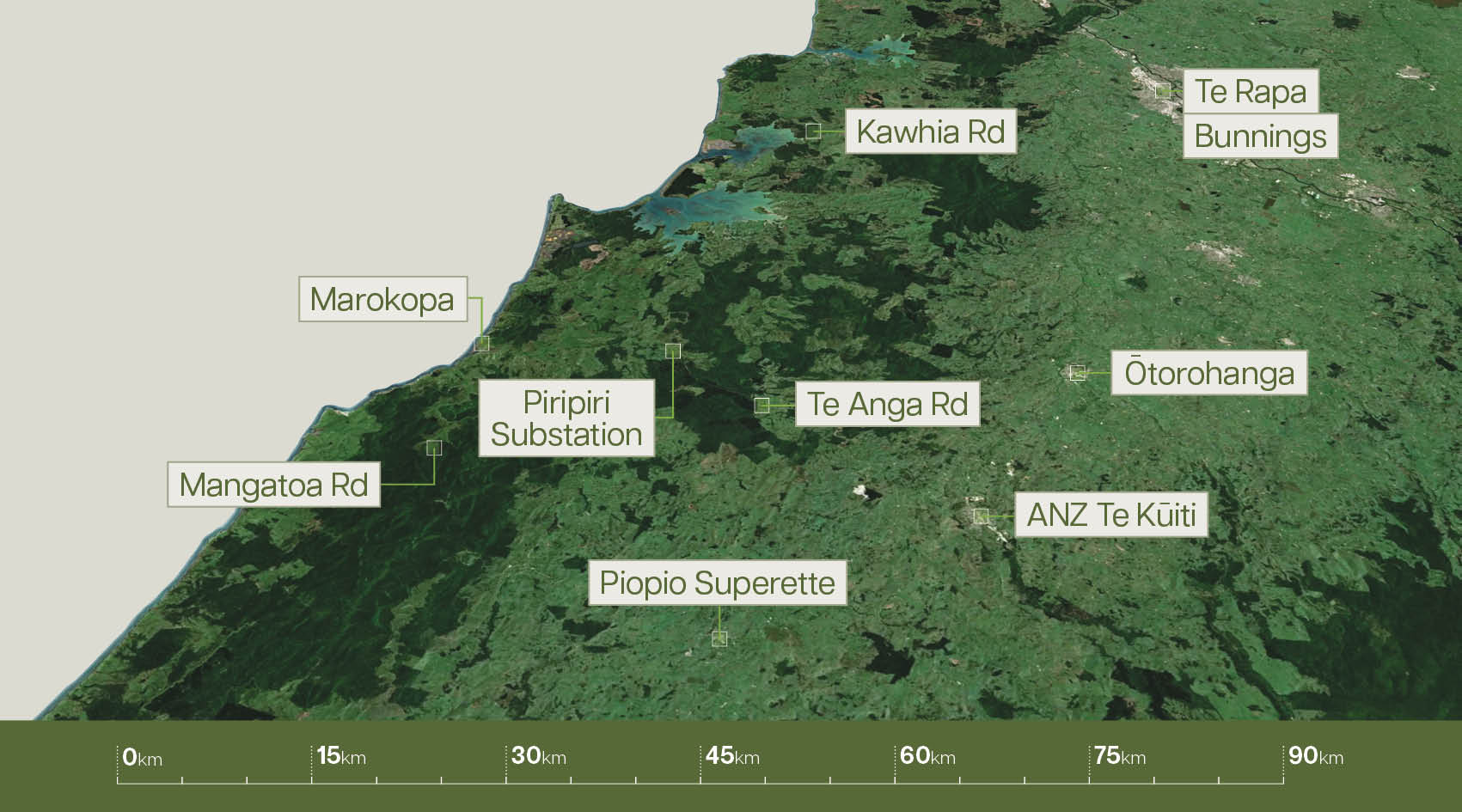
Source: NZ Police
Map: LINZ Basemaps. © Planet – New Zealand 10m Satellite Imagery (2024–2025) and GEBCO Gridded Bathymetry (2020)
380 Police told the Inquiry that approximately 1080 taskings, such as reported sightings of Tom Phillips or offending attributed to him (such as thefts and burglaries) were generated and followed up from December 2021 through to September 2025.
381 On multiple occasions, frustrated by the lack of progress, Police arranged for fresh eyes to critically review the investigation and identify other steps that might be taken. These regular reviews resulted in the CIB being given oversight of the investigation in May 2022, and then, from May 2023, the investigation being moved to the Major Crimes Unit at District Headquarters.
382 Police sought assistance from its own internal specialist groups. These included armed and tactical groups and technical operations. Police also looked for help externally. They engaged with NZDF, the Department of Conservation, as well as private providers of surveillance and search technologies.
383 Despite this, the investigation suffered, particularly in the first year or so, from a lack of resourcing.
384 It was also hampered by two prevailing views that prevented Police taking necessary actions sooner. First, the erroneous belief that the only available offence with which to charge Tom Phillips was a breach of a parenting order and, secondly, that there was “no starting point” from which to begin a search or an effort to narrow a search area. The Inquiry considers that both these views unnecessarily limited Police action in the search for Tom Phillips and the children.
385 To assist an understanding of how Operation Curly evolved over its three-plus year duration, it may conveniently be divided into four phases, starting with the first year.
April 2022 – April 2023: First year of Operation Curly, western Waikato-led investigation
386 In the first year of Operation Curly, the investigation remained largely with the local Public Safety Team, but – from May 2022 – under a lead from the Te Awamutu CIB. As set out in Chapter 4.1, Police deliberately utilised local staff, known and trusted within the Marokopa community, rather than officers from outside the district, to undertake area canvasses and to use the community’s “eyes and ears” to be vigilant and report any suspicious activity. This was not a straightforward exercise because, at least during the early stages of Operation Curly, there were some elements within the community who harboured a degree of sympathy towards Tom Phillips and what they understood was his stand against authority.
387 Police also carried out a more focussed investigation of leads. As the first year drew on they also looked at other options for investigation. They actively sought assistance both from within specialist arms of Police as well as externally from the likes of NZDF. However, as identified later in this chapter, the investigation was hampered by being primarily reactive, that is focusing on responding to leads. Operation Curly ran alongside other Public Safety Team roles undertaken by local front-line officers. It lacked investigative expertise through more dedicated CIB involvement. This led to lines of inquiry being initiated but not properly followed through. That state of affairs was influenced by Police continuing to hold the erroneous view that Tom Phillips was not committing any criminal offence. This unnecessarily limited their tactical options.
A stalled investigation and the approach of winter
388 When Operation Curly began in April 2022, it remained with the Public Safety Team at Ōtorohanga. Over late April and early May, Police:
a. obtained a legal opinion on applicable offences,
b. took a formal statement from Ms Smith. Ms Smith provided details of the breaches of parenting orders that resulted from Tom Phillips taking the children, as well as providing information about her past relationship with Tom Phillips, and concerns about his safety relative to the children and safety with firearms,55
c. searched Tom Phillips’ cabin on the family farm and visited neighbouring farms,
d. contacted potential associates of Tom Phillips and landowners to ask if they had any relevant knowledge, and followed up on other leads,56
e. delivered fliers to rural properties in the area, and handed them to motorists passing through a key local intersection,57
f. submitted information requests and production orders to banks and telecommunications providers to obtain information about Tom Phillips’ bank account and cell phone use,58 and
g. contacted the Ministry of Education, who informed Police that the Ministry had not had any contact with Tom Phillips for over six months.
389 None of these initiatives resulted in the receipt of information about the whereabouts of the children. The result of the production orders was also disappointing. There had been no activity on any of Tom Phillips’ known bank accounts or phones since prior to his disappearance.
390 In early May, the then Area Commander frankly acknowledged to his superiors that the investigation had stalled. In email correspondence to the District Commander and Assistant Commissioners, he confirmed:
....that all enquiries have been completed and have not yielded a result. Police hold no current intelligence that can be acted on or can enable a deployment of resources.
391 Police expressed increasing concern as the months passed and winter approached without any sightings of the children.
392 The Area Commander recognised that conventional Police operational strategies were not working. He changed tack. He began to explore other options to gather intelligence and broaden the range of tools available to the investigation. He appointed a highly experienced Detective Senior Sergeant from Te Awamutu CIB as day-to-day Officer in Charge from May 2022, to bring investigative expertise. The Officer in Charge continued to be supported by the Public Safety Team.59
393 On 12 May 2022, Police made the first public appeal on a Police Ten 7 episode, and engaged with media in the hope that it would generate leads for the investigation team.60
394 The Area Commander and District Commander also sought additional assistance from within and outside Police. This initiative was met with limited success. Examples follow.
a. They sought and obtained approval from the Assistant Commissioner for the involvement of the armed Special Tactics Group (STG). STG immediately began work with Operation Curly developing a “concept of operations”, which later led to deployments to search and clear specific locations.
b. They explored the possibility of assistance from NZDF with geosatellite imaging support, and aerial search capability that may provide a “boost to search efforts and enable us to pinpoint areas of interest that can be searched via land-based search teams”. The geosatellite image request was redirected to the Police Geospatial team. NZDF declined the request for search assistance on the basis that the air assets were unsuitable or unavailable, and the search area was too large. NZDF suggested that they may be able to assist if Police could identify a smaller search area.
395 The Area Commander and District Commander also sought Assistant Commissioner approval to offer a $5000 public reward for information, stating:
This is all about the children who are the victims in this and we want to create an incentive for people that know where they are to reach out to Police before we hit the cooler winter months which poses some risks to the family.
396 The District Commander added that:
[w]hat is also clear to the investigation team is that there are people in the know – they believe that these people might provide information if there was a financial incentive.
397 The new Officer in Charge submitted a formal request for approval of a $5000 – $10,000 reward the following month. However, this request was declined two months later. The Assistant Commissioner expressed concern about the risk of “creating a precedent and other people then engaging in similar behaviour”. At this time, Police did not consider that Tom Phillips’ actions amounted to serious offending, and so there was also a concern that if a reward was used to secure their return, there would be nothing stopping him taking the children again.
Two credible sightings in western Waikato
398 Following these efforts, in May there were two credible sightings reported, in Ōtorohanga and Te Kūiti.
399 First, on 10 May 2022, Tom Phillips was observed visiting a friend in Ōtorohanga. He was riding a DR 200 Suzuki motorcycle, painted black, with a flat rear tyre. He was seen exchanging cash for a small amount of petrol.61
400 The second report was made on 31 May 2022, although the sighting was just over a month earlier. A person who knew Tom Phillips well, reported seeing him outside the entrance of Te Kūiti’s New World supermarket sometime between 25 and 28 April 2022. Police assessed this sighting as credible.
401 These added to information reported in earlier months including the discovery of Tom Phillips’ abandoned vehicle, and his visit to his parents’ farm in February 2022.
402 By the end of May 2022, Police had identified the location of Tom Phillips’ vehicle, had three confirmed or credible sightings in or between Marokopa and Te Kūiti, and knowledge that Tom Phillips was using a motorbike to travel around. Alarmingly, there were no confirmed sightings of any of the children.
Dozens of reports from around the country, no solid leads
403 After the May sighting, there followed more than a year without any confirmed sightings of Tom Phillips or the children. There was, however, an increase in reports to Police of potential sightings. This followed Police’s public appeal and media engagement. Over the following year, Police received approximately 50 reports of possible sightings. About three quarters of these were from outside the Marokopa and Waikato area. They included sightings in Queenstown, Wānaka, Gisborne, Auckland, Tauranga, Taupō, Carterton, and Gloriavale on the West Coast of the South Island.
404 Ms Smith also consistently provided information, including information she had received from others.
405 A key component of the investigation during this period was following up on these reported sightings and information provided by family members or locals. Police followed several different lines of inquiry including:
a. requesting information from a social media provider,
b. checking Interislander ferry bookings,
c. undertaking an enquiry with Gloriavale,
d. utilising production orders and information requests to monitor Tom Phillips’ bank accounts, Q card account and Trade Me accounts,62
e. obtaining a production order to obtain phone data information in relation to the friend Tom Phillips visited in May,
f. looking closely at some of Tom Phillips’ associates, including site visits, aerial flyovers, enquiries with their neighbours and interviews, and
g. requesting assistance from Police’s Technical Operations Group (TOG) regarding the use of surveillance or covert cameras around areas including the family farm, and areas known to be linked to Tom Phillips’ friend (see further at Chapter 4.6).
406 Police also investigated and searched specific locations where they believed Tom Phillips and the children could be sheltering. These were mostly in the western Waikato area, but included the Bay of Plenty as well as the east coast.
a. Police made enquiries with various locals including members of Te Kūiti’s Search and Rescue group and the Department of Conservation in relation to possible caves in Taumatotara East Block.
b. In May 2022, Police made enquiries in relation to the Te Raumauku cave, which they determined was not suitable for human habitation.
c. On 26 July 2022, armed Police (STG) were deployed to search farmland structures in Taumatotara East Road, Te Anga.63
d. Police searched properties of two associates, and another location.
e. Police undertook four aerial searches covering locations in the area, including the family farm, Taumatotara Scenic Reserve, Pomarangi, Te Anga and Ōtorohanga, as well as a location of interest in the Bay of Plenty.
f. Police also sought geosatellite imaging support, from the Police Geospatial team. However, this was of limited assistance due to the quality and availability of imaging in the Te Anga area.
407 None of these enquiries produced anything to help locate Tom Phillips and the children.
October 2022: survivability report – unlikely that Tom Phillips was self-supported in Marokopa bush
408 In October 2022, Police sought assistance from a NZDF survivability expert.
409 The expert opinion stated that it would not be sustainable for “even the most experienced of persons” to be unsupported in the bush for this amount of time. The expert referred to the mouldy gear from the first disappearance in September 2021 and stated that it would be “really hard to live off the land in those conditions especially with children”. Their view was it was more likely Tom Phillips and the children were staying somewhere with good shelter, supplies and support. Further, it was considered unlikely that Tom Phillips had remained in the same Marokopa bush area given the high Police attention in the area.
410 The expert suggested two steps for the Police to consider. First, offering reassurance to Tom Phillips that he would not lose access to the children if he returned and combining this with an offer of a visit to the doctor to confirm the children’s health, and secondly, offering a monetary reward for information.64
Further consideration of a reward for information
411 In January 2023, thirteen months into the second disappearance, the Police Commissioner made a request for the investigation team to reconsider the possibility of offering a reward.
412 The investigation team duly submitted another application for approval by the Assistant Commissioner.
413 Shortly after this, on 7 February 2023, an Assistant Commissioner repeated the concern around creating a precedent. This was influenced by the Police view that Tom Phillips was guilty only of minor offending. The Assistant Commissioner also noted that there was no mention of any concerns from Oranga Tamariki as to the welfare of the children:
“Currently the only offence committed by Mr Phillips is breach of a parenting order and failing to appear on charges relating to wasting Police time post their initial disappearance. It is the lack of a serious offence that is causing concern and could potentially create an unruly precedent. This is also an investigative hindrance in terms of specialist investigative capability. To date the Reward is not supported by either [the District Commander] or [the Assistant Commissioner].
There are still some enquiries to be completed by the team utilising NZDF.
In the considerations for the Reward, I note the absence of Oranga Tamariki and their views as to the children’s welfare. This may be in the [Investigation Management Tool] IMT file but is silent in the review considerations.
At this stage I agree with the decision in regard to the breach of a parenting order however if a Place of Safety warrant or OT has specific concerns then these may need to be factored into the considerations.
Can I ask that you loop this back to the Commissioner once we know the answer to the OT question.”
414 The Inquiry has seen no evidence that this was put to Oranga Tamariki. No reward was offered.
Some lines of inquiry were not pursued in a timely way
415 Across this period, senior Area, District and National members of Police maintained an interest in the progress of the investigation. Through the Officer in Charge and Area and District Commanders, requests were made for assistance from specialist Police units and NZDF. However, the Inquiry notes something of a pattern of these not being followed through in a timely way. Examples follow.
a. When, in May 2022, NZDF told the investigation team they would need a narrower search area, it took the team until December 2022 (that is seven months) to provide one. Furthermore, what they did provide was centred on the abandoned vehicle, which they had known about since January 2022 Chapter 5.2;
b. After the investigation team approached the Technical Operations Group (TOG) for assistance with the use of covert cameras, the TOG team recommended a proposed location. This was followed up by TOG in July, August and again in September 2022. The Inquiry is unaware of any response from the investigation team.
c. In October 2022, the team began engaging with the Police’s Behavioural Science Unit to develop a profile for Tom Phillips with input from a Police psychologist. However, this initiative does not seem to have been pursued.65
d. A number of reported sightings by the public were not followed through to completion: a review in March 2023 found that of 13 reported sightings, only three had been completed and closed.
416 It seems likely that these failings were, at least in part, driven by resourcing limitations. The Officer in Charge at the relevant time told the Inquiry he requested more staff to assist him to conduct enquiries, but was declined.
417 The children’s mother and older siblings took their own action to try and find the children. They made appeals in the media for members of the public to come forward with information. In June 2022, they organised a public search. This was abandoned on the advice of Police that it might expose people to danger. The children’s sister, Anna, told the Inquiry that the Area Commander met with them to explain Police concerns: that Tom Phillips was likely armed, and that Police believed he was dangerous. Tom Phillips’ sister also told the Inquiry she offered to different officers, on multiple occasions, to go in and look for or assist with the search for her brother and the children. She said that on at least one occasion the then Officer in Charge told her she could not because of potential danger.
418 In September 2022, the children’s sisters began a Givealittle page to fundraise for a reward. They raised just under $5,000. In December 2022 they made a public offer for a $10,000 reward for information via a Facebook post, with Jane taking out a personal loan to meet the difference. This was a significant amount for Jane, who was then working as an apprentice.66
Internal reviews of investigation
419 Police were also frustrated that the investigation was not making any progress. In October 2022, the Area Commander arranged for a senior and experienced CIB officer from outside the investigation team to review the investigation to date. He also convened a meeting between that officer, members of investigation team, and an Assistant Commissioner, to discuss additional steps that might be taken.67
420 Then, in March 2023, the Area Commander asked a Detective Sergeant from District Headquarters in Hamilton who had not previously been involved with the investigation, to undertake a more thorough review of the file, which for the purposes of this report we refer to as the March 2023 Review.
421 The Detective Sergeant was a highly experienced and senior CIB officer well qualified to undertake that role. He carried out a comprehensive and detailed review of the file. His report appears to have been the first comprehensive piece of work to include information gathered in the Operation Marokopa phase, including statements taken from Tom Phillips and his family on his return in September 2021.
422 The March 2023 review noted that the investigation had effectively stalled, relying as it had been, on new sightings reported to Police or information provided, largely by the children’s mother. It noted there were reputational issues for Police through the investigation not advancing in the way the public believed it should. It identified that the investigation had been hampered by being carried out largely by uniform staff, with no single person having the necessary “ownership”. Relevant information was also being split over different locations within various Police databases. Many of the reported sightings had not been fully closed.
423 The review also identified leads that could be followed up from information already gathered and investigative steps that could be taken. By way of example, these included questioning other friends of Tom Phillips, investigating additional phones and phone numbers that Tom Phillips had been known to use, trawling through Trade Me and other accounts, examining other potential sources of finance or cards that Tom Phillips had previously had access to. The review also recommended that those sorts of enquiries should be extended to people who might have been assisting Tom Phillips. It noted that there had been no search undertaken of either the area off Mangatoa Road where Tom Phillips’ ute had been located in January, or investigation done to identify the area where he had set up camp during the first disappearance in September 2021.
424 Significantly, the review re-examined whether there might have been more serious criminal offences committed by Tom Phillips. If so, this could open up the possibility of the investigation team having access to a suite of sophisticated electronic surveillance techniques, which had not been deployed earlier because it was believed the statutory threshold for such applications had not been reached. The review posited that Tom Phillips had potentially committed the offence of attempting to defeat the course of justice, on the basis that he took the children with the intention of interfering with Family Court proceedings. The factual foundation for proving that charge lay, at least in part, in the statements Tom Phillips made when he returned from the first disappearance.68
425 The March 2023 review also emphasised the importance of building a profile of Tom Phillips, based on information gathered during Operation Marokopa, as well as potentially new information that could be gathered from family and friends. This profile would be of assistance in predicting his future behaviours. The review noted the potential for Tom Phillips’ mental health to have further declined during the disappearance, potentially adding to the risk posed to the children:
Regardless of whether …the family is safe and healthy and now living somewhere under a hard shelter or in a dwelling, Thomas Phillips’ current mental health is cause for concern.
Thomas will undoubtedly be feeling the immense pressures associated with living a remote and reclusive existence, coupled with the disquietude associated with being in constant hypervigilant state, always in fear of being discovered. His mental health is surely impacted living such a lifestyle. Long term, I am uncertain what these pressures may have on Thomas Phillips and most importantly how they might impact on his children.
426 It also noted a concern for the children and concluded with a recommendation that Police commit greater resources to finding them, including through increasing the full-time staffing allocated to the investigation. On that topic the review insightfully recorded the following:
The children are young and vulnerable due to their ages. Some of the information obtained about Thomas Phillips reveals he is an alcoholic. Taking the children in order to hide them from their mother is not in the best interests of the children. As time passes without any sighting of the children, concern for their welfare mounts. In my view Police are obligated to commit more resource to finding the children, hopefully safe and well….
The paramount consideration is the safety and welfare of the missing children. In order to finalise this investigation and to achieve the safe return of the children it will be necessary to commit the resources needed to locate them.
May 2023 – April 2024: The second year of Operation Curly, District Headquarters
Summary of the second year
427 Into its second year, the stewardship of Operation Curly was moved to District Headquarters and resourced with several CIB staff. Later in the year, there was a significant change in momentum when Tom Phillips was sighted shopping in Hamilton and later identified as the offender in the armed robbery of the ANZ at Te Kūiti [as described in Chapter 4.4]. The latter of these events was indisputable criminal behaviour, which led to a major shift in the way Tom Phillips was perceived by Police and potentially the public. If there had been a view in some quarters that he was some kind of misguided, but sincere, anti-establishment figure, this changed when he showed he was prepared to use firearms to rob the bank.
428 This also opened up investigative options such as covert surveillance under the judicial authorisation of a surveillance device warrant. The shopping activity also led to additional relevant information about Tom Phillips’ location, including information confirming Tom Phillips was in the area, and that he had a vehicle belonging to a friend, and that based on the supplies he purchased, he appeared to be camping with the children. There followed a concerted effort to follow and progressively clear areas of interest. However, when these were unsuccessful, the investigation team downsized. The investigation stalled again. Police went back to the drawing board.
May 2023: transfer to District Headquarters, increased staffing
429 In response to the March 2023 review, at the end of May 2023 the investigation was transferred to the Waikato Major Crimes Team at District Headquarters in Hamilton. The Detective Sergeant who carried out the March 2023 review was appointed to lead the day-to-day running of the investigation, with oversight from the then Acting Field Crime Manager. Five additional CIB investigators were assigned to the investigation, none of whom had been involved previously.
Intelligence gathering in July 2023
430 The new investigation team set out to build and maintain relationships with Tom Phillips’ family and friends, particularly his parents, to ensure that communication channels were open if they received any information about Tom Phillips or the children.
431 In July and August 2023, detectives from the new investigation team went out to the Phillips family farm to introduce themselves. They met with Tom Phillips’ parents. They spoke to them about what they knew. They also visited other family members and friends to discuss concerns Police had for the welfare of the children. Police also applied for production orders to obtain information about phone usage and bank accounts relating to friends and family members.
432 During their visits with Tom Phillips’ parents, the team discussed his visit to the family home in February 2022. His father disclosed that during that visit Tom had warned that the Police would not take him alive.
433 The Officer in Charge at the time told the Inquiry that this information materially changed the Police assessment of the risk Tom Phillips posed. It also materially informed what actions were available to them. From that point on, Police undertook no searches without Armed Offenders Squad or Special Tactics Group involvement.69
Five more months with no confirmed sightings
434 Between March 2023 and the end of July 2023, there were only a handful of reported sightings of Tom Phillips or the children. In May, a member of the public reported seeing the children fishing with their father at a bay near Te Maika Peninsula sometime in February, but this was unable to be confirmed. On 19 June 2023, Ms Smith provided Police with information from an anonymous source. The source said they had observed a small-engined motorcycle coming and going from a house between Te Anga and Marokopa. Police followed up on this information. They were unable to establish any links to Tom Phillips. There was also a sighting of Tom Phillips and all three children at Te Anga Road. This is detailed separately in Chapter 4.3.
435 In July there were two further reports of sightings in Blenheim and Tauranga. Neither resulted in any positive leads.
436 By the end of July, the best part of 15 months had passed since Tom Phillips had been sighted, and there had been no confirmed sightings of the children in the almost 20 months since their disappearance.
August 2023: Confirmed sightings and a clear escalation in risk
437 Then, in August, there were significant developments. On 1 August 2023, Tom Phillips was captured on CCTV footage at the family farm, carrying a firearm. The next day he was seen at Bunnings in Hamilton, following which he was seen in a ute travelling on Kawhia Road. Police put these sightings together and traced the evidence of purchases he made at locations in Te Awamutu and Hamilton. That body of evidence led Police to identify Tom Phillips as the offender in the ANZ at Te Kūiti armed robbery several months earlier. These events are set out in more detail in Chapter 4.4.
438 By mid-August, then, Operation Curly had significant new information.
a. Tom Phillips was confirmed to be still in the area, and likely staying somewhere in the general Marokopa area, near the family farm. He was seen at the farm on 1 August (on CCTV), and the ute he stole for the shopping trip was later found abandoned not far from the farm.
b. He was likely camping. The equipment he had bought was consistent with someone living in a camp. The relevant purchases included seedlings, water storage containers, and head torches.
c. It was likely the children were alive and with him. Again, the purchases on 2 August 2023 provided the information. These included children’s clothes, games, and exercise books and stationery.
d. He had access to firearms and was willing to use arms against others. The bank robbery proved this.
e. He had access to at least three all-terrain vehicles, being a black Suzuki DR200 Trojan motorbike, a Honda XR200 trail bike, and a TRX500 quad bike.
f. He was resorting to theft and robbery to get supplies. This suggested he was not, at this time, being supported by others.
439 Police also had clear evidence of serious criminal offending. This was significant for two reasons: it elevated the risk he posed to the public and to the children, and it could support applications for surveillance device warrants (as discussed in Chapter 4.6).
A surge in activity
440 Following the August 2023 sightings, there was a renewed surge of activity in the investigation. This coincided with the then Acting Field Crime Manager for Waikato returning from leave and taking over as Officer in Charge of the investigation.
441 Police gave a media statement immediately after the sighting of Tom Phillips at Bunnings. They called for information from the public and released images of the vehicles Tom Phillips was now known to have. This tactic resulted in an uptick of reported sightings from around the country. Over the following six months, Police received almost 90 reports of sightings. About a third were from locations outside the Marokopa / Waikato area. Others were from areas already associated with Tom Phillips. This included the discovery of a campsite with children’s clothing on Mangatoa Road, which has since been confirmed as a site used by Tom Phillips and the children.
442 Despite reports from around the country, Police did not suspend their focus on the Marokopa area, or on known associates of Tom Phillips.
443 Police applied for and were granted surveillance device warrants to utilise tracking devices and visual surveillance Chapter 4.6. They also obtained information from cellular phone towers situated on the route known to have been taken by Tom Phillips on 2 August. The data analysis was directed at trying to identify whether a cellular phone could be attributed to Tom Phillips. It was unsuccessful.
444 In August and September 2023, Police visited 193 addresses on roads mostly around the Marokopa area.70 The following month Police posted flyers to a total of 251 addresses on roads near locations of interest around Te Waitere Peninsula, Kawhia Harbour, and Ōtorohanga.
445 In November 2023, Tom Phillips was designated a “Staff Safety Person of Interest”, recognising that he presented a significant risk to Police staff. The practical effect of this designation was that any planned search from this point on was required to be carried out by the Special Tactics Group (STG).71
446 With the help of the Police AOS and STG, Police searched around 10 locations on farmland, in huts and caves in the region, including both ground searches and aerial searches.
a. In early August, Police searched a campsite near Honikiwi72 and a hut in Marokopa.73
b. Police also searched a campsite at Mangatoa, and found children’s clothing and toys, and recently abandoned food.
c. On 9 and 10 August, Police searched the Puaroa cave system located on Department of Conservation land, which had been identified as a location of interest due to its proximity to other events and locations of interest. Police had received advice from a caving expert that it was suitable for habitation. NZDF provided STG with geospatial intelligence support in preparation. There was no information to suggest it was being used by Tom Phillips and the children to live in. The search was to investigate whether it was being used to store equipment.
d. On 11 August 2023, a police officer accompanied a civilian pilot on a flight from Te Kūiti. This covered locations of interest including cave systems, remote huts, the family farm, an address of interest on the Te Waitere Peninsula, Tawarau Forest and Pomarangi Forest.
e. Between 17 and 18 August 2023, Police searched the southern and eastern boundaries of the Phillips farm.
f. Between 27 and 28 September 2023, Police searched a single cave on Department of Conservation land near Marokopa. A drone was utilised to assist with the search.
g. On 19 October 2023, the Eagle helicopter undertook a flight over remote parts of the Kawhia Harbour, including Te Waitere and Te Maika peninsulas, in response to information provided to Police on 8 August 2023 and an analysis of items purchased during the shopping trip. Two boats were also deployed with AOS support. Tents, an outside bath and dingy were observed.
h. Following the aerial search, between 30 October and 1 November 2023, Police made covert observations of a make-shift campsite on the Kawhia Harbour.
i. Between 23 and 24 January 2024, Police searched the Pomarangai Track including two Department of Conservation huts.
j. On 25 January 2024, Police searched another campsite near Ōtorohanga.
k. During the same period, the investigation team executed search warrants at the Phillips family farm to search outbuildings and cabins. And later, in February 2024, Police executed search warrants at the addresses of various known associates of Tom Phillips. The primary purpose was to seize electronic devices for analysis.
l. In January 2024, Police also installed cameras at key road intersections leading into Marokopa.
447 Despite the breadth of these searches, nothing of evidential value was obtained. Nor was any useful material to identify the location of Tom Phillips obtained from the various surveillance technologies deployed.
November and December 2023: burglaries and activity in Marokopa and Piopio
448 In November and December 2023, there were two further confirmed or likely sightings that showed Tom Phillips was active in the Marokopa and Piopio areas.
449 On 2 November 2023, a quad bike was stolen from an open shed on a property on Marokopa Road. The same night, at 2.21 am, Tom Phillips attempted to burgle the Piopio Superette. He arrived and left on a quad bike.
450 On 2 November, at 7.00 am, the quad bike owners reported the burglary to Police. Police attended the superette later that morning. They viewed the CCTV footage and identified Tom Phillips. They also contacted neighbours for any potential observations or further footage. A possible link between the stolen quad bike and the quad bike used in the attempted burglary was investigated at the same time. AOS staff were deployed that night to undertake covert observations in Piopio and Te Kūiti in case Tom Phillips returned.
451 On 23 December 2023, at approximately 2.00 am, a member of the public reported seeing Tom Phillips and a child fishing off a bridge over the Mōkau River, Piopio. Police were informed of the sighting via a third party on the evening of 26 December 2023. Police responded the following morning. They located the witness and recorded his account. They conducted a scene visit and attempted to access footage from the witness’s work vehicle and CCTV footage from a local camera. Neither was available. Police recorded it as a likely sighting.
Team downsized
452 On 13 November 2023, with no new leads and the investigation seemingly going nowhere, the core investigation team staffing was scaled back to just three. The Officer in Charge of the investigation told the Inquiry that he recommended reducing the size of the team because he was “conscious of other things going on in the District... There are other jobs you want them doing.” Area CIB Managers were advised that any new information coming in, or enquiries to be completed, would be left with the relevant Area lead for assigning out. The ongoing deployment of STG and AOS assistance was to be only when there was “solid evidence”.
May 2024 – April 2025: The third year of Operation Curly, a reward offer and a sighting of the children
Summary of the third year
453 With the electronic surveillance phase producing nothing of any real use or value to the investigation, and with locations of interest successively cleared, the Operation Curly team went back to the drawing board. Amongst other operational initiatives, they explored the possibility of seeking assistance from NZDF, this time in relation to tracking capabilities, and reconsidered options previously declined or abandoned, such as a public reward.
Reward phase and Operation Sella
454 In April 2024, planning began for a proactive multifaceted operation designed to draw out any information from the community or family as to the location of the Phillips children. The outcome of this logistical and investigative reorientation was the roll out of a large, overt initiative codenamed Operation Sella.
455 Operation Sella began on 10 June 2024 with a covert phase involving intercepted communications and surveillance of key locations. At the same time and in parallel with the overt phase, Police announced an $80,000 public reward for information leading to the location and safe return of the children.74 This was accompanied by a media phase designed to generate information about Tom Phillips and the children.
456 The reward remained in place until 25 June.
457 Police also deployed members of the Armed Offenders Squad, Special Tactics Group, the Police Eagle Helicopter team and investigation team to the Marokopa area, as well as involvement from the SAS. High visibility checkpoints were set up at all main roads in and out of Marokopa for 72 hours, after which a smaller team, consisting of uniform and investigative staff, remained in the area until 24 June 2024. Due to the remoteness of the area and the unreliability of local telecommunications, assistance was sought to enhance communication between sites.
458 Police informed the Inquiry that approximately 160 tasks were generated in relation to the June 2024 reward phase/Operation Sella. These included actions arising from reported sightings of Tom Phillips or burglaries attributed to him. The investigation team worked to follow up each of these tasks.
459 On 21 September 2024, Police undertook a fixed wing flyover over multiple locations of interest, including those identified as such from information received during the reward phase. These included remote huts, and locations identified in satellite imagery obtained.
October 2024 – April 2025: a sighting of Tom Phillips and the children
460 Then, at approximately 7.00 pm on 3 October 2024, there was a confirmed sighting by pig hunters of Tom Phillips and the three children walking across farmland above the Marokopa Valley, approximately three kilometres from the Phillips family farm. Each was carrying a large backpack. Tom Phillips was carrying a rifle. The sighting was an event described by several close to the investigation as “a game changer”. And indeed, it was.
461 Discussed in more detail in Chapter 4.5, this verified sighting proved two things; first the children were all alive and secondly, they were still in the Marokopa area.
462 The hunters took photos and videos of the family, and sent them to Police.
463 The sighting sparked a coordinated and carefully planned effort to locate the group and recover the children in a way that did not expose the children or others to unnecessary danger or put them in harm’s way.
464 The investigation team, STG, and NZSAS were deployed to Marokopa immediately to try and track the group. Despite the swiftness of their response, it ultimately proved unsuccessful.
465 But Police now knew that the group was somewhere in the general vicinity. Armed with that knowledge, Police and NZDF developed a comprehensive strategy using trail cameras and road cameras to narrow down the area the group was operating in. These cameras picked up three further sightings of the group over the next six months. This is set out in Chapter 4.5 (October 2024 sighting).
466 In conjunction with the trail cameras, Police implemented an “investigative phase”. During this phase, they:
a. canvassed houses in Marokopa and Ōtorohanga in November 2024 and March 2025, respectively,
b. made further inquiries with Marokopa residents in late October and early November 2024,
c. installed covert surveillance cameras at selected locations in late November 2024,
d. applied for production orders to obtain telecommunications data for cell phones belonging to associates of Tom Phillips in February 2025,
e. forensically analysed banking records for certain persons of interests, to identify potential support being provided to Tom Phillips,
f. met with one family member in March 2025, and conducted a flyover of the area of a different family member’s home with an Eagle helicopter to obtain updated photos,
g. consulted with Police’s Behavioural Science Unit regarding the profiling of potential persons providing assistance to Tom Phillips,75 and
h. intercepted radio transmissions around the Phillips family farm.76
467 The Police’s Undercover Programme also offered assistance to the investigation. This offer was declined for logistical reasons. Successfully operating undercover officers in relation to the limited number of persons of interest in such a small, remote and close-knit community was assessed as next to impossible.
April 2025 – Police use the FlexRotor drone
468 Between late October 2024 and early April 2025, Police had had four sightings of the group within a reasonably defined area. Police then deployed a privately owned and operated drone, fitted with a thermal camera, over the area for a period of two weeks.
469 Although the capability of the drone did not meet its expectations, its use did result in a further three possible sightings of Tom Phillips and the children. This had the effect of further narrowing the location of interest.
April to September 2025, five more months
Summary of the final five months
470 While the use of cameras and the drone was successful in narrowing the location of the group and gathering intelligence about their habits, Police were becoming increasingly concerned about what might happen if they were involved in a violent confrontation with Tom Phillips. Their greatest anxiety centred around avoiding any risk of harm to the children, Police or the public. They had sufficient information about Tom Phillips to believe that if confronted he was likely to resort to armed violence. Police considered that the best course was to identify an opportunity to safely intercept Tom Phillips while he was away from the children. Police continued to attempt to gather information to identify such an opportunity. But meanwhile, for the children, it was a further five months of winter in the bush.
471 We now know that the drone activity caused the group to move from their relatively stable and well-set up camp to a different location. The new location, from where the children were ultimately recovered, was darker, wetter, and with fewer food sources. It seems probable that the pressures of subsisting in this new environment likely led to Tom Phillips committing more burglaries, and ultimately, being intercepted by Police on 8 September 2025.
Narrowed focus, and reduction in team
<472 On 26 April 2025, while STG and NZDF personnel were still deployed and tracking Tom Phillips and the children, the investigation team began to consider their next steps.
473 The Officer in Charge determined that the FlexRotor sightings had made it “clear that we are in the right area in terms of our Area of Operation”. He recommended that “[t]his should be our focus and we need to look at how we can clear this area and when the likelihood of that will occur”. He advised the District Manager of Criminal Investigations that, with this focus, “I believe we can reduce the team and allow [the Major Crimes Team, which had responsibility for the investigation] to operate in a smaller capacity which will assist the district”.
474 The concept was approved, in principle, by the then District Manager of Criminal Investigations, and then implemented by a new District Manager of Criminal Investigations the following month. The key tasks for the investigation team were the installation of new trail cameras, and the repositioning of some existing trail cameras; the review of live-feed cameras; potential installation of another camera; and the ongoing interception and monitoring of radio communications. Other information would be “assessed and tasked in IMT” and “[a]ll taskings not related to our area of interest will be placed on hold”.77
475 By June 2025, the investigation team had been reduced to the Officer in Charge, second in command, and three detectives, as planned. It was apparent that this resource was insufficient. In a report to the District Manager of Criminal Investigations on 26 June 2025, the Officer in Charge noted that there were “[c]urrently 2 x vacancies with investigation team” and that the monitoring and review of cameras and radio transmissions “require[d] immediate replacement of staff that have been returned to [business as usual] duties”.
476 The investigation team continued work on reviewing and repositioning cameras. The Officer in Charge was also “awaiting a report from [STG] regarding the feasibility of searching the area of interest” but “[e]arly indications are that this is not possible”.
Consideration of other technologies
477 During this period Police also explored the possibility of contracting a New Zealand-based company which analyses satellite and geospatial imagery. In 2025,78 the company made a proposal to Police for the use of hyperspectral surveying/imaging — a technology that captures imagery across electromagnetic spectrum bands to identify objects. That proposal was vetted by Police and NZDF geospatial personnel, who confirmed that the proposal was viable, but would require significant data processing and management. Police told the Inquiry they decided not to proceed with the company’s proposal, because it would be resource intensive and other investigative strategies – thought more likely to be effective – were being prioritised. The use of hyperspectral surveying was still regarded as a potential future option.
The documentary
478 Sometime around late 2024, Police entered into an agreement with a production company for the making of a documentary, to be released on Netflix, on the search for Tom Phillips and the children.
479 The decision to involve the documentary is outside the scope of this Inquiry, except to the extent it may have had some impact on the steps Police took to find and recover the children.79
480 It is not unusual for Police to participate in documentaries. But the Inquiry was surprised that Police invited a documentary crew to document an investigation that not only heavily relied on sensitive operational technologies and specialist personnel from Police and NZDF, but also involved children whose privacy and welfare was at stake.
481 Officers the Inquiry spoke to acknowledged that the presence of documentary cameras likely did have an effect on the way the investigation was conducted: both a chilling or limiting effect on the openness of Police internal communications, and a logistical impact with covert or sensitive Police resources having to be deployed away from documentary cameras. While registering its concern, the Inquiry accepts the evidence of all officers it spoke to on the topic, that the documentary did not have an impact on the outcome of the investigation.
482 Of more concern is the potential impact on the children.80 There is an inherent risk of publication or sensitive information relating to this investigation interfering with the privacy and welfare of the Phillips children.
Renewed focus on electronic surveillance of persons of interest
483 In June 2025, Police renewed their efforts into electronic surveillance;81 this time mostly of persons of interest who they suspected might be helping Tom Phillips or know of his whereabouts.
484 On 28 July 2025, a significant meeting was held between members of the investigation team, Police district management, Technical Operations Group (TOG) and STG to discuss the next stage of Operation Curly.
485 The minutes of that meeting record that “[t]he current focus is identifying PHILLIPS’ resupply location to support STG in safely rescuing the children and arresting PHILLIPS”. It was agreed by the attendees that, given the risks associated with STG encountering Tom Phillips during a covert search, “the electronic surveillance phase targeting [associates of Tom Phillips] should be initiated or completed prior to any STG deployment”. It was further agreed that the investigation team would submit a formal request to the TOG for listening and tracking devices, and progress the planning and installation of an additional road camera as planned.
August 2025: More signs of activity in Marokopa and Piopio
486 Separate to the investigation’s focus on surveillance, several burglaries attributed to Tom Phillips were reported to Police. These included the theft of a water tank and other items stolen from the Phillips family farm which were reported by a family member on 4 and 5 August 2025, respectively.
487 And, on 27 August 2025, the Piopio Superette was burgled by a person believed to be Tom Phillips, who again arrived on a quad bike. Tom Phillips was seen on CCTV wearing camouflage clothing and a face mask. The Inquiry was told that a local Police constable tracked the quadbike to Te Anga Road, and saw what he believed were fresh tracks entering the Tawarau Forest via a forestry road. Two additional trail cameras were then installed on that forestry road on 3 September 2025.
Events on 8 September 2025
488 In the early hours of 8 September 2025, Tom Phillips committed another burglary in Piopio. He was seen by a member of the public who notified Police. Police were dispatched. They encountered Tom Phillips and one of the children in the Te Anga Road area. Road spikes were deployed. Tom Phillips drove the quad bike over the spikes and, it seems, lost control and left the road.
489 He was armed. He shot at, and critically injured, the first police officer to arrive at the scene. Another police officer, who arrived just seconds later, shot and fatally wounded Tom Phillips. The child was unharmed.
490 These events confirmed Police’s assessment of the significant danger and risk to life posed by Tom Phillips. The Police’s actions, especially those of the officer who was the first to arrive at the scene and who was seriously injured in the line of duty, deserve commendation. Their actions were courageous. It does not take much imagination to think of how a very much worse outcome was averted by their professionalism and bravery. At significant personal cost they brought to an end the nearly four-year ordeal.
491 It was not long before media reported a “major Police operation” linked to Tom Phillips. A senior Oranga Tamariki staff member, responsible for the Oranga Tamariki recovery response of the children, who saw the media reports, contacted the Officer in Charge. He confirmed that Police had safely recovered one of the Phillips children and the others were yet to be located.
492 Police believed that firearms remained at the camp where the two other children had been left. STG was therefore deployed. Their task was to locate and recover the children, with the assistance of the Police Negotiating Team and members of the investigation.
493 Armed police officers entered the bush at approximately 1.45 pm. They located the remaining children several hours later. Over an hour or so, STG officers skilfully and peacefully persuaded the children to accompany them out of the bush.
494 The Inquiry considers that those officers also acted with great courage and professionalism. This was a very difficult and fraught situation. They rightly deserve commendation.
495 The successful recovery of all three children was a huge source of relief to the entire Operation Curly team and to the very many officers who participated and contributed to the successful outcome over the four years this Inquiry has examined.
Findings
Police applied extensive resource and investigative skill to the task of trying to locate the children over the course of an almost four-year investigation
496 The disappearance of the children was not a typical Police investigation. Police investigate crime. They use a variety of forensic tools to do so. Ordinarily, their task is reasonably constrained; assembling evidence in support of proof. But here the challenge was completely different. Although crimes were committed, the focus was not on the apprehension of a criminal or the marshalling of evidence to prove a crime. The focus was on the safe recovery of three missing children who, through the actions of their father, were being denied the basic necessities every child is entitled to including access to their families (both maternal and paternal), and to education, healthcare, shelter and regular food. Searching for a person who does not want to be found in the vast and impenetrable bush of the western Waikato is not a core role for Police. Then add to those complexities that Tom Phillips was known to be armed and likely dangerous. What Police were faced with was unique. And yet despite the novelty of all of this, there can be no real argument that Police were the best qualified agency to lead this investigation. No other organisation has the necessary command and control structures as well as access to the range of technologies, specialist staff and expertise this investigation demanded.
497 Across the span of this investigation, Police deployed a wide range of investigative methods, techniques and technologies. In doing so, they expended very considerable resources, both in time and money. And they largely did so skilfully and conscientiously.
498 Indeed, across the almost four year investigation, the Inquiry considers that Police adopted all the necessary types of investigative steps that could reasonably have been expected, to generate leads and sightings of Tom Phillips and the children. They carried out extensive area canvassing, made public appeals in the media, offered a reward, identified and cleared numerous locations of interest, examined maps and satellite images, and carried out aerial searches and conducted electronic surveillance.
499 Police also recognised that other agencies and private companies may have capabilities they did not and reached out for assistance. With the assistance of others, including NZDF, Police conducted targeted surveillance of their search area via cameras and a drone.
500 The Inquiry was impressed at the dedication and care that every officer the Inquiry interviewed demonstrated. This included those directly involved on the ground to those in higher command. When the investigation was not getting results, Police were open and receptive to reconsideration. They carried out robust reviews to ensure there was periodic fresh thinking injected into the process.
501 It wasn’t always easy for the public, or any of the children’s family, to see or understand what was being done. However, the Inquiry has had the single benefit of examining a significant range of Police documents and speaking to more than a dozen officers linked to the operation. The Inquiry has no doubt that the officers involved were committed to locating Tom Phillips and the children and were deeply concerned about their welfare in the bush. They persisted diligently, in the face of major difficulties and complexities arising from the nature of the investigation, that is finding someone who was determined to stay hidden in an inhospitable and dense environment. To their considerable credit, a number of senior officers gave their direct contact details to the children’s mother and other family members to enable ongoing and timely communication. Those higher in the command structure were directly involved in significant decisions and took the time to visit the area on multiple occasions.82 As the District Commander told the Inquiry “you try to make the best decision you can with what you’ve got”.
Operation Curly could and should have involved more CIB staffing from the beginning
502 However, the Inquiry finds that Police missed significant opportunities by not assigning more CIB resource from the beginning of the investigation.
503 By May 2022, at the outset of Operation Curly, it was clear that using local community Police to undertake enquiries and waiting for information to be provided was not working. Police brought in a single Detective Senior Sergeant as Officer in Charge, who could bring different tactical and technical awareness from uniformed staff. But a single Detective was plainly insufficient.
504 As subsequently acknowledged in an internal review in March 2023, this led to enquiries not being properly pursued and inadequate record keeping.
505 When this was noted in March 2023, it was quickly rectified by a move to the Major Crimes Team at District Headquarters in Hamilton, and the assignment of five investigators in addition to the Officer in Charge. However, this was a full 16 months after the children had been removed from their family and home and isolated from society. They had missed birthdays and two Christmases with family. During that period significant opportunities to follow up early leads were missed.
506 The Inquiry finds that increased CIB staffing for the investigation and a review of progress and future options, should have occurred much sooner. In the Inquiry’s view this delay is likely a result of the initial and erroneous assessment that there were no concerns about the children, as set out in detail in the previous chapter. After April 2022, investigation efforts were stepped up incrementally, but slowly, from that starting point. This failed to recognise the seriousness of the risk to the children, and, as time went on, the ongoing harm from being alienated from their mother, siblings and wider families escalated.
507 After May 2023, the investigation team continued to suffer from a lack of investigative staff at times. The Inquiry acknowledges that Police were required to manage finite resources, with competing demands from investigations into other serious crimes. Officers we spoke to were consistent in saying that resource would have been made available if there were significant leads to follow, and this was demonstrated in October 2024, and in the July 2024 Operation Sella. However, there are two occasions where the Inquiry finds that the staffing levels impacted the steps Police could take.
a. In late 2024 and in 2025, Police did not have the staffing to monitor the live-feed of their covert cameras in a timely way; rather, these cameras were monitored after a delay, as a result of which, the sighting of the group on 5 April 2025 was not seen by Police until five days later.83
b. Despite that fact, in May 2025, Police decided again to reduce core investigation team staffing, to the Officer in Charge, his second-in-command, and two detectives. That was acknowledged by the Officer in Charge, in hindsight, to be “a mistake”, because Police were left with insufficient staff to do anything other than review camera footage (even on delay).
508 The Inquiry finds that Police could and should have allocated additional staff to reviewing and monitoring camera feeds during the periods that this was a core part of the investigation strategy.
Police should have established a multi-agency working group to guide response throughout
509 From at least the beginning of Operation Curly in May 2022, if not earlier, it was clear that Tom Phillips was not coming out with the children as expected, and that locating them was beyond a typical Police investigation. Finding them required input and involvement from multiple units and agencies, including specialist groups from within Police, NZDF and Oranga Tamariki. During Operation Curly, the investigation teams appreciated this and rightly sought assistance and used other capabilities both from within and outside Police, including NZDF and private companies.
510 However, when seeking external help, the investigation team largely made discrete requests for support, which resulted in unnecessarily limited responses. For example, as the Inquiry has described in Chapter 5.2, the Police investigation team understandably did not know the full range of capabilities within NZDF. As a result, they made limited or specific requests which were unsuited to what they were hoping to achieve. In particular, Police initially limited themselves to making requests for aerial search support. Only much later in the investigation, in 2024, did Police seek to understand NZDF’s ground search capabilities, and request assistance in that area,84 and later still asked to “sit[] down with the right people [in NZDF] to discuss what can and can’t be done and options”.
511 Internal requests also suffered from this to a degree: teams with specialist expertise such as the TOG and STG were typically brought in for discrete requests for support in operations otherwise planned by the investigation team.
512 The Inquiry acknowledges that the processes followed were the norm for how investigation teams seek support from these specialist teams and other agencies – for good reason.
513 However, the Inquiry finds that the unique and complex task of recovering the Phillips children called for full coordination between agencies and units. A multi-agency working group, involving representatives from relevant parts of NZDF, TOG, STG, and other units, would have been able to develop a strategic response plan that took account of combined knowledge, expertise, and the full range of capabilities available.
514 An interagency approach is not without precedent. Police regularly collaborate and co-operate with relevant agencies in planning and conducting operations, particularly in relation to organised crime,85 or clearly involving other agencies such as Customs. The Waikato District Crime Manager of the time accepted that such an approach should have been considered here. The Inquiry agrees.
515 Such a working group should also – crucially – have had involvement from Oranga Tamariki, to ensure the risks to the children were appropriately understood (by both agencies), and appropriate plans were able to be made for their wellbeing. This would include ensuring a proper appreciation of the harm to the children of being separated from their mother and wider whānau. The Ministry of Health, Te Whatu Ora and Ministry of Education could also have had intermittent roles in such a group in informing a response about the needs of and risks to the children.
Police should have taken some steps much earlier
516 The Inquiry also finds that many of the investigative steps that were taken, particularly after August 2023, and after October 2024, could have been taken earlier, and should have been taken if the seriousness of the children’s situation had been properly and fully appreciated.
517 This includes in particular the offer of a reward. It is understandable that an offer of a reward carries some risk, and that it is typically a measure of last resort. However, when this was first considered in June 2022, the children had already been taken into the bush and not seen for six months. When it was considered again in January 2023, they had been away for 13 months. Every effort should have been made to obtain relevant information without delay, and the Inquiry considers this could and should have included a substantial reward offered earlier.
518 It also includes developing a strategy and using technologies including trail cameras and a drone to attempt to narrow the search area, as was deployed after the sighting on 3 October 2024. This exercise, in the Inquiry’s view, was appropriate and showed effective collaboration with both external agencies, and privately owned technologies. Police consistently told us that prior to that sighting, there was no clear “starting point” for that type of approach. Despite this, as early as May 2022, Police were advised by NZDF that Police could consider utilising a commercial drone, if unable to narrow down the search area enough for an Airforce asset. And although that was the “first” confirmed sighting of the whole group,86 the Inquiry considers there were other starting points to begin a long term strategy of attempting to narrow the search area. For example, the confirmed sightings of Tom Phillips pointed to him being active in or near the family farm, and between Te Anga and his abandoned vehicle (and later the campsite) off Mangatoa Road. The Inquiry does not overlook the vastness of this area, but considers that Police could have developed a strategy to gradually reduce the area, from an earlier stage.
519 Relatedly, and as dealt with separately in Chapter 4.6, the Inquiry finds that Police could and should have utilised surveillance from an earlier stage.
520 The Inquiry finds that if these steps had been taken earlier, there is a real possibility that the children may have been recovered sooner. As set out elsewhere in this report, there were signs that Tom Phillips was active in the earlier stage of the disappearance, visiting family and friends who he thought may support him. Measures such as reward and surveillance could have had drawn out information in those early months that was not available later.
Findings
15 Police applied extensive resource and investigative skill to the task of trying to locate the children over the course of an almost four-year investigation
16 Operation Curly could and should have involved more CIB staffing from the beginning
17 Police should have established a multi-agency working group to guide response throughout
18 Police should have taken some steps much earlier
4.3 Te Anga Road sighting
May 2023: A sighting of Tom Phillips and all three children
521 On 28 May 2023 at around 2.00 pm, a resident living on Te Anga Road (the main road out to Marokopa), called Police on the 105 phone line and reported a possible sighting of Tom Phillips and the children. For the purposes of the following narrative, the Inquiry will call her Rhonda.
522 Rhonda reported that, at 12.30 pm that day, a man had knocked on the door of her home and asked for a jump start for his car. He said that the car was stuck on a forestry road. Rhonda described the man as Caucasian, in his late 30s to early 40s, around 5 foot 10 inches with a skinny build, black hair and a beard. He was wearing a black hat, black/grey shirt, black jeans, and work boots. She said that he smelled strongly and like someone who had not had a shower in a very long time.
523 Rhonda, accompanied by her mother-in-law, drove with the man in her car along Te Anga Road to a forestry road, where the man’s car was parked. The bonnet was open. Rhonda believed it was a black or dark Nissan. She took a note of the number plate but noted that it looked “quite blurry”.
524 Rhonda said she saw a girl by the car. She described the girl’s appearance. Rhonda saw other children inside the car.
525 Attempts to jump start the car were unsuccessful. Rhonda and her mother-in-law drove back home. In her call to Police, Rhonda expressed her concern about the man and the children because they seemed to be stuck in the middle of nowhere on a forestry road.
526 Rhonda said that her mother-in-law believed they might be Tom Phillips and the children.
The Police response on the day of the call
527 Police dispatched a unit at 2.27 pm, about half an hour after receiving Rhonda’s call. Shortly after, that unit was diverted to a family harm incident at a different address on Te Anga Road, about a 16-minute drive from Rhonda’s address. Family harm incidents are usually given priority.
528 At 3.30 pm, the unit “advised North Comms to ‘K1’ the event. K1 is a code meaning no further action was required from Police. There is no evidence that the unit visited Rhonda’s home or attempted to visit the location of the sighting. Police have not been able to explain to the Inquiry why it was “K1’d”, without any follow up.
Limited follow-up by Operation Curly over a week later
529 Despite this response, an astute Senior Constable noted the call. Later that afternoon he emailed a member of Police Search and Rescue (SAR), who had been a member of the SAR team involved in the Operation Marokopa search, to draw his attention to the call, stating: “It doesn’t say why it was K1, but could be worth a look”.
530 There then followed a series of unfortunate missteps and circumstances that together conspired to compound the delay in Police properly appreciating and investigating the significance of Rhonda’s sighting.
531 The first of these was that the SAR officer the Senior Constable emailed was not part of Operation Curly, and no member of Operation Curly was copied in on the email. The second was that the officer was on annual leave. The third was that while their automated out-of-office reply was activated, the Senior Constable did not resend his email to an alternative officer. The fourth was that the SAR officer did not return to work until 6 June 2023, that is some nine days after Rhonda’s sighting and the sending of the Senior Constable’s email.
532 That said, on clearing their emails, the SAR officer appreciated the importance of the message. The next morning he called one of the Operation Curly detectives and advised of the potential sighting of Tom Phillips and the children.
533 This led one of the Operation Curly staff to call Rhonda. A record of Rhonda’s account was taken. Her account was broadly consistent with her earlier description of the man, but she added some detail. She described the man as someone who seemed evasive, covering his head and face, and not engaging in conversation. He showed signs of living rough, for example she saw mud under his fingernails. Rhonda said that the man claimed he was from New Plymouth and was driving to Hamilton to see his brother but had broken down the day before. He did not mention that there were children in the car, which Rhonda thought strange. Rhonda also pointed out that the drive from her place to where the broken-down car was at least 10 minutes. She estimated that it would have taken a couple of hours to walk that distance. Rhonda described to Police where the car was parked.
534 Rhonda also told Police that she had taken a photo of the man. This was at 12.17 pm on the day of the sighting when he was at her house. She emailed the photo to the officer.
Suspected sighting, 28 May 2023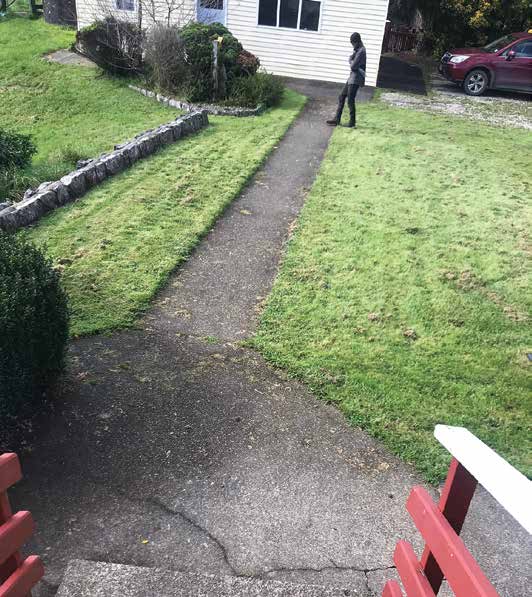
Source: NZ Police
535 The officer then rang Rhonda’s mother-in-law and recorded her account of the sighting. Unsurprisingly, her version was broadly similar to Rhonda’s. But she believed that the man was “in his late 50s perhaps”. She also gave some additional details. The man had said that he had parked to sleep overnight, but the car battery went flat. He said that he was “off the grid”. She similarly described him as smelling and having dirty fingernails. She also noted that the “edges” of the numbers on the car numberplate “looked fuzzy, they didn’t look crisp”.
536 She described seeing two girls, one who she estimated to be an early teenager and another 10 or 11 years old. There was movement in the back of the car, so she was “sure there was another child”. The girls had black puffer jackets on, which looked “quite new”. She described it as “strange” that the man never asked to use the phone at Rhonda’s house.
537 Over the next few days, the officer took steps to try to identify the car Rhonda had described. The numberplate they had been given was for a different make and model. The owner of that car said that he had not lent it to anyone and did not know Tom Phillips. The officer, with the assistance of an intelligence analyst, ran searches looking for registered vehicles of the make/model and colour as described by Rhonda and her mother-in-law with a corresponding registration number starting with H. No vehicles of interest were identified.
538 From this point Police seem to have treated this facet of the investigation as having been taken as far as possible. Rhonda’s sighting and descriptions were, for the time being, left as undetermined.
September 2023: a follow-up by the caller – identification as Tom Phillips and children
539 On 5 and 6 September 2023, several media outlets reported that a warrant had been issued to arrest Tom Phillips for the armed robbery of the Te Kūiti ANZ that took place almost four months earlier, in mid-May 2023. This story was accompanied by photographs of two black-clad people leaving the scene on a motorbike.87
540 Rhonda saw those photographs. She recognised the man on the bike was wearing the same black jeans and work boots as the person who had showed up to her house, and whose image she had captured on the photograph she had sent to Police.
541 On 13 September 2023, Rhonda submitted another online “105” report to Police about the same sighting. Police made a record describing the caller’s report as possibly “credible” and stating that it was to be passed on to the Te Awamutu CIB. Police who spoke to the Inquiry confirmed that the man’s distinctive boots, which were visible in the photograph sent by Rhonda, established a clear link between the Te Anga Road visitor and the offender in the bank robbery at the ANZ at Te Kūiti. It was therefore Tom Phillips.
542 The next day, a Detective Constable at Te Awamutu CIB telephoned Rhonda and took a written witness statement over the phone. This statement reflected what she had already told Police on 28 May and 7 June 2023. Rhonda later provided Police with screenshots of Google Maps, showing the coordinates of the track where she thought the car had been parked.
543 On 21 September 2023, detectives drove out to Te Anga Road to try to locate where Tom Phillips’ car had been parked. Unsurprisingly, given that several months had since passed, nothing of interest was noted. However, the officer did pass on the information to the Operation Curly team, including a map with a pin drop and Rhonda’s witness statement, requesting that the area be “added to any air asset deployment”.
544 It does not appear that Police took any further steps to investigate this sighting. That is to be expected. By this time, over 100 days had passed since Rhonda had first reported her engagement with Tom Phillips and the children. They had likely moved on. There was little prospect of finding the children based on that information alone.
545 Disappointingly, it also does not appear that the sighting was flagged as the significant and credible sighting of Tom Phillips and the children that it plainly was. To place it in its proper context, this was the first credible sighting of the three children since their disappearance nearly 18 months earlier. As such it was a hugely significant development in the progress of the investigation. Despite that, Rhonda’s sighting was not referenced in later documents summarising the status of the investigation. When Tom Phillips and the children were later seen by pig hunters in October 2024, the internal report incorrectly noted: “Of importance is that this is the first time there has been a sighting of all 4 of them since their disappearance.”
546 The significance of the location of the stranded car and its occupants on that forestry road was also not recognised in 2025, when an officer followed quad bike tracks to a nearby location, which is now known to be close to where Tom Phillips and the children were then camping.
547 The vehicle described by Rhonda was found almost two years later, after the children were recovered. It had been pushed down a bank, a short distance from the coordinates which Rhonda had given and, significantly, not far from two of the camps used by the family across the four-year disappearance. Police identified that the car had been stolen from Te Kūiti on 27 May 2023.
Findings
Police inaction on the day of the 28 May 2023 Te Anga Road sighting led to avoidable delays
548 The Inquiry finds that there were avoidable delays in the initial response to the sighting. In particular, the Inquiry finds:
a. Rhonda’s sighting should not have been “K1’d” on 28 May when there had been no site visit or follow up call, and
b. The notifying officer, who saw fit to pass this on to a member of Search and Rescue and received an out of office response on 28 May, should have followed up with another available officer – ideally with Operation Curly directly.
549 The Inquiry also finds that there was not an effective system in place to ensure prompt delivery of highly relevant and time-dependent information to the Operation Curly team, and that on this occasion that caused material delays that prevented timely consideration of the reported sighting.
Police should have recognised the report was credible, and investigated more thoroughly and in a more timely way
550 The Inquiry finds that Police should have recognised that Rhonda’s report of 28 May 2023 constituted a highly credible sighting of Tom Phillips and the children when they first received it. More particularly:
a. the descriptions (and photograph) provided by Rhonda and her mother-in-law were consistent with being Tom Phillips and the children,88
b. the behaviours and condition they observed and described were consistent with people who were living rough and attempting to maintain a low profile, and
c. the location of the sighting was off the main road out to Marokopa and between the two locations of confirmed sightings (a property in Ōtorohanga and the family farm at Marokopa).
551 Senior officers from Operation Curly at the time of the sighting explained to the Inquiry that Police were responding to sightings “all over the show” and that it was hard to distinguish this particular report from any other reported sighting.
552 That explanation does not withstand scrutiny for several reasons. First, there had been only a handful of sightings over the previous four months89. Secondly, while Police were following older reports from around the country, this should not have prevented a thorough parallel investigation into what was plainly a credible and current report of suspicious activity on the part of an adult male and three children (broadly matching the missing people’s description) in the same area that it was known Tom Phillips had lived and previously been sighted.
553 Given the credibility of Rhonda’s initial report, Police should have investigated more thoroughly in June 2023 to obtain as much information as possible about a new location of interest. At the very least:
a. the Operation Curly officer who contacted Rhonda by phone on 7 June 2023 should have asked for the specific location of the sighting, and
b. members of the Operation Curly investigation team should have visited Rhonda and the location of the sighting, to obtain more information.
554 Further investigative actions could have included asking Rhonda whether she knew Tom Phillips or the Phillips family (to assess the level of reliability),90 and asking Tom Phillips’ family whether there were locations in that area which he might likely frequent.
555 Some steps were taken after Rhonda rang again in September 2023, and Police obtained specific information about the location, including GPS coordinates, and visited the site.
556 However, Police did not take any further steps to investigate the location, and appear to have overlooked the sighting for the remainder of Operation Curly.
557 With the sighting now confirmed to be very likely Tom Phillips, Police should have done more, for example investigating what those close to Tom Phillips knew about the specific area and targeting area canvassing for further information about suspicious activity.
558 Police should also have considered the sighting in future phases of the investigation, for example when developing surveillance plans or considering options for searches.
559 The Inquiry finds that Police did not give the sighting the significance it deserved, and did not adequately investigate the location or its environs either at the time the information came in, or at any later time during the children’s disappearance.
Had there been no delay, there might have been a real prospect of locating the children
560 The delays in the Police response to this sighting are significant. The inaction of the dispatched unit, together with the fact that the information was only forwarded to a single analyst who was on leave, had the effect that no one visited the site at a time when there was a real possibility that the broken down vehicle, with the children in it, may still have been there.
561 Once the connection was made to Tom Phillips in September 2023, Rhonda’s sighting, albeit now dated, still had significance: it provided evidence the children were alive, and that they and their father were in the area.
562 The information could have been used to identify further locations for road cameras, or targeted questioning or canvassing of local addresses for other information about sightings involving activity around the roads in that stretch of forest.
563 The Inquiry finds that had some or all of these actions been undertaken the children could well have been found sooner.
Findings
19 In response to a sighting of Tom Phillips and the children on 28 May 2023 near Te Anga Rd:
• Police inaction on the day led to avoidable delays,
• Police should have recognised the sighting was credible, and investigated more thoroughly and in a more timely way, and
• had there been no delay, there might have been a real prospect of locating the children
4.4 The aggravated robbery and the shopping trip
16 May 2023: The aggravated robbery and Operation Rora
564 On 16 May 2023, a man dressed in a black face mask, glasses, and large puffer jacket, held up the ANZ bank in Te Kūiti at gun point, using a semi-automatic sawn-off shot gun. He took $15,000 cash, and left on a black farm-style motorbike heading towards Te Anga.
565 The investigation into the aggravated robbery was carried out by Te Awamutu Criminal Investigations Branch (CIB). It was codenamed Operation Rora. The investigation team included officers who had previously been, but were not currently, involved in Tom Phillips matters, in both Operation Marokopa (before it concluded) and Operation Curly.
566 The Operation Rora team started immediately by circulating images taken from the CCTV footage to other Police teams. They asked for “nominations” as to who the offender might be. Images of the offender on the motorbike were also published in the media.
567 Police also investigated the particular brand of tinted reading glasses that had been abandoned at the scene after being knocked from one of the pair. They found that two pairs of those same glasses had been purchased at The Warehouse in Te Kūiti earlier that month. Further inquiries revealed the purchase of other items worn and used in the robbery. The purchaser was a man who arrived on a similar looking motorbike. He was wearing a distinctive brown beanie and a face mask, but could not be identified from the CCTV footage.
568 The then Officer in Charge of Operation Curly reviewed the Te Kūiti ANZ CCTV footage on the day of the robbery. He noted the bike looked similar to the bike that Tom Phillips had previously been seen with when he visited a friend’s house in May 2022. The Officer in Charge told the Inquiry that he called a senior officer in Operation Rora and raised the possibility that the man was Tom Phillips. He was told that the Operation Rora team had already received credible information that day which pointed towards other suspects. That line of enquiry became the Police’s focus.
569 As the following analysis reveals, there were strands of cogent evidence available in the first few days which tended to support the inference that Tom Phillips was involved. Examples follow.
a. As identified by the Operation Curly Officer in Charge, the bike used looked identical to one already associated with Tom Phillips. Operation Rora identified the motorbike used in the robbery as a “black farm bike similar to a Suzuki DR200 Trojan Motorbike”. This is consistent with the motorbike he was seen with a year earlier when visiting his friend.
b. Tom Phillips had an account at the Te Kūiti branch of ANZ.
c. The motorbike was seen leaving Te Kūiti on a road that led towards Marokopa.
d. There were similarities between Tom Phillips and witnesses’ descriptions of the height and build of the person.91
570 In any event, it does not appear that the Operation Rora team gave any serious consideration to whether Tom Phillips was in fact a credible suspect. Nor does it seem that anyone from the Operation Rora enquiry contemplated engaging with the Operation Curly team to explore that possibility further, until later events in August.
571 Instead, the Operation Rora team pursued a different suspect, who had been suggested by three different sources. Police executed a search warrant at the home of the suspect on the evening of the robbery. By 18 May 2023, two days after the robbery, that person was ruled out as a suspect on the basis of an alibi.
572 Police then pursued several successive lines of enquiry. These all centred around the same group of people and associates. However, by around the end of June, these lines of enquiry had been all but exhausted. All suspects were ruled out on the basis of alibis.
573 It appears that Operation Rora stalled after some six weeks or so. And yet, other than the then Officer in Charge of Operation Curly, no one seems to have contemplated the possibility that Tom Phillips might have been involved. That connection wasn’t made until August 2023.
574 Had a broader, parallel enquiry been considered, the link between Tom Phillips and the offender would almost certainly have been made earlier.
A sighting with a gun and shopping trip
575 At the beginning of August 2023 there were a number of sightings of Tom Phillips in different places around Marokopa and Hamilton.
576 On 1 August 2023, at around 9.30 pm, Tom Phillips was captured by CCTV camera at a calf shed on his parents’ farm. He was carrying a rifle equipped with a scope and silencer. During this visit, he stole a number of items from the shed. These included a Honda XR200 trail bike, a TRX500 quad bike, alcohol and assorted screws. The theft was reported to Police on 3 August 2023 and later CCTV footage was provided. Police located the Honda trail bike down a bank on a road in Ōtorohanga the following month. It had been covered with grass and shrubbery. Police installed a tracking device on the bike and left it where it had been found. Tom Phillips never returned to collect it.
577 On the morning of 2 August 2023, Tom Phillips took a ute from a friend’s property on that same road in Ōtorohanga. He drove to The Warehouse in Te Awamutu, and then to another six businesses in Hamilton, where he made purchases in cash totalling $5,808.68. The following table contains a breakdown of his purchases that day.
Purchases on 2 August 2023
|
Business |
Arrival time |
Time spent |
Money spent |
Examples of purchases |
|---|---|---|---|---|
|
The Warehouse, |
11.17 am |
40 mins |
$779.50 |
Hair products, batteries, |
|
Bunnings Warehouse, South Hamilton |
12.31 pm |
46 mins |
$1065.50 |
Headlight x 2, gumboots, |
|
Countdown, Anzac |
2.04 pm |
40 mins |
$1030.03 |
Variety of food, confectionary, spices, exercise books, |
|
Waikato Hunting |
3.15 pm |
17 mins |
$1828.66 |
Torch, fishing equipment, hat, beanies, cap, |
|
Bunnings Warehouse |
3.48 pm |
14 mins |
$326.00 |
30m of galvanised |
|
PGG Wrightson, Hamilton |
4.23 pm |
<10 mins |
$268.99 |
Electric fence wire, pair of size 8 safety boots |
|
Countdown, Dinsdale |
Time of Purchase 4.45 pm |
$510.00 |
Flour, rice, sugar, oats, |
578 Remarkably, he was spotted by the children’s mother, Ms Smith. It was about 4.00 pm in the car park of Bunnings, Te Rapa. She happened to be in town that afternoon. As she drove into Bunnings, she saw Tom Phillips in a farm ute wearing a face mask and beanie. She told the Inquiry she knew it was him because of “the way he moved” and “the way he looked at [her]”.
579 Ms Smith immediately contacted the then Officer in Charge of Operation Curly. When she couldn’t get through on a call, she sent him text messages; one recording the ute’s number plate and the next telling him that she had seen “someone of Thomas’s build. He was alone. … He saw me and left again immediately. I followed him up the road but then he took evasive action and went down a side road.”
580 The officer was off duty. He didn’t have his work phone with him when the messages came in. He cleared it three and a half hours later at 7.25 pm and read Ms Smith’s messages. He responded without delay. He called his supervisor and then went into headquarters.
581 Meanwhile, at around 5.00 pm, the owner of the ute posted on Facebook that his ute had been stolen. A friend called him to report seeing it drive past. The owner, along with several others, went out to find it. They called Police at around 6.43 pm and reported that they located the ute driving on Kawhia Road towards Kawhia with a different numberplate, but had lost sight of it. One said that he believed the driver was Tom Phillips.
582 Police spoke again to the owner just after 7.00 pm. He told them that he believed the ute was on a property on Kawhia Road.
583 At 7.40 pm Police arrived at the Kawhia Road property. They searched for the ute and its driver without success. Later that evening, Police carried out searches using a drone and an Eagle helicopter but found nothing of interest.
584 The next day, 3 August 2023, Police made a public appeal for information about the case. They released images of the ute.92 Police described the sightings of Tom Phillips the previous day as the first confirmed sightings since February 2022.
585 The ute was located by Police the following day. It was hidden in bush between the Phillips family farm and the intersection of Marokopa Road with Te Anga and Taharoa Roads.
Operation Rora connects the dots
586 The Te Rapa Road Bunnings in Hamilton sighting proved to be a turning point for Operation Rora. Police finally confirmed Tom Phillips as the offender in the armed robbery.
587 Police reviewed CCTV footage recorded on 2 August 2023 in which Tom Phillips was shown shopping at the Te Awamutu Warehouse. Significantly, he was carrying a distinctive bag that had been purchased at the Te Kūiti Warehouse. It was the same bag that he had with him at the ANZ robbery. The CCTV footage also revealed Tom Phillips wearing the same brown beanie as the person who made the purchases at the Te Kūiti Warehouse in May. He also purchased the same brand of reading glasses, identical to those bought at Te Kūiti and left at the robbery scene.
588 The team then drew together the other connections listed above, including the similarity of the bike with one previously identified with Tom Phillips.
589 Police acted quickly after these connections were made. By 18 August 2023, the Operation Rora investigation team considered Tom Phillips a “viable suspect” for the armed robbery. On 5 September 2023, Police laid charges of aggravated robbery and unlawful possession of a firearm against him in Te Kūiti District Court. That day the Court issued a warrant for Tom Phillips’ arrest.
590 The Operation Curly team also continued their enquiry into the whereabouts of Tom Phillips and the children with greater focus. They used evidence from the armed robbery and the Bunnings sighting to apply for and obtain surveillance device warrants in an attempt to identify any person assisting Tom Phillips, as detailed in Chapter 4.6.
591 In September 2023, Operation Rora also made the connection with Rhonda’s credible sighting of Tom Phillips and the children near Te Anga Road on 28 May 2023 (detailed in Chapter 4.3), when Rhonda made a second report after seeing footage of the aggravated robbery on the news. The Te Anga Road sighting was 12 days after the aggravated robbery. Significantly, the person who committed the armed robbery was wearing very similar looking boots and clothing to the man who had asked Rhonda for a jump start; the same man who she and her mother-in-law thought could be Tom Phillips.
Findings
Police took all practicable steps in response to the 2 August 2023 sightings
592 The first report on 2 August 2023 was from Ms Smith, by text message to the Officer in Charge. It is commendable that the officer had given Ms Smith his direct number, and simply unfortunate that he was off duty at the time. As soon as he cleared his messages, he took her report seriously and took immediate and appropriate action.
593 The second report on 2 August 2023 was from the owner of the stolen ute. Police gathered relevant information and dispatched to the area quickly.
594 When they were unable to find Tom Phillips or the vehicle, Police engaged an Eagle helicopter, a drone, and used a public appeal to get more information. They followed up with an investigation which led to important information about what he had purchased and his movements on that day.
595 The Inquiry finds that Police took all practicable steps in response to this sighting.
Police took too long to identify Tom Phillips as the offender in the aggravated robbery
596 Police missed or otherwise overlooked the early signs and evidence pointing to Tom Phillips as being a credible suspect for the aggravated robbery.
597 It was entirely reasonable for the Operation Rora team to prioritise investigating credible leads and information which pointed to other suspects. No criticism is made of that. However, those leads were pursued at the cost of a more expansive approach which would have included Tom Phillips as a potential suspect. Such a prospect was hardly fanciful. After all, it was the Officer in Charge of Operation Curly who nominated Tom Phillips as a potential suspect on the day of the robbery. That suggestion deserved more weight than it got. Once the prime suspect’s alibi stood up two days into the enquiry, and the focus broadened to include other persons of interest, it is surprising that Tom Phillips’ candidacy as a suspect was either ignored or overlooked. Had his name then gone into the mix and the Operation Curly team fully and effectively engaged and consulted, it is difficult to imagine anything other than his status as a significant suspect firming up earlier.
598 As a senior officer with Operation Rora responsibly acknowledged to the Inquiry:
We probably could have reached out earlier… we had some positive lines that we were concentrating on, and that probably took the focus down that path and then when we got to a point of actually they’re done and they’re not who we are looking for it probably could have been reassessed at that point around, okay, cool. Who have we got? Where are we at?
599 The same officer also accepted that if Operation Rora had seen the photo taken by Rhonda on 28 May 2023 it would have “pricked our interest a lot more, obviously, absolutely, … they’re our boots … it would have pointed us in the right direction sooner”. And, of course, once that happened other evidence, such as the four points discussed at paragraph 569, would have added to the growing body of material tending to identify Tom Phillips as the offender.
600 As a senior officer with Operation Curly fairly acknowledged to the Inquiry, it was not a “great surprise” when Tom Phillips was identified as the offender. The evidence was there to make the connection.
601 It thus follows that the Inquiry finds that if Operation Rora had engaged with Operation Curly from a much earlier point, Tom Phillips would have been identified as the offender in a serious and violent offence sooner.
The delay in identifying Tom Phillips as a suspect in the armed robbery, and as the person sighted in May 2023, meant that some practicable steps were not taken early enough
602 The delay had consequences. It was significant in several ways.
603 First, it was evidence that Tom Phillip’s was armed, and willing to use firearms against others. This necessarily meant that his children were at additional risk of harm.
604 Secondly, it was critically important evidence that Tom Phillips had remained in the west Waikato area and was active there. This would have allowed Police to have narrowed their focus to the relevant area from an earlier point.
605 Thirdly, Police could have used the information to inform their decisions about surveillance including applying for surveillance device warrants earlier. Covert surveillance could potentially have captured video or audio of a person who had knowledge of Tom Phillips’ whereabouts, or more footage of his activity and any patterns of movement.93 As it played out, the first surveillance device warrant was obtained in August 2023. Ultimately, this did not lead to any evidence that directly helped to locate Tom Phillips or the children. However, it is possible that Tom Phillips was more active in the area earlier in 2023, and earlier surveillance or investigation, may have led to additional evidence on the issue of whether he was receiving external support or on his location.
606 Fourthly, it is not speculative to record that earlier identification of Tom Phillips as the offender in the armed robbery may have made a significant difference to the response to the 28 May (Te Anga Road) sighting of Tom Phillips and the children. That sighting occurred 12 days after the aggravated robbery. Had the connection between these two events been made within the first few days of Operation Rora, it is likely there would have been a more urgent response to the sighting and with it, conceivably, the apprehension of Tom Phillips and the recovery of the children.
Findings
20 In response to other sightings in 2023:
• Police took all practicable steps in response to the 2 August 2023 sightings at Bunnings and on
Kawhia Rd,
• Police took too long to identify Tom Phillips as the offender in the aggravated robbery of a Te Kūiti
bank in May 2023, and
• the delay in identification meant that some practicable steps were not taken early enough
4.5 October 2024 – a “game changer” sighting
Response to a sighting at Trig Paddock: 3–6 October 2024
607 On 3 October 2024, at approximately 7.00 pm, two pig hunters saw Tom Phillips and the three children walking across remote farmland in a location known as Trig Paddock. This was approximately three kilometres from the family farm and approximately 1.5 km from the camp at which they were then believed to be staying. All were carrying large backpacks. Tom Phillips was carrying a firearm.
608 The hunters took photos and videos of the family. An image from a video is reproduced below:
Still image from video taken by pig hunters of Tom Phillips and the children on 3 October 2024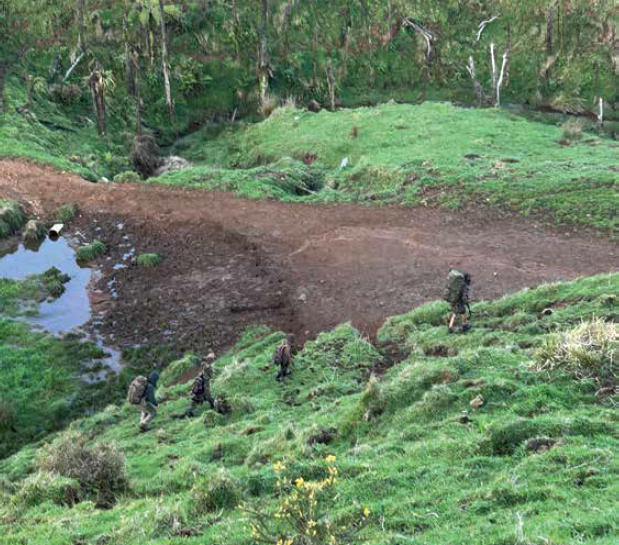
Source: NZ Police
609 Within half an hour, the hunters reported the sighting to a senior police officer. He promptly notified the Officer in Charge of Operation Curly. Police acted swiftly. Senior police officers, the STG and the AOS were briefed less than one hour later. At 10.06 pm, Police made a request to NZDF for tracking assistance. NZDF approved it within approximately 40 minutes.
610 Later that night, STG officers prepared a “concept of operations”, setting out the situation, risks, and plan for the tactical response. The plan included on-the-ground tracking by STG officers and two SAS trackers, and deployment of further STG officers and AOS officers both by road and air, to support any tracking effort required. At 2.17 am, the STG Commander sent the concept of operations to the Police-NZDF liaison, who a few hours later sought approval from Police for the deployment of STG with support from NZDF.
611 Early on the morning of 4 October 2024, NZDF and STG personnel deployed from their Auckland bases, and travelled to the farm where Tom Phillips and the children were seen. They travelled by road in order to bring the necessary equipment, a journey that typically takes more than three hours.
612 The Police Tactical Operations Director approved the joint deployment according to the concept of operations at 10.42 am. They began transporting personnel by farm vehicle to the remote paddock. At approximately midday, around 17 hours after the sighting, STG and NZDF personnel arrived at the Trig Paddock and began tracking.
613 On any analysis the speed of the rollout of this complex, multi-agency response was impressive.
614 The Inquiry heard that STG personnel were ready to deploy up to two hours earlier that day, but this was delayed, while NZDF awaited the appropriate level of Police approval for NZSAS personnel to carry weapons. This was important, and the Inquiry accepts the account of NZDF and STG that this delay did not materially compromise the recovery attempts which followed.
615 STG and NZDF personnel continued tracking for the remainder of 4 October and on 5 and 6 October 2024. They did so with NH90 helicopter support from NZDF, which was used to redeploy the tracking team at various locations of interest.
616 On the afternoon of 4 October 2024, the trackers located some disturbance along the track that they identified as “sign” of the party. Later that evening they found footprints. On the evening of 5 October, trackers identified another footprint. By 6 October, however, the trackers were unable to find any other signs which might have allowed them to follow the party further at that time.
A “fresh plan” – using trail cameras
617 Even though the children were not located after the sighting, the investigation team regarded the 3 October 2024 sighting as a “gamechanger”. This was because it confirmed that Tom Phillips and the children were still in the Marokopa area. They (incorrectly) described this sighting in internal documents as “the first time there has been a sighting of all 4 of them since their disappearance”.94
618 Police immediately prepared a “[f]resh plan” with a “[c]lear Marokopa focus”. As put by the District Commander at the time, “[t]his plan is for us to be more proactive”. Police developed the plan with input from STG, AOS, TOG, NZDF, and the investigation team.
619 While the sighting had given Police a starting point, the search area for Tom Phillips and the children was still very large. Police explained to the Inquiry that it would have been impossible to do a thorough ground search over such vastness. The chances of finding people actively avoiding detection in dense, steep terrain were slim. The Inquiry repeatedly heard that the conundrum they faced was akin to finding a “needle in a haystack”. The focus of the new plan, then, was to “shrink this area further prior to a search phase”. Police planned to do this primarily by installing trail cameras, which could be monitored to identify locations where Tom Phillips and the children were active.
620 On 5 November 2024, Police installed 10 trail cameras. Additional cameras were added in December 2024, January 2025, and August 2025, resulting in an eventual total of 16 trail cameras. Also, over time, Police reviewed camera locations and repositioned some to more suitable locations.
621 Trail camera deployment was more difficult than it might seem. The trail cameras could not be monitored live. They were motion-activated. They captured still images, which were saved onto an SD card in the device. Police told the Inquiry that approximately every two weeks, officers would need to return to the various sites to service the trail cameras by removing SD cards and checking batteries. Each time they did so, the staff would need to spend at least one full day in the dense bush. When the number of cameras was increased, two days were required.
622 Installing and monitoring the trail cameras was also very dangerous work. Police knew that Tom Phillips was armed.95 They knew he was prepared to use firearms against people. Police asked for an assessment by a Police forensic psychologist. The psychologist concluded, among other things, that Tom Phillips was equipped to defend himself and had the capabilities to do so, and that it was “almost certain” that he would resort to violence to defend his position and the children.
623 To reduce the risk of such a confrontation, Police needed to create an authentic cover for whoever was tasked with servicing the cameras. Their solution was inventive. Within the local Police was a senior and experienced officer who happened to be particularly familiar with the area. He was also a seasoned hunter who not only knew the area extremely well but had often hunted pigs with his dogs on the property where Trig Paddock is located. If he encountered an armed Tom Phillips, he would present authentically. With his dogs, dress, and demeanour, he would likely assuage suspicion. To another hunter, he would know and use the appropriate language, and he would look the part.
624 Nevertheless, this was very dangerous work which required the officer to be taken out of his “day job” and sent to Marokopa for several days at a time. Furthermore, despite the real risk of being shot by Tom Phillips he could not wear a protective vest. The courage and aptitude of this officer deserve special mention.
625 That officer was always accompanied in the bush by a member of the AOS. The officers who undertook that task equally deserve praise for their courage.
626 To further safeguard those servicing the cameras, their movements were monitored remotely and an AOS team was kept on standby in the event of any engagement with Tom Phillips.
627 A total of 358,212 images were captured by the trail cameras and analysed by Police. Many were “false activations”. For example, because the cameras were motion-activated, a blade of grass or a fern frond moving in the wind could be enough to set the camera off. Many other images were triggered by stock, or wildlife. But every single image had to be examined by staff in case it contained something of value.
628 In addition to the trail cameras, Police installed six live cameras on bush trails and on nearby roads. Unlike the motion-activated trail cameras, these provided a live-feed to Police. The feed was not, however, monitored live. Police resource limitations meant that footage tended to be reviewed after a delay, which could sometimes be significant. For example, at a briefing of the investigation team on 6 January 2025, Police recorded that the cameras were “currently 2 weeks behind checking”.
629 Over their deployment, the cameras made three likely sightings of Tom Phillips and the children not far from the pig hunters’ sighting. These are described below.
a. On 19 November 2024, at 3.18 am, a trail camera took an image of two people, an adult carrying a firearm and a child, walking close to the location of the Trig Paddock. The SD card containing that image was retrieved six days later, and reviewed by Police the following day.
b. On 5 April 2025, at 10.53 pm, a live-feed thermal camera recorded four people walking along Marokopa Road, past Coutts Road towards Marokopa. Despite being a live-feed, that footage was reviewed by the investigation team five days later on 10 April 2025.
c. A few hours later, at 2.13 am on 6 April 2025, a trail camera took images of an adult man and three children walking north away from Marokopa, towards Trig Paddock. The man was holding a hunting rifle. The SD card containing this image was retrieved and reviewed five days later on 11 April 2025.
630 The trail and live-feed cameras, and the handful of sightings they recorded, did not directly provide opportunities for Police to go in and recover the children. Instead, their utility was to confirm and narrow the area of interest. Police told the Inquiry they were also highly valuable to the investigation because they:
a. identified potential patterns for resupply,
b. provided information on the topography and vegetation of the area, and
c. confirmed that Tom Phillips had access to multiple weapons.
631 Police used this information to inform lines of enquiry as well as risk assessments and response planning, including for the final response that occurred on 8 September 2025.
The Airbus FlexRotor drone – April 2025
632 In October 2024, a helicopter pilot who had worked occasionally with Police provided Police with information about a drone manufactured by Airbus called the FlexRotor. Airbus describes the FlexRotor as a “small tactical vertical take-off and landing (VTOL) uncrewed aircraft system (UAS)”, which is “designed for Intelligence, Surveillance, and Reconnaissance (ISR) missions for more than 12–14 hours in a typical operational configuration”. The FlexRotor can carry payloads of different kinds including equipment, such as cameras and sensors.
633 This drone had potential. It had several potentially useful features such as its ability to remain above a location for 14 hours, and the fact that it could be fitted with different sensors and cameras, including an infrared camera capable of detecting human beings with heat signatures.
634 Police attended meetings with Airbus representatives in November 2024. They were told that Airbus had “[h]igh confidence in locating parties”. Members of the investigation team told the Inquiry that they were also advised by Airbus that the FlexRotor could be equipped with an infrared camera capable of penetrating the bush canopy, and that it could operate covertly; that is, loitering at a sufficiently high altitude that people on the ground would not hear it.
FlexRotor drone
Source: www.airbus.com/en/products-services/defence/uas/flexrotor
635 In January 2025, Police approved Airbus’s proposal.
636 Over the next three months, Police prepared for the FlexRotor deployment by:
a. holding planning meetings throughout February, March and April 2025,
b. seeking and obtaining Civil Aviation Authority approval and assistance for operation of the FlexRotor,96
c. obtaining a surveillance device warrant for the operation of the FlexRotor,
d. conducting a limited area canvas of some Marokopa coastal properties in April 2025,
e. asking the STG to establish a locally-based quick-reaction force to be available during the deployment of the FlexRotor, in order to respond to any sightings of Tom Phillips or the children. STG in turn asked for and received support from NZDF for tracking personnel and helicopter support to assist in locating the family,
f. working with Airbus to ensure that imagery from the FlexRotor could be transmitted to Police, and
g. installing additional cameras in the trail camera area.
Some limited success: sightings from the FlexRotor
637 From 14 April 2025, Police began a two-week flight phase using the FlexRotor. The FlexRotor flew for a total of 111 hours over that 14-day period.
638 Some challenges were experienced with the FlexRotor. There was difficulty importing the “Overwatch Imagine PT-6”, a piece of equipment Police were told could be attached to the FlexRotor and used for wide-area search. Instead, Police had to rely on FlexRotor’s cameras. But these could not consistently penetrate the bush canopy. The Inquiry was also told that the FlexRotor was noisier than expected.
639 In any event, the FlexRotor did successfully detect heat signatures of Tom Phillips and the children. Police considered that there were two to three possible sightings of one or more of the family, on 20, 24 and 26 April 2025. The most significant of these was on 24 April 2025, at 3.27 am, when the FlexRotor identified the heat signatures of four people.
640 The FlexRotor followed the images for a few minutes, but lost track of them due to the thick cloud cover. The STG team later assessed this sighting as having a “likelihood of 80%” of being Tom Phillips and the children.
Response to the FlexRotor sighting: 24 April 2025
641 Within an hour and a half of that sighting, the STG commander arranged for Eagle support and redeployed the locally-stationed STG to a position from which they could observe and, if required, intercept the family. He discussed the situation with members of the investigation team. Police recognised the need to avoid creating a standoff where the risk of harm or death to the children was high, and the need for any dog tracking to be “low and slow” to make sure they weren’t detected. At approximately 5.00 am, STG and the investigation team agreed that STG officers would hold their positions and not attempt to go in to locate Tom Phillips or the children until first light.
642 At 6.52 am that morning, STG officers and a tracking dog moved to the location Tom Phillips and the children were detected and began tracking. They reported locating a boot print later that morning, but by 10.00 am the dog had lost track of them at a river crossing.
634 In the meantime, Police deployed additional STG officers from Auckland and requested tracking support from NZDF. The request was approved and NZDF personnel departed Auckland shortly after midday. They arrived and began tracking at approximately 4.00 pm.
644 Police and NZDF personnel continued efforts to track Tom Phillips and the children. They searched several locations on 24, 25, 26 and 27 April, and found a child’s footprint on 26 April. However, no other sign was found, and the group was not located.
645 It appears likely that Tom Phillips and the children moved from their well-established camp in this area at least in part as a result of hearing the FlexRotor drone circling the area. The area they moved to had less access to wildlife to hunt and other resources necessary to sustain life. It was this paucity of food that ultimately led to the recovery of the children.
Findings
The initial Police response to the October 2024 sighting was prompt and thorough
646 The October 2024 sighting came out of the blue. It was, at the time, the first confirmed sighting of Tom Phillips and the children since their disappearance nearly three years earlier.97 It reinforced Police’s fears that Tom Phillips was armed and mobile. And, of course, the children were with him. Importantly, this confirmed that all three children were still alive.
647 From the perspective of Police there was an imperative to ensure any engagement was meticulously planned and executed. Police also needed to take effective steps to mitigate any danger posed by Tom Phillips to themselves. And, of course, top of mind was the need to ensure that any response would not threaten the health or life of any of the children. On any analysis this created an extremely complex problem.
648 From the sighting at 7.00 pm until around midday the following day when there were feet on the ground at Trig Paddock, 17 hours passed. The Inquiry critically examined what happened over this period and in depth. The Inquiry finds that this time was reasonable in all the circumstances. Over that period a great deal needed to be achieved. Police needed to undertake the necessary detailed planning. They needed to obtain the required interagency approvals. The right teams needed to be assembled, that is specialist Police and NZDF personnel. Travel time to move personnel and equipment from Auckland to Marokopa needed to be arranged and factored in. And for much of this time it was through the night. In the Inquiry’s assessment Police acted promptly to ensure the deployment would proceed as quickly and effectively as possible. The Inquiry considers the response was excellent in all the circumstances.
Police then identified, planned, invested in, and implemented appropriate techniques to narrow the area of interest
649 After the initial response failed to locate the children, Police worked with specialist groups, NZDF, and private companies (Airbus) to identify and implement innovative strategies and technologies to narrow the area of interest. This included intelligence gathering through trail cameras and other surveillance methods. This was at a significant cost to Police.
650 The Inquiry finds that the use of trail cameras and the later use of the drone were effective uses of technology. As noted, the trail camera strategy was implemented at significant risk to staff. The information and intelligence collected was valuable and informed the Police approach, which led to the eventual recovery of the children on 8 September 2025.
651 The Inquiry finds that STG made a reasonable and considered decision not to immediately deploy when the children were spotted by the FlexRotor on the evening of 24 April 2025. This was appropriate in light of the information Police held about Tom Phillips’ likely motivation and reaction if encountered and the attendant risks to both Police and the children of a night-time confrontation in the bush.98
Some possible actions were limited by resourcing constraints
652 Police did not have the staffing resources to monitor the live-feed cameras in real-time. This meant that when Tom Phillips and the children were captured at approximately 10.30 pm on 5 April 2025 on a live-feed camera on Coutts Road (that is, not in the bush), it was not seen by Police until five days later. Police explained to the Inquiry that it would have taken significant numbers of staff to monitor the nine live-feed cameras that were operating at that time 24 hours a day, and that even if they were monitored in this way, it would have been difficult to mount a prompt and safe response to any given sighting. The Inquiry accepts that staffing all cameras 24 hours a day may have been an unreasonable burden on Police resources, in the context of other policing needs.
653 Nevertheless, the Inquiry finds that Police could have made better use of the live-feed cameras had they had sufficient staff resources to monitor them closer to real-time. In particular, if Police had identified the 5 April sighting sooner, they could have potentially deployed trackers to the location soon after (as they did after the 3 October 2024 and 24 April 2025 sightings). This could potentially have resulted in locating the children sooner or further narrowing the areas of interest.
Findings
21 In response to a sighting of Tom Phillips and the children on remote farmland in October 2024:
• the initial Police response to the sighting was prompt and thorough,
• Police then identified, planned, invested in, and implemented appropriate techniques to narrow the area of interest, and
• some possible actions were limited by resourcing constraints
4.6 Surveillance
654 Surveillance in various forms is a core Police investigative tool. Police used that tool in their search for Tom Phillips and the children. They did so in various ways across the four-year period. In particular, Police used surveillance in places they thought Tom Phillips might go. They also used surveillance in relation to people they believed were helping him and might lead them to him.
655 Throughout the investigation, Police maintained the firm view that Tom Phillips was receiving help or support from others, and thus that those people must know something about where he and the children were. As is discussed more fully in this chapter, there were sound reasons for that belief at the time.
656 Initially, Police hoped that members of the close-knit local community would share this sort of information with them. But when that didn’t lead to anything useful, Police began to consider alternative strategies. The first of these was to identify persons of interest who they suspected could be helping Tom Phillips, or places where Tom Phillips might be accessing resources.
657 Having identified these persons and places, Police needed to know more about them. So, how did they do that? One of the ways they did so was through various forms of surveillance. By its very nature, surveillance is covert. It can be undertaken in person or remotely. It may also be done by gathering personal data about someone. However, because most of these modes of surveillance involve some level of personal intrusion, Police are required to obtain judicial authorisation, usually in the form of some sort of order such as a warrant.
658 In the present case, surveillance ultimately bore surprisingly modest results: Police received very little information about Tom Phillips’ activity or whereabouts, or the location of the children.99 Despite that, the Inquiry is firmly of the view it was an important element in the range of strategies deployed throughout Operation Curly. Indeed, if there is any criticism to be made, it is that the utility of surveillance ought to have been recognised and used a good deal earlier. Had it been, it is likely that information material to resolving the disappearance would have been discovered. The Inquiry’s reasons follow.
Police form the view that Tom Phillips was receiving external assistance
659 As noted, from an early stage, Police were aware that Tom Phillips had sought assistance from family or friends on at least two occasions.
660 In February 2022, Tom Phillips visited his parents’ farmhouse. He took cash and food. Then in May 2022, he visited a friend, exchanging cash for petrol. Police learned of each of these visits shortly after they took place.
661 In October 2022, ten months into the second disappearance, Police commissioned a “survivability report” from an NZDF expert. This expressed the opinion that it was unlikely that Tom Phillips was “self-sufficient unsupported” in the bush with the children over this time period. The expert considered it more likely that he was being supported.
662 That Tom Phillips was receiving external assistance from a person or persons unknown remained Police’s view for the remainder of the investigation. For example, when Police made a public appeal for information in August 2023 (nearly two years into the second disappearance) the then Area Commander for Waikato West stated that “[w]e’ve always maintained he’s had support from people that’ve shared his view.”100 And after Operation Curly concluded with Tom Phillips’ death on 8 September 2025, Police still actively investigated those they suspected of assisting. That investigation did not result in Police laying any charges.101 But no criticism can be made of Police in holding to that belief given the circumstances of this exceptional case.
When electronic surveillance can be used
663 As noted earlier in this context, because almost all components of search and surveillance involve some degree of privacy intrusion, the power to do so is generally prescribed by statute. In New Zealand those powers are primarily set out in the Search and Surveillance Act 2012.102 Despite that, some surveillance from or in public spaces can be carried out without a warrant. This generally arises where there can be no reasonable expectation of privacy. Warrantless searches are also permitted in limited circumstances. However, where privacy rights are engaged, Police are generally required to obtain prior authorisation from a judge in the form of a warrant. So, for example, if Police wish to search a house or car, they must first obtain a search warrant.103 If they want to intercept private communications they must obtain a Surveillance Device Warrant (SDW).
664 Police may also obtain production orders, which require a third party, for example a telecommunications company, to provide Police with documents if there are reasonable grounds to suspect that an offence has been, is being, or will be committed, and the documents will be evidence in respect of the offence.104
665 SDWs are generally required where Police seek to use devices for more intrusive forms of surveillance. Examples include surveilling private property using cameras, intercepting phone calls, using listening devices, or tracking vehicle movements using tracking devices. The statutory threshold to obtain an SDW is higher than for search warrants and production orders because the level of privacy intrusion is greater. For example, an SDW may only be obtained where the relevant offence is punishable by a term of imprisonment of seven years or more.105
666 In the context of Operation Curly this elevated threshold posed a problem for Police when contemplating deploying an SDW as one of their investigative tools. Search and surveillance powers could not be used simply for the purpose of locating the missing children alone. It had to be linked to suspected serious criminal offending on the part of Tom Phillips, or persons suspected of assisting Tom Phillips.
667 But that was not the only complication. In this case there were also unique practical challenges. Self-evidently, surveillance devices need to be installed and operated covertly. The safety of installers and the integrity of the installation are paramount considerations. First, Police’s technical teams needed to identify a suitable location likely to yield evidential material without raising suspicion. This might be a private residence or a location from which images might be captured. Secondly, installers must be able to access the surveillance point without detection. Thirdly, they must also be able to retrieve the device without detection.
668 Those are all obvious considerations. However, the isolation and remoteness of the Marokopa Valley introduced another layer of difficulty for Police. The area is serviced by a limited number of roads. Vehicle movements are relatively infrequent. Observant locals were alert to all vehicle and other movements in and around their district. Unfamiliar people and vehicles were particularly noticed. Operating at night did not materially mitigate these risks. If anything, it elevated risk. For Police, this posed another layer of complexity to any covert activity. How could they get technical staff into the area, let alone onto or into private properties without compromise?
669 But that is not where the complexities presented by operating covertly in and around the Marokopa Valley ended. Even after installation, the devices needed to be operational. They needed to work properly in order to capture sight, sound or movement. And, obviously, devices needed a power source and some required cell phone or satellite coverage.
670 These unique complexities conspired to create very significant investigative challenges for the Operation Curly team. They must not be overlooked by the Inquiry when reviewing the efficacy of the electronic and covert phases of the investigation.
671 We now turn to discuss the electronic phases of Operation Curly.
Surveillance by Police
Initial requests for surveillance of public areas: May 2022 to March 2023
672 From the time Tom Phillips took the children and throughout 2022, Police were of the view that Tom Phillips’ criminal offending was limited to breaching a parenting order. That is a relatively minor offence. It is punishable by a fine or imprisonment not exceeding three months.106 That penalty falls well below the seven-year threshold required for an SDW. Police considered that the more serious offence of abduction was not available because Tom Phillips had day-to-day care of the children when he took them. [redacted]. However, Police were concerned that unless Tom Phillips had knowledge of those requirements, the offence of abduction was not available.
673 The effect of this conclusion was that Police considered they could not apply for an SDW. And as a result, they were limited to production orders to obtain banking and telecommunications data and engaging the public and the community to assist in providing information that might relate to Tom Phillips’ movements. The limitations of this approach are obvious. It meant Police believed they could not, for example, place cameras to record movements in private places. Neither could they install listening or tracking devices. The frustration of these limitations is reflected in the words of the Officer in Charge of the investigation on 25 October 2022 when he said, “…the only offence that Phillips is committing is that of ‘Breach of Parenting Order. Subsequently our ability to use surveillance and interception practices is thwarted”.
674 On 15 June 2022, the investigation team made a request for “surveillance / covert cameras covering public areas in or around” the Phillips family farm and two addresses linked to a friend of Tom Phillips. One month later, that request was recast as a request for assistance to TOG — the group within Police which has specialised technical expertise in such matters.
675 The request was dealt with as follows.
a. The investigation team chose to visit one of the addresses linked to the friend rather than seeking surveillance.
b. For the other address linked to the friend, the Inquiry understands that significant assessment work was undertaken, but a suitable installation site could not be found.
c. For reasons unclear to the Inquiry, the installation of cameras covering the Phillips family farm appears not to have been further considered at that time. This tactic may have been abandoned because the risk of compromise was considered too great.
676 In discussing this request, the investigation team also raised the possibility of installing a camera covering the intersection of Marokopa, Taharoa and Te Anga Roads, because “[w]e believe this may be a regular route Phillips is using”. For logistical reasons, TOG instead proposed a camera covering only Te Anga Road. This proposal was reiterated by TOG in July, August, and again in September 2022. The Inquiry is unaware of any response from the investigation team. No camera was installed at the time.
677 In October 2022, the Officer in Charge noted further consideration of surveillance of the farm. He stated that “[t]actical support is being investigated to establish the feasibility of public surveillance of [Tom Phillips’] parents’ home borders, endeavouring to capture PHILLIPS visiting the address in his parents’ absence”. The Inquiry has seen no evidence that further consideration was given to this until 2023.
Consideration of in-person surveillance
678 The Officer in Charge of the investigation also reported in October 2022 that the investigation team had considered in-person surveillance of a person of interest in Marokopa. The view was that the person might be assisting Tom Phillips in some way and that by monitoring their movements, information about Tom Phillips’ whereabouts might be obtained. Again, the tyranny of the physical environment intervened. The officer concluded that this initiative would not be pursued because, “[the person’s] movements are too sporadic as well as the fact the remoteness of [Marokopa] exposes to (sic) our surveillance teams being unsuccessful”.
679 When Operation Curly was reviewed by an external officer in October 2022, surveillance of a person of interest was again identified as a priority. On 1 November 2022, the then Area Commander for Waikato West advised the Officer in Charge that “[t]he priorities for me are the work around [the person of interest] (covert and overt)”. To that end, on 9 November 2022, the Officer in Charge made a request to the Waikato surveillance team for surveillance of the person. The objective of the surveillance was to “gather locations and associates of interest”.
680 The request was declined. Police surveillance experts noted that the location of the person’s home in Marokopa was so isolated that covert surveillance would be impossible.
681 Nonetheless, Police visited the person on 25 January 2023. They were satisfied, apparently on the basis of that visit, that the person was not supporting Tom Phillips. The surveillance proposal was then described as “parked” and “closed”.
Consideration of more serious offences
682 In March 2023, an experienced CIB officer, a Detective Sergeant from outside the investigating team of the time, carried out a review of Operation Curly. This officer brought a fresh set of eyes to the issues Operation Curly was facing, including whether a more serious charge might be available on the facts. He formed the view that a charge of wilfully attempting to defeat the course of justice was available. This was based on Tom Phillips’ actions in removing the children for the purpose of interfering with the Family Court proceedings. That is an offence punishable by up to seven years’ imprisonment.107 That penalty met the threshold for an SDW. Furthermore, any person supporting Tom Phillips and assisting him in avoiding the authorities may be a party to that offence.
683 In May 2023, the investigation was moved to be run by the Major Crimes Team in District Headquarters in Hamilton. The Officer in Charge told us that the new investigation team began preparing an SDW application on that basis. However, they did not make any application over the following five months. In the end, any debate about the appropriateness of a charge of attempting to defeat the course of justice was rendered academic when, in August 2023, Tom Phillips was linked to the aggravated robbery of ANZ at Te Kūiti. That offence carries a maximum penalty of 14 years’ imprisonment; well above the legal threshold for an SDW. This charge (and charges for related offending committed in the course of the robbery), as well as that of attempting to defeat the course of justice, formed the basis for subsequent surveillance warrant applications.
First major phase of electronic surveillance on persons of interest: August 2023 to October 2023
684 On 11 August 2023, the investigation team submitted a wide-ranging request to TOG for assistance with installing interception devices, visual surveillance devices, tracking of cellular phones and tracking devices for vehicles. These all related to Tom Phillips’ family and friends.108
685 Police obtained an SDW covering parts of this request on 18 August 2023. The private communications of some of those individuals were intercepted for a period of approximately three months. On 15 September 2023 Police obtained a second SDW, relating to other individuals, which enabled Police to install cameras on their property and intercept communications on their landline telephone.
686 Police advised the Inquiry that, during this period, they intercepted more than 98 hours of audio, 1,380 text messages, 94,869 sessions during which data was being used on a device, and identified 2,645 device “polling” locations.
687 During the same period, Police also installed a tracking device on a friend’s work vehicle, and on an abandoned motorbike Police understood had been used by Tom Phillips. These devices were in place until October 2023.
688 Police also attempted to progress the installation of surveillance devices at two of the addresses associated with persons of interest, but ultimately these were considered too high risk and abandoned.
689 No information relating to the location of Tom Phillips or the children was obtained from this surveillance phase.
690 In early October 2023, the then Officer in Charge advised his supervisors that he did not “currently see the value in continuing with the electronic surveillance of [friends of Tom Phillips]” and considered that “[t]here is likely little value in continuing with the PHILLIPS”. He advised that, rather than continuing with such surveillance, and “conscious of the Major Crimes Team remaining on this investigation for any further significant period given the other major investigations that require attention…[w]e should look at scaling back the investigation team at the end of this month”. That scaling back appears to have happened as recommended.
Intersection cameras: January 2024
691 On 22 August 2023, the investigation team, in discussions with TOG, identified the installation of cameras at key public road intersections as a priority.
692 The investigation team made its formal request for TOG assistance in November 2023. They identified three key intersections on the only roads in and out of Marokopa. The cameras were first installed in late January 2024. Initially, one camera could be monitored and viewed live; the other two required the recorded footage to be retrieved before analysis. In March 2024, these two installations were modified to allow for live monitoring and viewing of footage. While a delay of some five months from inception to deployment might seem significant and open to criticism, the Inquiry finds otherwise. This was not the only operation the TOG team was working on at the time. Resourcing was an issue. They had other significant priorities to juggle. There was also the question of finding the right time to travel to the sites with their equipment and install the devices without drawing attention to themselves. That presented a significant challenge for the reasons already discussed.
Further Surviellance
693 In 2023 and 2024, there were reports of burglaries at the Piripiri substation in Te Anga. Tom Phillips was the principal suspect.109 In March 2024, Police installed a camera at the entrance to the Piripiri substation, Te Anga, and tracking devices in two electronic items at that location, in the hope that Tom Phillips might return to take them. He didn’t and the devices were removed in May 2025.
694 Between June and July 2024, during “Operation Sella” (the reward phase described in more detail at Chapter 4.2), Police again intercepted the telecommunications of three individuals of interest in case the activity during that period prompted any of them to contact Tom Phillips or speak about him, or about those who might have been helping him. This phase did not obtain any useful intelligence that might have assisted in locating Tom Phillips and the children.
695 Police advised the Inquiry that, during this period, Police intercepted more than 23 hours of audio, 3,380 text messages, 42,858 sessions during which data was being used on a device and identified 1,821 device “polling” locations.
Additional intersection cameras: October 2024 to August 2025
696 As discussed in Chapter 4.5, the 3 October 2024 sighting of Tom Phillips and the children on Trig Paddock marked a significant shift in the Police investigation plan. Along with the trail cameras detailed in that section, Police planned to place additional covert cameras on public roads that they thought Tom Phillips might use.
697 On 23 October 2024, the investigation team requested TOG support for the installation of these covert cameras.110 In late November 2024, TOG installed the covert cameras. These covered the intersections of Te Waitere and Kawhia Harbour Roads, and of Coutts and Te Anga Roads.
Some limited surveillance between April and August 2025
698 The Inquiry understands that, in April 2025, alongside the deployment of the FlexRotor drone, Police conducted phone interceptions of persons of interest, and carried out some further phone interception in May and June 2025.
699 Between April and September 2025, Police also carried out five periods of intercepting UHF radio.
Second major phase of electronic surveillance on persons of interest: August to September 2025
700 In June 2025, approximately eighteen months after the end of the first phase of electronic surveillance of persons of interest, District Police leadership recommended conducting a renewed electronic surveillance phase, “focussing on listening devices in properties and tracking devices on vehicles, relating to our current [Persons of Interest]”. The Officer in Charge advised that this phase would “require significant resourcing and time (likely to be a minimum of 3 – 6 months) to plan and execute”.
701 The investigation team immediately renewed their discussions with TOG to obtain an assessment of available devices, planning and installation.
702 The team submitted a wide-ranging formal request for support to TOG in August 2025. It identified priorities, being “1. Tracking devices [on specified vehicles belonging to persons of interest]”, “2. Audio devices in [a specified address in Marokopa]”, and another covert camera on a road in Marokopa: “3. Camera on Te Karaka Road”.
703 The Inquiry was told that over the following weeks, TOG conducted extensive preparatory and reconnaissance work towards fulfilling that request. The result was that:
a. in August 2025, a tracking device was installed on a vehicle of interest. As of 8 September 2025, planning was underway for the installation of tracking devices on five other vehicles,
b. in August 2025, a camera was installed covering Te Karaka Road,
c. in September 2025, a listening device was installed in the Ōtorohanga home Tom Phillips had lived in with the children before the first disappearance, and
d. as of 8 September 2025, planning was underway for the installation of a listening device in another property in Marokopa.
704 Police advised the Inquiry that, between April and September 2025, they intercepted more than 66 hours of audio, 701 text messages, 35,125 during which data was being used on a device, and identified 1,880 device “polling” locations.
705 This electronic surveillance did not result in information material to locating Tom Phillips or the children.
Findings
Police rightly pursued electronic surveillance of persons of interest from August 2023 onwards
706 Police ran three electronic phases in relation to various persons of interest during the four-year period. These were in August – November 2023; accompanying the “Operation Sella” / reward phase in June – July 2024; and a final phase largely conducted in August – September 2025.111 None of these phases yielded any evidence of material value to locating Tom Phillips and the children.
707 Despite the results from the surveillance efforts, the Inquiry finds that Police were correct to pursue this line of enquiry. To have done otherwise would have been to ignore a potentially valuable evidential source. Police had a well-founded belief that Tom Phillips was likely receiving support from others and had identified that the safest method to locate the children was to isolate Tom Phillips when he was not with the children, avoiding any potentially dangerous confrontation near them. Alternative investigative methods, including conventional operational methodologies, were proving fruitless. Something new had to be tried.
708 Surveillance is an intrusive measure. Those who were subject to electronic surveillance by Police during Operation Curly may rightly feel aggrieved that their privacy was intruded upon. That is why applicants must step through various statutory obstacles before a warrant is issued. Judicial authorisation is required. Judicial officers must be satisfied that the strict criteria for issuing a warrant are met. Furthermore, search and surveillance warrants are usually reserved for those investigations where other, more orthodox, means of enquiry have proved or are proving ineffective. Operation Curly was such a case and Police’s decision to include an electronic surveillance phase was an entirely appropriate and proportionate response to an investigation which was turning up very little in the search for Tom Phillips and the children. It was also one of the most effective technologies available for obtaining information from third parties who Police had good cause to suspect may have been assisting Tom Phillips or may have some knowledge of his whereabouts.
709 The Inquiry also accepts that Police faced significant logistical and safety challenges in deploying and carrying out electronic and other surveillance in this remote area.
Police could and should have pursued surveillance device warrants before August 2023
710 By May 2022, when the children had been missing for over four months, it was clear that:
a. the local community were not providing Police with information, and
b. Tom Phillips was known to have visited his parents in February 2022 and a friend in May 2022.
711 Conventional investigative methodologies were yielding very little. Police should have initiated an electronic surveillance phase much earlier. The major impediment preventing Police from taking this action appears to have been their adherence to the view that the only offence committed by Tom Phillips was breaching a parenting order. As explained, if correct, Police’s “…ability to use surveillance and interception practices [was] thwarted”.
712 But in the Inquiry’s view that assumption was not correct. From the moment Tom Phillips entered the bush with the children with the intention of keeping them away from their mother, he was intentionally avoiding the Family Court’s processes. Breaching the parenting order was incidental to that but it was not the only available charge. It is strongly arguable that Tom Phillips’ conduct amounted to a wilful attempt to defeat the course of justice.
713 Furthermore, the statutory threshold for obtaining an SDW is relatively modest. In this case it required the applicant only to satisfy the issuer that there were reasonable grounds to suspect Tom Phillips had committed, was committing or was about to commit a qualifying offence, that is an offence punishable by seven or more years of imprisonment and that there were reasonable grounds to believe evidential material would be obtained. The safeguard against the improper exercise of the power to issue an SDW lies in the requirement that it must be a judicial officer who is satisfied the statutory grounds are made out.
714 It is regrettable that it was not until the fresh review of the file in March 2023 that Police came to accept that there was at least another alternative, available charge which would meet the qualifying maximum penalty to obtain an SDW. The factual basis for that charge existed from the moment Tom Phillips disappeared into the bush for the second time with the requisite intent. And that was arguably from December 2021.
715 Other qualifying offences were also arguably available. For example, within a few months of the second disappearance, there were probably reasonable grounds to suspect Tom Phillips of having committed the offence of neglect. Neglect of a child applies if, among other things, the person who has care of a child intentionally fails to provide that child with “necessaries of life”, such that the child is likely to suffer adverse effects to health.112 “Necessaries of life” include food, clothing, housing and medical care necessary to sustain life.113 The maximum penalty is ten years’ imprisonment.114
716 By mid-February 2022, it appeared that Tom Phillips had been concealing the children in the bush for over two months. The Inquiry’s view is that there were reasonable grounds to suspect that as a result of doing so, he had failed to provide the children with these necessaries, including at least housing and medical care, and that the other elements of the offence were met.
717 It does not seem that Police considered the availability of this charge either, or if they did, why it was not considered as available on the facts.
718 The Inquiry also considers that there may have been reasonable grounds to suspect Tom Phillips had committed the offence of abduction. This is punishable by up to 7 years’ imprisonment.115 Police did consider the availability of this charge. Their view was that it was not available because it could not be proved that Tom Phillips intended to deprive a parent or guardian from lawful care of the children. This, in the Police view, was because Tom Phillips lawfully had day-to-day care of the children at the time he took them. [redacted].
719 That view overlooked the fact that Tom Phillips was told about the change by his mother when he returned to the family farm on 9 February 2022. Police did not directly question his parents on this point after the visit, but had they done so, this information could have been available to them.116
720 The point is that whatever charge or charges are offered to the warrant issuer, it is for that issuer, not Police, to be satisfied that the requisite grounds are made out. That is the safeguard against executive overreach. In the Inquiry’s view, there were at least three possible qualifying offences available. Some were stronger on the facts than others. Given the obvious utility of early surveillance in this case, greater scrutiny should have been made of potential offence categories than it was. There was a sound basis for granting a surveillance device warrant from the outset, and certainly by the time Tom Phillips was known to be visiting family and a friend in February 2022 and May 2022, respectively. Had Police properly considered these available offences sooner, they could have pursued an electronic phase, using SDWs, at least 15 months earlier than they did.
721 But even after it was realised that there was a legitimate basis to apply for an SDW in March 2023 the first applications were not made until August 2023. Police told the Inquiry this five-month delay may have been a result of the investigation being transferred from Area staff to the Major Crimes Team, as well as attending to other operational tasks such as following up on reported sightings. Given the utility of SDWs in the context of an investigation which was not enjoying much in the way of forensic success, the Inquiry finds it difficult to accept these distractions justified a five-month delay.
722 Police also explained to the Inquiry that this delay was because Police needed to gather further evidence to satisfy the high standard required for an application for a surveillance device warrant to be successful. They explained that further evidence was required in two areas. First, Police said it was unclear whether Tom Phillips and the children remained in Marokopa. Secondly, Police said that further evidence of assistance was required. They explained that information relating to others suspected of assisting Tom Phillips – and in particular the confirmed visits to the family farm and to his friend over a year earlier – had become stale, and fresh information was therefore required to demonstrate reasonable grounds for an SDW in relation to those people. They said the shopping trip and aggravated robbery and related evidence provided such grounds.
723 As for the first, this explanation sits uncomfortably with the contemporaneous assessment, in March 2023, that the possibility of Tom Phillips having relocated was “not a likely scenario”. It also would not preclude the possibility that known associates may have information of value that could be intercepted.
724 As for the second, the Inquiry does not accept that further evidence of association was required to support an application for an SDW. Throughout the investigation, these same individuals were identified by Police as the most likely to be assisting Tom Phillips. The absence of more recent evidence of visits did not undermine the relevant test: that is reasonable grounds to believe that evidential material might be obtained from those individuals. On the contrary, the absence of sightings of Tom Phillips and the children supported an inference that he was being helped. Indeed, that same information about the earlier visits was referred to in support of Police’s application for an SDW in August 2023.
725 Furthermore, in the Inquiry’s experience, it is not at all uncommon in so-called “cold cases” or where an investigation has stalled, for SDWs to be applied for in anticipation of Police exciting interest in the investigation by undertaking strategic “door-knocking” on persons of interest or issuing media statements about the investigation. This strategy is often successful in getting persons of interest to the enquiry making evidentially valuable disclosures which can be intercepted.
726 The Inquiry thus finds that Police should have actively considered applying for SDWs once a qualifying offence was identified.
Police could and should have made earlier use of intersection/road cameras
727 Police may use covert intersection cameras without obtaining an SDW. By May 2022, it was known that Tom Phillips had travelled by motorbike to visit an address in Ōtorohanga, and it was still suspected that he was living somewhere out towards Marokopa.
728 There are only two access roads to Marokopa. Police first discussed putting a camera at an intersection on one of those in June 2022, seven months into the second disappearance. The technical team suggested a slightly different location on the same road. There does not appear to be any record of why this offer was not taken up by the investigation team. Cameras were not installed on this intersection or, in fact, on any other intersection or road, until January 2024 nearly two years later.
729 This was a practicable step which Police could have taken much earlier in the investigation. In the Inquiry’s view, such an investment, both in terms of the technology as well as the personnel required to review the camera footage, was justified having regard to the known health and other risks the children were being exposed to by mid-2022.
The delay in use of surveillance had potential significance
730 The surveillance conducted by Police from August 2023 did not produce any material information. This may suggest that at some point, perhaps for example prior to his shopping trip and the ensuing car chase in August 2023, that Tom Phillips was no longer receiving support from others.
731 But in early 2022, there was evidence that Tom Phillips had at least twice visited family and friends. The Inquiry considers that if surveillance of Tom Phillips’ associates had been pursued more actively from an early stage, it is likely that evidentially valuable and useful information and intelligence could have been obtained irrespective of whether Tom Phillips was receiving assistance from others.
Findings
22 Police rightly pursued electronic surveillance of persons of interest from August 2023 onwards
23 Police could and should have pursued surveillance device warrants before August 2023
24 Police could and should have made earlier use of intersection/road cameras
25 The delay in use of surveillance had potential significance
5. Recovering the children – other agencies
732 This chapter sets out the involvement and actions of other agencies after Tom Phillips took the children for the second time in December 2021. It makes findings about whether agencies acted in an appropriate and timely way to locate the children; and whether there were practicable steps that agencies could have taken (or could take in any future situation) to find and recover the children sooner.
733 Chapter 5.1 looks specifically at Oranga Tamariki’s involvement after the children disappeared, and particularly their actions during that period in relation to the reports of concern about the children, and their interaction with Police.
734 Chapter 5.2 sets out and assesses the actions of the New Zealand Defence Force (NZDF) when assisting Police to locate the children. Police requested input from NZDF on a number of occasions between 2022 and 2025, and NZDF provided critical assistance to efforts to locate the children. In this part the Inquiry reviews the assistance given by NZDF and assesses whether there were additional practicable steps that NZDF could have taken or could take to protect children caught in any similar situation in the future.
5.1 Oranga Tamariki – Ministry for Children
Tom Phillips takes the children a second time
735 Police notified Oranga Tamariki on 21 December 2021 that Tom Phillips had taken the children away again, and they had not been seen for 11 days. The Oranga Tamariki social worker recorded that “Police are not worried or have any concerns, they will just wait and see what happens”.
736 [redacted].
Notification of concerns: Anna
737 Early on the evening of 27 January 2022, Anna called Oranga Tamariki asking what they were doing to find the children, stating she was concerned they were “not eating and not attending school” while in the bush. She was advised that Oranga Tamariki was still involved and to contact the allocated social worker during business hours.
738 Two weeks later, on 9 February 2022, Anna called again. The Oranga Tamariki file note records that Anna was spoken to “very briefly”. During that call Anna was recorded as raising concerns about the children “being in the bush for eight weeks”.
739 Anna’s concern was passed to an internal Oranga Tamariki staff member who responded to her colleague: “If the children are missing that is a Police matter not an Oranga Tamariki matter anyway”.
740 On 15 February 2022, Anna phoned Oranga Tamariki again. The relevant file note records:
[Anna] has made multiple attempts to get her concerns on record subsequent to the children being taken into the bush by their father again. National Contact Centre (NCC) refer her to site social worker, she has been unable to get in direct touch with site social worker and other people she has spoken to also don’t record her concerns and she feels fob her off.
741 The file note then records: “[Anna] wants to know that the information contained in her affidavit is on our record”. Anna stressed in that call she wanted Oranga Tamariki to be aware of the information it contained.
742 The file note states:
[Anna] is worried as her young [siblings] are not attending educational facilities, are prevented from having normal social relationships with other people; peers, family and she misses seeing them. She thinks it is sad they are prevented from being with family.
743 As set out in Chapter 3.2, the relevant staff member confirmed to the Inquiry that they had no recollection of reviewing Anna’s affidavit. And at no stage did Oranga Tamariki treat the concerns raised by Anna, that is the absence of educational facilities and contact with family, as a report of concern, or as “harm”.
Notification of concerns: Jane
744 On 10 February 2022, Jane sent an email to the Oranga Tamariki National Contact Centre with the subject heading “Report of Concern & Request”. She stated:
I rang numerous times after [the children] disappeared the first time and no effort was made to establish a safer, stable living environment for them and I discussed the possibility of them disappearing again (as there was absolutely nothing in place stopping their [f]ather from taking them at any moment). I made it very clear I was concerned for their safety and wellbeing.
745 Jane continued:
[redacted]. Therefore, he has kidnapped the children. He has no right to do this. Don’t forget there is a warrant for his arrest for failing to appear in court for charges relating to their first disappearance. So not only have they been kidnapped, they have been kidnapped by [someone] unstable… – unstable because no one in their right mind would put their family (and especially first and foremost their children) through this a second time.
746 Jane stressed:
There needs to be the utmost urgency placed upon this case, as these children do not deserve this. … [T]hose children did not ask to be kidnapped.
They have missed Christmas, [a] birthday, they have missed 63 days worth of opportunities to see their family and friends, to enjoy the Summer holidays as normal [children]. In all of their years this is the longest I have gone without speaking to them.
Now I ask, what is being done?
It is completely unacceptable that it has been 2 months since they were last physically seen and Oranga Tamariki needs to be doing more for these children. If anything has happened to those children, Oranga Tamariki will be responsible for not stepping in when they had a chance.
I look forward to regular updates.
747 On 12 February 2022, Oranga Tamariki confirmed receipt of Jane’s email and noted that it had been passed on to the relevant team.
748 After receiving no further response, Jane sent a follow-up email on 15 February 2022. In that email she advised Oranga Tamariki of the following:
I would like to bring to your attention that last Wednesday ….Thomas tried to sneak into [his parents’] house and grab supplies. He asked for money and helped himself to some food.
The children WERE NOT WITH HIM.
We have grave concerns for their safety and wellbeing.
Where were they if they weren’t with him?
What is Oranga Tamariki doing to ensure their safety?
749 Jane emailed again that day and said:
…as I’m sure you would be aware, there has been torrential rain and winds all over New Zealand this past week, and Marokopa is no exception.
750 Jane then attached a link, noting it showed the Phillips family farm was flooded, with low-lying flats and the main road to the Marokopa township completely submerged. Jane said “[w]herever those children are in that area – whether it be Bush or Hut, they are not in a safe, warm and comfortable situation”.
751 The next day, Jane called the social work supervisor, who advised that the assigned social worker was on leave, and asked if there was anything she could help with. It was recorded that “Jane is understandably worried about her siblings and said she would update [the assigned social worker] with any new information she had”.
752 Two days later, on 18 February 2022, Jane again emailed asking for Oranga Tamariki’s position regarding recent Police statements that there were “no immediate concerns” for the children’s safety. Jane said:
What is Oranga Tamariki’s standpoint on these [Police] statements?
Is there really no concern? It has now been 71 days, and counting, since they were last physically seen. At what point does there become concern for the children?
Tom returned to his parents house last Wednesday … at approximately 12:15am without the children. If Oranga Tamariki weren’t concerned before, they should be now.
753 Jane then continued:
Obviously, there are few different parties involved in this (Police, OT, Family Court etc.) and it could potentially cause problems allocating roles to each individual party.
My understanding is “Oranga Tamariki is responsible for ensuring that children and young people are safe and nurtured in their families, whānau and homes.” Quoted directly from the Oranga Tamar[i]ki website.
Please explain to me how the children being missing for 71 days and away from their “home” … is Oranga Tamariki ensuring they are safe and nurtured.
Obviously, I do not expect Oranga Tamariki to head out to Marokopa and locate the children within the hour, or anything ridiculous like that. What I do expect is an urgency placed on the location of the children, by Oranga Tamariki to the Police and any searchers.
A search and rescue operation needs to be initiated. Those children are not safe. It has been far too long to still be making initial enquiries.
Also, the public deserve to know that actually we are all concerned for their safety and that Tom’s truck has been located in the bush very close to Kiritehere Beach, and that he has returned once (and how many other times unnoticed) to his parents house. It is important that what is being reported is factual.
754 On 22 February 2022, Jane called again. This time she spoke to the assigned social worker. She stressed the above concerns and raised further concerns. The Oranga Tamariki file note of the phone call records the following:
…Tom is not supposed to have contact with the children without supervision.
[Jane] is [adamant] that Tom had kidnapped the children, and Police should investigate. She wants Oranga Tamariki to put pressure on the Police to search for the children. It was stated that they are aware that the children are not back. She wants Oranga Tamariki to visit the family to confirm that the children are not back. …
[Jane] shared her feelings of frustration and stated that nobody is doing anything. She shared that she had told Oranga Tamariki and Police that she is worried for the safety of the children. She shared that she told [P]olice that Tom had told her that he deliberately parked the ute at the beach the previous time…
755 Jane said:
…that the children shared with her that their stuff got mouldy and this is why they returned. This is an indication for her that he is not caring for the children. She is worried about schooling for the children – although they are home schooled. They need to have contact with their family, they love their mum and they tell her stuff that they will not just share with anyone.
756 The file note concludes with the following:
[Jane] is advised that [the children’s grandmother] or [Ms Smith] can discuss with the [P]olice and open a kidnapping case if they want the [P]olice to investigate this further.
757 There is no evidence, or suggestion, of any attempts by Oranga Tamariki to understand Jane’s concerns, other than to record them in these file notes.
758 After hearing Jane’s concerns, the social worker followed up with both Tom Phillips’ mother and Police regarding Tom’s visit to the family farm, and requested a general update. In her email to Police, she noted that she had “spoken to [Jane], who is frustrated that ‘nobody is doing anything’, and requested confirmation that Police were ‘still following up on leads’ and had ‘an idea where Tom and the children might be’”.
Police “not worried”
759 During this period, from 21 December 2021 to 21 February 2022, Oranga Tamariki had relatively limited contact with Police.
760 On 13 January 2022, Oranga Tamariki asked Police for an update because the matter was of “media interest”, noting they had “completed an assessment” and now had a Family Court report to provide. Oranga Tamariki then said:
From our perspective and thresholds the concerns for the tamariki are minimal so wouldn’t ordinarily report nationally on a case with these presenting risk factors.
761 On 4 February 2022, Police called Oranga Tamariki. The Oranga Tamariki internal file note of that call records that Police informed Oranga Tamariki that Tom Phillips is “still gone” with the children and has been since December 2021. The file note records Police as saying:
He has the means and knowledge to live from the land.
The family indicated that he went bush to avoid COVID-19.
It is difficult to find someone who does not want to be found.
They do not have worries about him to live in the bush and to provide for the children because of his skills.
They know where his Ute is, and they are not worried that he went into the sea.
The grandparents
762 Oranga Tamariki records show it had contact with the parents of Tom Phillips once during the period from December 2021 to 21 February 2022. The record shows a call with Tom Phillips’ mother on 14 February 2022, during which she told Oranga Tamariki, she did not know where Tom Phillips and the children were, but “knew they were safe”.
Oranga Tamariki closes report of concern
763 On 21 February 2022, Oranga Tamariki staff met to discuss the “current situation for these children”. The social work supervisor and social worker reported at the meeting, as recorded in the note summarising the meeting:
Tom, the children’s father has again taken the children camping and has not been seen since mid December…
The Police are aware that the children have again ‘gone bush’ with their father and do not have an open investigation.
764 Those present at the meeting discussed matters including the following:
…we are now considering whether the children are in need of care or protection [redacted].
[The social worker and social work supervisor confirmed] they did not have concerns.
Tom is in breach of the Contact order in favour of the children’s mother, however this is a Family Court matter and we do not have any place in that matter.
Whether there is any work for us with these children. It was agreed that there is not.
Therefore, [the social worker] will prepare the file for closure…
765 Some Oranga Tamariki staff members maintained to the Inquiry that, while their involvement would be crucial once the children were located, they could not be actively involved while the children were missing.
766 On 24 February 2022, Oranga Tamariki informed Tom Phillips’ mother of the closure. During the call, Mrs Phillips confirmed to Oranga Tamariki that she was “sure that he [Tom Phillips] is still in the bush”. She further said, “we do not have any concerns for the children at all”. And added “Tom is not happy” that [redacted].
767 On 25 February 2022, Oranga Tamariki informed Jane by email the file would be closed.117
768 At no stage during this investigation, from 30 September 2021 to 25 February 2022, did Oranga Tamariki meet with Jane, Anna or Ms Smith. Nor does it appear to the Inquiry that Oranga Tamariki asked questions or took steps to understand the sisters’ concerns for their younger siblings.
769 Police emailed Oranga Tamariki on 25 February 2022, stating:
We don’t know where Thomas is, nor do we know where the children are.
We do follow up on information that is provided for us, but at this stage that has not assisted in locating them.
We are monitoring any changes, but we [are] still conscious that there are no concerns for the children. We are aware that Thomas did return to the family home around midnight a few weeks ago, indicating that the children are okay.
770 Oranga Tamariki replied confirming it was closing its file. There were no questions raised relative to the above. There was no apparent attempt to understand any risks posed to the children. Instead, Police were simply told they “were welcome to make another report of concern” once the children were found.
The remaining three and a half years
July 2022: second report of concern
771 On 26 July 2022, Oranga Tamariki generated a report of concern after Police advised they intended to retrieve the children that night. However, Police confirmed on 28 July 2022 the children had not been found and Police had no further leads.
772 Meanwhile, the report of concern remained open. On 10 October 2022, an Oranga Tamariki staff member questioned the ability of Oranga Tamariki to keep the file open “forever and a day without a clear mandate/role”. On 31 May 2023 the file was closed.
773 On 9 June 2023, the assigned social worker contacted Police to request any updates on the whereabouts of the children, and to advise that Oranga Tamariki would be closing the file. Oranga Tamariki told Police they could make a new report of concern if or when the children were found. Police advised there were no updates.
774 Also on 9 June 2023, a member of the Police investigation team contacted the same social worker, following up on a phone call earlier that day, requesting that Oranga Tamariki provide ongoing updates from the Family Court, and placement decisions, to enable Police to “have the ability to be consulted or provide input into any such decisions”.
775 On 3 July 2023, an Oranga Tamariki safety and risk screen was produced, recording the children as being “safe”, with no further action required. At this point the children had been missing for some 18 months. Oranga Tamariki told the Inquiry this appeared to have been entered in error. Instead, Oranga Tamariki referred the Inquiry to two safety and risk screening documents from July 2022 and February 2023 in which it says it could not complete in the absence of the children.
February 2023: “absence” of Oranga Tamariki views
776 Meanwhile in February 2023, within the same period during which the second report of concern was open, internal emails were exchanged within Police in relation to whether a reward should be issued for information assisting in locating the Phillips children. An Assistant Commissioner of Police noted that at that stage “the only offence committed by Mr Phillips is breach of a parenting order and failing to appear on charges relating to wasting Police time”. The communication continued stating the “lack of a serious offence” created concerns around offering a reward, as this “could potentially create an unruly precedent”.
777 The Assistant Commissioner went on to say:
I note the absence of Oranga Tamariki and their views as to the children’s welfare. This may be in the IMT file but is silent in the review’s considerations.
At this stage I agree with the decision in regard to the breach of a parenting order however if a Place of Safety warrant or OT has specific concerns then these may need to be factored into the considerations.
Can I ask that you loop this back to the Commissioner once we know the answer to the OT question.
778 Oranga Tamariki maintains Police could have made a further report of concern. However, the Inquiry considers that Oranga Tamariki itself could and should have maintained an open report of concern and could have meaningfully identified risks for the children under its own legislative framework, to raise with Police.
August 2023: further report of concern
779 On 3 August 2023, Oranga Tamariki’s media team received a press release from Police about a reported sighting of Tom Phillips. It was noted that the media team would “liaise with Police on further information if need be”, and the manager of operational issues responded “[l]ooks like the children were not with him either which is a worry”.
780 From early August 2023, [redacted] Oranga Tamariki was to act as agent of the Court.118
781 On 11 August 2023, Oranga Tamariki generated a report of concern in relation to the children.
782 On 6 September 2023, Police phoned Oranga Tamariki to discuss a plan for when the children were located, and informed Oranga Tamariki that they were no closer to finding the children.
783 Also on 6 September 2023, the chief media advisor of Oranga Tamariki emailed staff noting “Police publicly stating that they have concerns for the children and Mr Phillip’s (sic) is considered dangerous”. In response, a member of the Oranga Tamariki’s national office communicated the need to be proactive, ....noting Oranga Tamariki “had a role around a Report of Concern and assessing the tamariki’s wellbeing”, particularly on recovery of the children.
784 During this period Oranga Tamariki worked with family to discuss arrangements for when the children returned.
2024: steps taken
785 During 2024, Oranga Tamariki took a number of steps to seek to assist with the safe recovery of the children. These included the following steps.
786 On 24 January 2024, Oranga Tamariki’s national office requested information on whether the assigned social worker had had any recent updates or engagement with Police or others regarding the children. There is no record of any response to this.
787 In June 2024, Oranga Tamariki continued to contribute to the “all of services plan” for the children.
788 On 11 June 2024, Police contacted the assigned social worker to advise that they were embarking on a new phase of the Police investigation and there would be significant media coverage. Oranga Tamariki was asked to advise of its 24-hour process in light of this, should the children be recovered, and to forward the latest custody order to Police as requested. In response, the social worker requested that Police contact her with any updates relating to the case so they could “all be on the same page for when the tamariki are found”.
789 On 4 October 2024, Police emailed Oranga Tamariki asking about the status of the response plan should the children be located. Oranga Tamariki advised Police the plan had been updated six weeks ago, and they would come back to them the following week.
790 On 7 October 2024, Oranga Tamariki forwarded an updated coordinated recovery plan to Police. The plan listed risks and concerns in relation to the children.
791 On 13 December 2024, Oranga Tamariki emailed Police, noting that Oranga Tamariki “were not notified of the last two Police media releases”, and reminding them of the requirement at law not to publish information submitted to, or orders of, the Family Court, to protect the children’s privacy and interests.
792 On 23 December 2024, Oranga Tamariki met with Police to provide a brief on the Phillips children. The Oranga Tamariki Regional Commissioner and Regional Delivery Advisor, Operational Support were in attendance, along with the Acting District Commander from Police; among other matters, this meeting set a framework for ongoing communication.
2025: steps taken
793 On 18 February 2025, the Oranga Tamariki Delivery Advisor Operational Support emailed Police asking whether there were “any developments”.
794 From late February 2025, Waikato’s Nurse Coordinator for Child Protection, from Te Whatu Ora, and the Delivery Advisor Operational Support from Oranga Tamariki began planning an interagency hui with Police. On 18 March 2025, the Nurse Coordinator for Child Protection emailed Police and Oranga Tamariki, with input from Oranga Tamariki, to arrange the interagency hui, in the best interests of the children, noting:
Following a conversation with [the Delivery Advisor Operational Support] from Oranga Tamariki we have identified that potentially the Health, Police and Oranga Tamariki plans … needs review with Oranga Tamariki and Police input to ensure everyone is on the same page ....
We would like to arrange a hui to discuss how all agencies will work in partnership … and what is required of each agency. Specifically we will need to address what is expected in terms of communication between teams/agencies….
795 On 12 March 2025, the Delivery Advisor Operational Support emailed Police asking for confirmation that there was an alert at the border for Tom Phillips and the children not to be able to leave the country.
796 On 17 March 2025, the Police lead for the Phillips investigation emailed Oranga Tamariki. Oranga Tamariki replied stating, among other matters, they would “support the Police … with each Ministry being tika to the agreements that we have reached”.
797 From 17 March 2025 to 28 March 2025, Oranga Tamariki led a discussion with Police, using staff with specialist expertise, to ensure the safe and legally-compliant recovery of the children, ensuring the children’s best interests would be safely met.
798 On 19 March 2025, the Police Waikato District Crime Manager (apparently separately from the plans referred to above) emailed the Oranga Tamariki Delivery Advisor Operational Support and Regional Commissioner suggesting they meet “to discuss Tom Phillips and any other strategic matters re our Child Protections Teams”.
799 The interagency hui was held on 25 March 2025 regarding an updated plan for the children. Senior representatives from Oranga Tamariki, Police, and Te Whatu Ora were in attendance.
800 In July 2025, internal Oranga Tamariki emails confirmed that the Delivery Advisor Operational Support had spoken to Police “last week” and there were no updates.
801 On 5 August 2025, Oranga Tamariki staff met to complete a three-monthly review of the established location and communication plan.
802 On 29 August 2025, the Delivery Advisor Operational Support noted in an email to Oranga Tamariki staff that she had called Police who confirmed a recent sighting of Tom Phillips and one of the children but said they were no closer to locating them.
8 September 2025 – recovery of the children
803 At around 7.45 am on the morning of 8 September 2025, the Oranga Tamariki Delivery Advisor Operational Support proactively and promptly contacted Police after seeing media reports of a “major Police operation” linked to Tom Phillips. Police confirmed to her that Tom Phillips had been shot and killed in the early hours of the morning, and that one child had been safely recovered and taken to the Police station. The two other children were yet to be located.
804 Oranga Tamariki acted immediately. An urgent meeting was convened before office hours, with staff mobilising to ensure the children would be supported and safe, with all material supports they might require. The steps taken to implement these measures were significant and in place within hours. The welfare of the children was prioritised.
805 Oranga Tamariki also mobilised quickly, professionally and effectively to support Police in the safe recovery of the other two children.
806 Oranga Tamariki worked hard and incredibly effectively to ensure the right staff were present physically with the children, and to establish safe and private care arrangements for the children on their recovery.
Findings
Oranga Tamariki should not have closed the report of concern in February 2022
807 By 21 February 2022, the day Oranga Tamariki closed the report of concern, the children had been missing for 74 days. It did so on the basis that there were “no concerns for the children”. Oranga Tamariki told the Inquiry it considered this referred to an assessment of “no concerns” should the children return and reside with their grandparents.
808 Oranga Tamariki also said it stopped its investigation and closed the report of concern at that time, because there were no practicable immediate steps it could take, so limited itself to assessment of the proposed home environment in the event the children returned.
809 However, the Inquiry finds it was the role of Oranga Tamariki to continue to investigate the reports of concern of Police and Jane, and the concerns raised by Anna. Those concerns identified current and ongoing risks to the safety and welfare of the children. The absence of the children itself presented a care and protection issue.
810 In addition, Oranga Tamariki held information that should have led it to have grave concerns for the children’s continuing safety during their concealment. This information included:
a. that Tom Phillips knew, in December 2021, he would likely lose unsupervised contact with his children if he took them into the bush a second time. This was a disincentive to his returning, and strongly countered any suggestion it was “just camping”,
b. that he had left his children alone in the bush overnight on 9 February 2022,
c. the likely conditions in the bush for three young children, without access to ordinary amenities, healthcare and ablutions. In addition, as pointed out by Jane to Oranga Tamariki, there had been heavy rainfall during the time the children were missing, and
d. the harm of isolation from family and friends.
811 Further, there was a clear pattern of isolation and alienation by Tom Phillips of the children from their maternal family. This in itself is a harm.
812 Importantly, there was also no mention, at any stage of this report of concern investigation, of mana tamaiti and the requirement at law that the children’s wellbeing should be protected by Oranga Tamariki. This principle recognises the children’s whakapapa and the whanaungatanga responsibilities of their family, whānau, hapū, iwi and family group, and that the primary place of the children within their family and family group is strengthened.119
813 The above matters should have been taken into account as part of an ongoing investigation into a report of concern.
814 A senior Oranga Tamariki official acknowledged to the Inquiry that in hindsight, closing the report of concern “wasn’t the right decision”. She agreed the report of concern could have stayed open based on the risk of emotional harm or neglect. She told the Inquiry this would have maintained visibility, as the case would still have been allocated to a social worker, and matters would have been monitored and recorded in the Oranga Tamariki case recording system. Oranga Tamariki agreed that this may have led to a greater appreciation of the degree of concern about the children’s wellbeing.
815 The Inquiry finds that, based on the information before it, Oranga Tamariki did not take all practicable steps to protect the welfare of the children. It erroneously closed the report of concern in spite of the information before it.
Oranga Tamariki continued to minimise the concerns of the sisters after the second disappearance
816 The Inquiry finds that Oranga Tamariki did not place sufficient weight on the account of the children’s sisters, and should have treated their account as a report of concern.
817 Jane notified Oranga Tamariki on 10 February 2022 with a report of concern, and Anna again raised the contents of her affidavit and other concerns. The concerns raised by Jane and Anna, in January and February 2022, were legitimate concerns, and materially differed from those earlier raised by Police on 30 September 2021 and 1 October 2021.
818 The Inquiry finds that failing to treat these concerns as a report of concern was inconsistent with the Oranga Tamariki Act and with Oranga Tamariki policies.120
819 The Inquiry heard from a Deputy Chief Executive of Oranga Tamariki. She provided an invaluable insight into and overview of Oranga Tamariki’s processes and policies. She confirmed that Jane’s concerns should have been treated as a report of concern, and that an initial assessment should have been undertaken. While this may not have resulted in any separate assessment process being progressed, she said it would have created “more checks and balances” around the response.
820 Practice guidelines provide that Oranga Tamariki is to make “every effort” to determine its response alongside the notifier, “so there is a shared understanding of the decision and next steps”.121 In the circumstances, and in accordance with its own guidelines, the Inquiry finds Oranga Tamariki should have taken certain steps, including meeting with Jane and Anna, to understand their concerns.
821 Instead, it does not appear Oranga Tamariki read Anna’s affidavit, and appears to have taken no steps, in terms of its own assessment processes or otherwise, in response to concerns raised by the sisters.
822 The Inquiry considers that, in addition to being contrary to statutory prescription and its own policies, it is deeply regrettable that, at all turns, Oranga Tamariki seems to have diminished the status, experience and concerns of the children’s siblings, not reading some of the information they provided, and not giving any adequate weight to their concerns.
823 Jane and Anna could have provided significant, and material information into the motivations of Tom Phillips, particularly his single-minded determination to isolate and alienate the children from their sisters and mother. They could also have provided first-hand accounts based on their long personal experience of Tom Phillips’ mental health, his coercive tendencies, his attitude to firearms and other factors relevant to an assessment of the risks he posed to the children’s safety and wellbeing.
824 A family member of Tom Phillips told the Inquiry that, while his family knew him as a brother, son and relative, they felt that family did not have the same insight as Anna and Jane who knew him as a stepparent. They told the Inquiry that the concerns Anna and Jane raised should have been listened to. They added that “Tom rode on the good reputation of his family and I don’t think their concerns were investigated thoroughly enough”.
Oranga Tamariki should have informed Police of the risk to the children, and had ongoing contact with Police
825 Oranga Tamariki should have identified the case as one of obvious parental exclusion or alienation that was harmful to the children. It should have taken steps to inform Police that the Police view of “no harm” to the children was wrong. This role is a core function of Oranga Tamariki in protecting a child’s place within their family, their mana tamaiti, and to have the wellbeing of the child, and the impact of harm at the centre of every decision made by it.122
826 A Deputy Chief Executive of Oranga Tamariki told the Inquiry that the Police advice that there were no concerns for the children likely related to Tom Phillips’ ability to survive and support the children in the bush and the absence of any evidence of criminal offending. It appears not to have taken into account broader issues of harm resulting from isolation or alienation. This is something that Oranga Tamariki, with its specialism in care and protection, could have assisted with.
827 The Deputy Chief Executive also told the Inquiry that there were opportunities for Oranga Tamariki to have taken up “a more ongoing advocacy role around raising the impact of being missing”. She said Oranga Tamariki should have been thinking more about their role, including prompting questions to Police about effects on the children’s wellbeing.
828 She also acknowledged that Oranga Tamariki “didn’t have a strong neglect and parental alienation thinking in [their] frame”, and did not challenge the ongoing narrative that Tom Phillips knew how to keep the children safe in the bush. She said, “it would have been helpful for Oranga Tamariki to take a more assertive stance in raising those questions of Police”. She also confirmed in-person conversations between staff at Police and Oranga Tamariki at an earlier stage would likely have created “more mobilisation” of the “response generally in the Police”.
829 Oranga Tamariki told the Inquiry it had no visibility of how active or inactive Police were. However, the point remains Oranga Tamariki did know that in early 2022, Police considered there to be no concerns for the children. And, Oranga Tamariki knew that their father was concealing them from family and authorities, likely in remote and austere conditions, and could helpfully have informed Police of their view as to the likely harm of this to the children.
830 As Jane so insightfully identified, as early as February 2022, the following facts and principles were engaged here.
a. There were limited different parties involved (Police, Oranga Tamariki, Family Court etc). There was a need to allocate roles to each party.
b. Oranga Tamariki is responsible for ensuring, where possible, that children and young people are safe and nurtured in their families, whānau and homes.
c. Oranga Tamariki was plainly not responsible for on the ground locating of the children. But it was well-positioned to encourage urgency on Police to locate the children. A search and rescue operation needed to be initiated. The children were not safe. It had been far too long to still be making initial enquiries.
d. The public should have been accurately informed. The public may have been able to assist if Oranga Tamariki articulated clearly the harm to Police, and Police could then accurately relay it. It was important for this reason that what was being reported was factual.
831 Oranga Tamariki’s view of harm, at law and in policy, expressly includes removal from family and whānau as one form of harm, amongst others (including physical harm). At no time during this period did Oranga Tamariki attempt to explain or identify to Police the broader concepts of harm, including isolation, exclusion or alienation.
832 Had Oranga Tamariki and Police maintained lines of communication, Oranga Tamariki would have learned that, on 9 February 2022, Tom Phillips discovered [redacted] when his parents advised him of this during his visit to the farm. This information markedly reduced the likelihood of his and the children’s return. Oranga Tamariki could also have learned of his mental health risks, and various other, critical matters. It could then have maintained an informed position to Police as to the risks posed to the children in these circumstances. The information flow was required to be two-way, between Police and Oranga Tamariki, but it was insufficient in terms of even a one-way flow between the agencies.
833 A senior Oranga Tamariki official told the Inquiry that the establishment of a multidisciplinary team would have been beneficial, noting that “[t]here was never a common accepted understanding of a level of concern” between Oranga Tamariki and Police.
834 The Inquiry finds that Oranga Tamariki, as the specialist child protection agency, should have informed Police on its review, that there were significant grounds for concern that the safety and wellbeing of the children was at risk. Oranga Tamariki ought to have carefully explained these concerns and worked with Police to urge them to act with urgency, and maintained ongoing communications with Police throughout this period to prioritise, and inform, the concerns held for the children.
835 The Inquiry further finds that the information flow between the agencies was deficient, and that deficiency was to the detriment of the wellbeing of the children.
Oranga Tamariki missed an opportunity for engagement with the Family Court
836 Because Oranga Tamariki closed its report of concern in February 2022, wrongly in the view of the Inquiry, it missed critical opportunities to raise with the Family Court concerns that both it and the Family Court should have been aware of.
837 Had these concerns been raised, the Family Court would have been better placed to take whatever steps were available to it to assist with the recovery of the children.
From August 2023 Oranga Tamariki treated the children’s disappearance as a risk of harm, however this should have occurred from December 2021
838 From March 2022 to July 2023, Oranga Tamariki largely recorded, both in its internal notes and [redacted] and to Police, that it did not have concerns for the children, and that the children were safe. This was a flawed assessment.
839 As noted in previous findings, Oranga Tamariki should have assessed the children as being at risk of harm caused by isolation and alienation from their family, and that there was likely an inability to access education, health and other critical facilities.
840 It should have maintained an open report of concern throughout this period and worked with Police to inform them of the risks of harm posed to the children, as assessed by Oranga Tamariki as the specialist child protection agency. Had it done so, Police would have been better-informed to prioritise the urgency and risk to the children.
From August 2023 to September 2025 Oranga Tamariki took appropriate steps to prioritise the welfare of the children
841 From August 2023 to September 2025, the Inquiry finds that Oranga Tamariki took appropriate steps to seek to safeguard the welfare and privacy of the children, including the following steps.
a. It generated a report of concern for the children in August 2023.
b. It accepted it had to be “proactive”, and that it had a role under the report of concern and in protecting the wellbeing of the tamariki.
c. It worked with family during this period.
d. It identified to Police some of the risks posed to the children, from the perspective of the children, in October 2024.
e. It sought to protect the children’s privacy and welfare under the Family Court Act, by highlighting the importance of ensuring certain information is not provided to media by Police in December 2024.
f. It consistently prompted, and at times led, a wraparound interagency response from January 2025 to September 2025.
842 The Inquiry finds that more information could have been provided to Police during this period identifying the risk of harm to the children, from the perspective of Oranga Tamariki.
843 However, the Inquiry finds that, from August 2023, Oranga Tamariki took steps to contribute to the recovery of the children, including ensuring that a report of concern remained open, and seeking to communicate concerns held by Oranga Tamariki to Police at relevant times. These steps would likely have assisted in maintaining urgency and focus on recovery of the children.
844 The Inquiry finds that, through commendable careful planning and contribution by Oranga Tamariki in the months prior, the safe recovery of the children on 8 September 2025 was achieved.
Oranga Tamariki took steps to protect the privacy, welfare and safe recovery of the children on 8 September 2025: actions were commendable
845 The Inquiry finds that Oranga Tamariki acted swiftly, carefully and professionally on 8 September 2025. It took considered and urgent steps to ensure the children’s welfare and needs were met during and on recovery. Through the highly professional steps and strategies implemented by Oranga Tamariki, Police were supported in the safe recovery of the children.
846 The Inquiry finds that Oranga Tamariki took significant steps to ensure the privacy of the children was maintained up to and on recovery.
847 The Inquiry finds the actions of Oranga Tamariki in meeting the children’s welfare and best interests on 8 September 2025 were commendable.
Findings
26 Oranga Tamariki should not have closed the report of concern in February 2022
27 Oranga Tamariki continued to minimise the concerns of the sisters after the second disappearance
28 Oranga Tamariki should have informed Police of the risk to the children, and had ongoing contact with Police
29 Oranga Tamariki missed an opportunity for engagement with the Family Court
30 From August 2023 Oranga Tamariki treated the children’s disappearance as a risk of harm, however this should have occurred from December 2021
31 From August 2023 to September 2025 Oranga Tamariki took appropriate steps to prioritise the welfare of the children
32 Oranga Tamariki took steps to protect the privacy, welfare and safe recovery of the children on 8 September 2025: actions were commendable
Recommendations |
|---|
|
6. The Inquiry repeats the findings concerning Oranga Tamariki from chapter 3.2, and further recommends Oranga Tamariki uses the insights arising from this Inquiry to strengthen its practice guidance and training. This should include: 6.1 ensuring staff understand how to recognise, where possible, parental exclusion and alienation, and adult mental health issues, 6.2 ensuring its view and assessment of harm is expressed clearly to, and understood by, Police, and that it understands Police concerns of harm. Further, that there is continuing communication with Police when there is ongoing, and unresolved, concerns with respect to the wellbeing of children, and 6.3 accurately informing the Family Court as to the concerns expressed by family, and any ongoing and unresolved concerns raised by Police of which it is aware. |
5.2 New Zealand Defence Force
Role of the New Zealand Defence Force in finding the children
848 The New Zealand Defence Force (NZDF) comprises the Armed Forces, being the Army, Navy and Air Force,123 as well as its civil staff.124 The Armed Forces may be deployed both domestically and internationally.
849 The Armed Forces may be used “to perform any public service” or to “provide assistance to the civil power [i.e., Police] in time of emergency”.125 The Inquiry heard from NZDF staff that this may include providing a range of support to government agencies from maritime search and rescue operations to responding to natural disasters or assisting in the disposal of explosives.
850 NZDF supported Police efforts to search for Tom Phillips and his children during their first disappearance in 2021.126
851 During the second disappearance, between 2022 and 2025, Police made a number of requests to NZDF for information, advice and support to locate Tom Phillips and the children. As is further discussed in this chapter, some of those requests were met with commendable skill and professionalism. Others were not, in the Inquiry’s view, addressed to the extent they could or should have been.
852 NZDF stressed to the Inquiry that its ability to provide assistance to Police must be contextualised, particularly noting its purpose and core outputs, limits on resources, and sensitivities when engaging the Armed Forces to support civilian policing matters. The Inquiry of course accepts this.
853 In the search for Tom Phillips and the children, the Armed Forces were asked to support Police. The Inquiry understands this to be the type of assistance which NZDF is directed to provide by its Outputs Plan, which includes the provision of assistance to civil authorities in emergency and non-emergency situations, and to the wider New Zealand community.
First requests for support — 2022
854 Police first requested support from NZDF on 22 May 2022. It was a request for surveillance to narrow the search area. The then Area Commander Waikato West informed NZDF that “there are limited lines of enquiry and a very large area to search” and that with “the children not [having] been sighted for five months I have real concerns for their wellbeing”. He went on to say that any support from NZDF “would provide a significant boost to search efforts and enable us to pinpoint areas of interest that can be searched via land-based search teams”.
855 The Area Commander’s email was relayed to NZDF by an Inspector in the role of Manager, Operations Support who added that “the terrain [is] to[o] challenging for ground search teams” and therefore “[t]he request is to see if Defence have capability that may be able to locate either ‘sign of life’ or a heat source that would suggest sign of life, that would or could narrow a search area to something that Police ground teams would then be able to conduct”.
856 The request was made to NZDF’s Strategic Commitments & Engagements (SCE) branch. The Inquiry was told by both Police and NZDF personnel that this was an established pathway for requests for support made by Police to NZDF.
857 It was explained to the Inquiry that SCE sits within NZDF’s National Headquarters. The branch reports to the Vice Chief of Defence Force, and works on behalf of the Chief of Defence Force (CDF) for national, regional and global engagements and commitments. SCE is effectively the “front of house” for “other government agencies” (OGAs), and is responsible for coordinating NZDF’s responses to their requests for support.
858 NZDF helpfully provided the Inquiry with a flowchart that summaries its process for considering requests for support by OAGs. That flow chart is represented here:
Other Government Agency request process to NZ 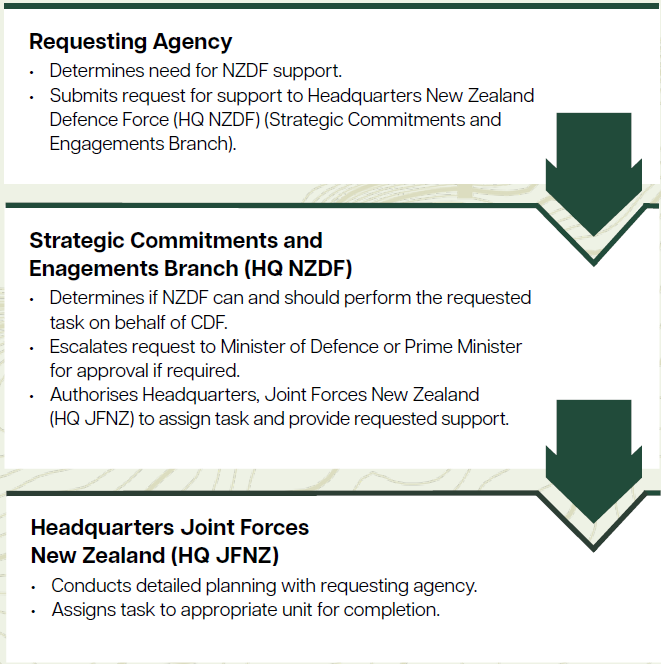
Source: NZDF
859 NZDF also told the Inquiry that there is a Memorandum of Understanding (MOU) between the agencies, which formalises the procedures to be used when either agency provides support to the other. The MOU sets out processes for authorising a request and planning the relevant activity.
860 After considering the Police request with Headquarters, Joint Forces New Zealand (HQ JFNZ), SCE personnel provided a response on 24 May 2022. They explained that various NZDF air assets (including the P-3K2 Orion) were either unsuitable or unavailable, and concluded that “…the search area as currently understood, is vast, and regardless of the method of searching, it will be like looking for a needle in a haystack making the use of these assets ineffective”.
861 While NZDF concluded that the request could not be fulfilled at the time, NZDF advised that it may be better placed to provide support or other potential options if the search area could be refined, “…for example to a 5km x 5km box”, or if more information on the “likely area of movement came to hand”, provided that assets were available.
862 The Inquiry was told that a senior officer from the SCE branch also had a phone conversation with the Police Manager, Operations Support, to further explain the response.
863 This response was not ignored by Police. They narrowed the search area. On 10 December 2022, the Manager, Operations Support forwarded to SCE another request for aerial support from the then Area Commander Waikato West. The Area Commander sought an aerial search of the 5 km2 area centred on the location where Tom Phillips’ vehicle had been found in January 2022. However, NZDF replied that it did not have any available air assets that would have been suitable to perform the request (noting that the P-3K2 had since been decommissioned).
Further requests for information and for aerial support, and provision of technical assistance – late 2023 to early 2024
864 In August and September 2023, Police made several discrete requests for assistance from NZDF. In response the following happened.
a. In August 2023, NZDF provided Police’s STG with geospatial intelligence support on certain locations of interest.
b. NZDF geospatial intelligence personnel also provided advice to their Police counterparts on the use of various forms of satellite and aerial imaging. This included hyperspectral imaging; that is, imaging that uses the electromagnetic spectrum. This technology was considered potentially useful for identifying objects in the bush.
865 On 21 September 2023, Police’s Manager, Operations Support communicated to NZDF a request from the Police investigation team for aerial thermal imaging to locate inhabited camps or huts in the area between Te Maika and Te Waitere, on the Kawhia Harbour. The Inquiry was told that NZDF personnel declined the request orally, on the basis that NZDF had limited capabilities for the task.
866 In January 2024, Police’s TOG requested NZDF’s technical assistance in relation to cameras. NZDF personnel developed and tested a technical concept which was provided to TOG in February 2024.
Request for Special Air Service (SAS) tracking support – from March 2024
867 In early 2024, the Police investigation team explored the possibility of using NZDF support for a ground search, and in particular using NZDF’s specialist tracking skills and resources.
868 To that end, in February 2024, the then Officer in Charge of the investigation, advised that:
I am interested in what tracking ability the defence force has that can assist in pointing us to certain locations within our wider area of interest. The area of interest is challenging for Police and the isolation equally makes it difficult to undertake further enquiries. Basically it is not an environment suited to Police staff and due to the risk that Phillips poses to staff we cannot complete any large scale SAR type operation.
869 This request was relayed to Police’s Manager, Operations Support by a Detective Inspector in the investigation team, who added: “…[s]imply put we have a large remote operating area and environment that is not compatible for us (Police searching)”.
870 Following correspondence between STG and the SAS, there was a meeting between STG and the SAS in March 2024. The concept discussed was summarised as follows: “They [SAS] would utilise trackers and observation posts to clear the area and ideally pin-point the Phillips’ location” before handing over to STG. Over the following weeks, SAS conducted further planning, and NZDF and STG intelligence personnel co-operated and exchanged information, in anticipation of a possible joint operation.
871 The Inquiry also heard from NZDF, including from trackers themselves, that trackers are highly experienced, having honed their skills in various environments both here and overseas. They are trained and experienced in locating people in all terrains including, relevantly, bush, forest and jungle. Apart from the more obvious signs of human activity, such as smoke from wood fires and hearing children’s voices, trackers are highly adept at recognising more subtle anthropomorphic changes in their surroundings such as ground and leaf litter disturbance, foliage damage, boot and footwear signs etc.
872 The approach trackers take to the wider context, building a picture of a “pattern of life”, may also have assisted Police to identify others in the community to speak to and questions to ask to assist the investigation. The trackers provided other information to the Inquiry that for operational and security reasons cannot be further detailed or disclosed.
873 This skill-set assists in identifying possible entry points and routes used by the targets, including when they were last used. The skill-set may also be deployed for wider scoping of areas of interest, and conducting “pattern of life” analysis. Plainly and unsurprisingly, elite tracking skills are neither shared nor possessed by Police. That is not a criticism. When Police investigate a crime, they use various operational methods including those discussed elsewhere in this report. Tracking, other than using dogs and surveillance (covert electronic or otherwise), is not generally a core function of Police work.
SAS support to Police as part of Operation Sella – June 2024
874 As set out in Chapter 4.2 of this report, in April and May 2024, Police were planning what became Operation Sella. This was the so-called reward phase.
875 On 31 May 2024, Police made a formal request for support to NZDF in relation to this operation. Specifically, Police asked that four unarmed NZDF personnel be deployed to provide tracking and reconnaissance support to STG. NZDF approved that request.
876 In the event, NZDF personnel participated in covertly infiltrating the identified area, establishing an observation post, observing a location of interest, and exfiltrating.
877 The Inquiry was also told that during this deployment NZDF personnel offered to conduct further covert reconnaissance. This offer included circumnavigating the Phillips family farm to determine whether Tom Phillips may have been accessing the family farm from other directions. NZDF advised the Inquiry that this offer was not taken further by Police.
Engagement at highest levels of Police and NZDF, further request for air support – May–June 2024
878 The Inquiry understands that, around the same time in May 2024, the then Commissioner of Police discussed further NZDF support for Operation Curly with the former CDF; specifically, whether NZDF’s air capabilities could assist in the search for Tom Phillips and the children. The Inquiry heard that this was prompted by the Police investigation team’s desire, supported by the Police Commissioner, to better understand NZDF’s capabilities and “getting cut-through on that”.
879 The Police Commissioner told an Assistant Police Commissioner that he was advised by the CDF to “…go through our usual channel”, being NZDF’s SCE branch. NZDF told the Inquiry that this reflected standard procedure for NZDF and Police, as set out in the MOU, and was not intended to be unhelpful.
880 This led to Police making a formal request to NZDF for aerial search support on 7 June 2024 to complement Operation Sella. In accordance with the standard protocol, that request was made by Police to NZDF’s SCE branch.
881 NZDF personnel evaluated the further request for RNZAF air support. They considered the deployment of P-8 Poseidon or KA350 King Air aircraft, and concluded that the request could not be fulfilled as they did not have assets which could achieve the outcome Police were seeking. That is, the available assets were not capable of performing “covert” surveillance (as requested) and other potentially useful capabilities had not been released for operations (and were unlikely to be).
882 This advice was communicated to Police on 10 June 2024. In responding to the request, the RNZAF noted that there were areas it would like to work through with Police (relating to the assistance that the RNZAF could provide) and offered to provide Police with a briefing on the capabilities of new assets that had recently entered into service. The Inquiry was told that an officer from the SCE branch also had a conversation with Police’s Manager, Operations Support to discuss the NZDF response to the Police request.
The Police investigation team’s efforts to obtain further information on NZDF capabilities – late 2024
883 The Police investigation team continued to consider possible and potential NZDF support. For example, in a jobsheet prepared by the Officer in Charge of the investigation team it is recorded that his priorities for Operation Curly in the week of 24 June 2024 included “NZDF consideration regarding use of SAS (tracking abilities) and Air Force (what capability)”.
884 It does not appear Police took up RNZAF’s offer in June 2024 for a briefing on its new capabilities. However, two months later, active steps were taken to advance the Police investigation team’s knowledge and understanding of what was available. Following discussions with Police’s geospatial intelligence team, the Officer in Charge of the investigation team considered the need to seek further information on NZDF’s capabilities, observing:
I think we need to go back to the drawing board and find the relevant Ass[istant] Comm[issioner] or higher up and get a meeting sorted with defence personnel (specifically the Air Force) who we can brief up and see what they can offer.
885 Then, on 30 August 2024, a Detective Inspector in the investigation team wrote to the Police Manager, Operations Support, advising that “[u]s sit[t]ing down with the right people to discuss what can and can’t be done and options is what we are looking for”. As the Waikato District Commander told the Inquiry:
[Police] had an idea that [NZDF] had some capability and … we were being told that they didn’t and we wanted to go and talk to them, eyeball to eyeball, to see whether that was true or not.
886 The request to discuss the options available for the NZDF to support Operation Curly was passed on by Police to NZDF in general terms (rather than specifically focusing on RNZAF capabilities). It was communicated in two ways.
887 Firstly, the request was forwarded by the Manager, Operations Support to SCE on 30 August 2024. It was explained that the investigation team “…would like to engage with the ‘right’ person across what options would be available to them”.
888 Secondly, on 3 September 2024 the Manager, Operations Support also forwarded the request to a senior STG colleague. The Inquiry understands that the colleague arranged a meeting later in September 2024. This was attended by at least one senior member of the investigation team and by SAS personnel. Significantly, SAS support, including tracking capabilities, was discussed. The Inquiry was told by the District Commander at the time that, ideally, he “wanted to put some people into the bush for a period of time”. But, following this meeting, he was told: “we don’t think this is going to be a goer”.
889 However, no response by SCE to the Detective Inspector’s request has been provided to the Inquiry. NZDF advised the Inquiry that its personnel could not recall whether a response was provided. In any event, there was no sit-down meeting arranged between Police and SCE. In the Inquiry’s view, had such a cross-agency meeting been convened, it would likely have materially assisted the Police investigation team in understanding what effective capabilities were available and how they might have been meaningfully deployed in the search for the Phillips children.
Further query regarding air assets – September 2024
890 At the same time as discussions were ongoing regarding possible SAS support for Operation Curly, Police’s Manager, Operations Support wrote again to SCE on 13 September 2024 regarding the availability of air assets. They noted that NZDF had previously advised that it had no relevant or available capability that would be more effective than Police’s Eagle helicopter to carry out covert surveillance of a large area to detect signs of life from the air, and sought confirmation that this was still the position. The Inquiry was told that an officer from SCE responded orally, confirming that NZDF’s capabilities for the task did not exceed those of Police.
891 As with earlier requests set out above, these instances show the Police investigation team seeking assistance, and attempting to understand NZDF capabilities, but being responded to within the confines of particular specialties. Police received commendable engagement from one specialist NZDF element – SAS.
892 However, at no stage does it appear that NZDF personnel with knowledge of the full range of NZDF capabilities sat down with Police, as requested in 2024, to discuss how best those capabilities could be utilised in a coherent strategy to assist with safely locating the children. As put to the Inquiry by a senior police officer, “we are trying to flag up everything, right…Why don’t you come back and be proactive?”
SAS tracking support in response to October 2024 sighting
893 As described more fully in Chapter 4.5 of this report, there was a sighting of Tom Phillips and the children by pig hunters on 3 October 2024. It was in an elevated area in what is known as the Trig Paddock. This was a particularly significant development in the course of the investigation.
894 On learning of the sighting that evening, Police promptly requested NZDF tracking support (within around or under two hours). NZDF approved the request, informed by the earlier planning for an operation of this kind. SAS personnel were deployed early the following morning to join STG personnel. SAS arrived at the area of the sighting, in Trig Paddock, around midday – approximately two hours after STG personnel had arrived in the area.
895 The Inquiry heard that STG personnel could possibly have deployed sooner that day, but this was delayed, albeit by not more than approximately two hours, while NZDF awaited Police Assistant Commissioner approval of SAS personnel carrying weapons. The Inquiry accepts the account of NZDF and STG that this delay did not materially compromise the recovery attempts which followed.
896 Between 4 and 6 October 2024, SAS personnel provided tracking support to STG. Despite those combined efforts they were unable to locate Tom Phillips and the children in the time allocated.
897 Complementing the ground operations, NZDF also fulfilled a Police request for support from NH90 helicopters, which were used to deploy trackers to a number of locations of interest in the area.
898 Notably, during their deployment at this time, SAS personnel and STG developed a targeted surveillance plan, drawing on and led by specialist NZDF expertise, to further narrow the search area. They did this by installing covert cameras on trails in the area. Furthermore, the specialist NZDF staff and STG personnel together assisted the investigation team by developing that plan in subsequent weeks. As is described further in Chapter 4.2 and 4.5, that plan was later put into effect and became a critical element in Police’s investigation over the following eleven months.
SAS tracking support in response to April 2025 sighting
899 As is described more fully in Chapter 4.5, in April 2025, Police deployed the FlexRotor drone to seek to locate Tom Phillips and the children. The FlexRotor phase involved placing STG on stand-by to respond to any detection. On 9 April 2025, Police also made two requests for support to NZDF: for tracking personnel, and for NH90 helicopter support to deploy the trackers. Both requests were approved by NZDF.
900 In the early hours of 24 April 2025, the FlexRotor detected four figures moving across open ground in the search area. That morning, Police activated their request for NZDF tracking support and NH90 support. SAS trackers were deployed into the operating area shortly after 4.00 pm that day. Between 24 and 27 April 2025, the trackers located and followed a number of signs, but were ultimately unable to locate Tom Phillips and the children in the time allocated.
Findings
For those requests that NZDF accepted to fulfil, the support provided by NZDF to Police was exemplary
901 The Inquiry finds that, for those requests that NZDF accepted to fulfil, the support provided by NZDF to Police was of an exemplary quality. In particular, the Inquiry was told that the SAS reconnaissance and tracking support (and helicopter support for these operations) provided by NZDF was well-planned and provided in a prompt, effective and highly professional manner. The Inquiry was also told that while NZDF assets are subject to considerable competing demands, NZDF provided Police with highly-skilled personnel to provide the support requested. The Inquiry accepts this and considers that the NZDF personnel involved deserve commendation.
902 Likewise, the technical assistance provided by NZDF, and the involvement of NZDF personnel in the development of the trail camera concept, demonstrated commendable initiative by NZDF personnel. They assisted their Police colleagues in a timely, skilled and efficient manner. As a consequence, NZDF made a significant and positive contribution to the investigation.
NZDF as an entity should have communicated better with Police to understand the investigation team’s requests for support and discussed appropriate and available capabilities
903 The Inquiry accepts that there is co-operation and interagency understanding between some Police and NZDF elements. In particular, STG and SAS worked well together, and contributed to joint planning in early 2024, and to the successful deployment of SAS tracking support in 2024 and 2025. The Inquiry also heard that NZDF and Police geospatial intelligence personnel work together closely.
904 However, the requests for support by Police to NZDF during Operation Curly were made by members of the Police investigation team, not by other Police units with knowledge of NZDF capabilities. NZDF personnel were, or ought to have been, aware of this; the emails of the Police investigators were being forwarded to them when requests for support were made by Police. This was also made clear when the Police investigation team asked to sit down “with the right people [in NZDF] to discuss what can and can’t be done”.
905 The Police investigation team’s requests, in 2022 and 2023, were – as NZDF acknowledged – “specific” and “transactional”. In particular, they were primarily limited to requests for aerial search support, before it occurred to Police investigators in 2024 to explore NZDF’s ground search capabilities. Those requests were responded to by NZDF in like terms.
906 NZDF told the Inquiry that the process of providing support to OGAs could be improved by requiring interagency planning, between NZDF and the requesting agency, as early as practicable, if possible, prior to lodging a formal request for support.
907 The Inquiry agrees. It expects that early operational planning would necessarily involve an open dialogue between NZDF and the requesting agency, as a result of which NZDF would be able to understand the outcome sought, and work collaboratively with the requesting agency to identify its available resources, and jointly plan a concept of operations.
908 The utility of early operational planning was demonstrated by the joint planning and co-operation between STG and SAS during Operation Curly. This resulted in an early and shared understanding of Police’s objectives and NZDF’s available resources, and ultimately in deployments of SAS personnel alongside STG personnel that were conducted effectively and efficiently.
909 The Inquiry finds that it would have been reasonable and practicable for NZDF to have responded to the Police investigation team’s requests by ensuring:
a. the operational context, including the outcome that Police desired to achieve, was understood, and
b. relevant NZDF capabilities were identified and provided to Police, subject to NZDF’s resourcing and other operational considerations.
NZDF could have encouraged the setting up of a multi-agency working group early in the investigation
910 NZDF routinely participates in multi-agency responses in its role as a supporting agency. Knowing that Police had not set up such a response, NZDF could have encouraged this approach at an early stage rather than responding to Police on a request-by-request basis.
911 The Inquiry has found that Police should have responded to the disappearance of Tom Phillips and the children in December 2021 by promptly establishing a multi-agency working group, of which Police should have been the lead agency, and NZDF an important component as a participating agency.
912 The lack of such a multi-agency response in 2022 was identified to the Inquiry as a missed opportunity by NZDF personnel. One NZDF officer who was involved in responding to Police requests for support in 2022 reflected that the lack of a “combined planning session…involving different agencies”, which “have different things that they can offer, to then come up with a plan” was an oversight.
913 The Inquiry also heard from NZDF about the processes in the emergency management context, where such combined planning sessions and multi-agency responses are routine, for example when responding to a natural disaster. In those cases, “[y]ou’ll have that initial sort of engagement, planning activity, and then you come up with a plan of how you’re going to get after [it]”. As the NZDF officer insightfully observed:
[N]o one person’s going to have all the answers but by bringing in agencies with different perspectives, you can sort of draw that out and so perhaps that’s the key takeaway there is…in these types of scenarios…it’s essentially another emergency. It’s a crisis, it’s a very unique scale. But actually…apply the same emergency response framework…We’ve already got a framework, it’s a crisis. It’s just not a flood, it’s not an earthquake, or whatever that we are typically more akin to responding to.
914 The Inquiry heard that NZDF does not ordinarily operate as the lead agency in such multi-agency responses. That is understandable and the Inquiry accepts that is particularly appropriate when the Armed Forces are being used in New Zealand to provide a public service, such as support to Police.
915 The Inquiry finds that, in this case, NZDF could have appropriately encouraged Police to adopt and lead a multi-agency response with NZDF as one of the participating agencies. This was warranted by the inherent seriousness of the situation: three young children taken into the bush following a previous disappearance. In responding to that situation, Police required complementary skilled input and assistance from other agencies, including NZDF.
NZDF capabilities could have been utilised more fully and earlier to help in finding the children
916 NZDF could have made additional contributions to the search for Tom Phillips and the children. This is largely because of the impressive range of capabilities possessed by NZDF, potentially available to assist.
917 NZDF told the Inquiry that the availability of these capabilities cannot be assumed, in light of competing military uses and operational priorities. The Inquiry accepts this.
918 However, if better communication between NZDF and Police had occurred, and a multi-agency working group had been established, it is likely that NZDF’s subject-matter experts would have had useful contributions to offer the Police investigation team. The Inquiry expects that would or should have included personnel with tracking expertise.
919 Other NZDF capabilities, as told to the Inquiry (not all of which can be repeated here due to security and operational reasons), could have included map analysis to narrow and identify locations of interest, and developing methods to investigate (using particular technologies and specialist skill-sets). The Inquiry also heard that tracking and reconnaissance may be possible even in a large area of interest without a defined starting point (e.g. a recent sighting). Tracking of this kind requires an extended time commitment.
920 In addition, it can be expected NZDF personnel would identify information of value to the investigation, even if they do not locate the targets. The Inquiry also heard that NZDF personnel are capable of conducting tracking and reconnaissance operations for extended periods, measured in weeks or months. Critically, utilising these capabilities did not require a sighting of Tom Phillips and the children.
921 The Inquiry finds that if the full range of relevant NZDF capabilities had been identified, possibly as part of a multi-agency response, and fully utilised from an early stage (subject to availability), they may have contributed to a significantly speedier outcome.
Findings
33 For those requests that NZDF accepted to fulfil, the support provided by NZDF to Police was exemplary
34 NZDF as an entity should have communicated better with Police to understand the investigation team’s requests for support and discussed appropriate and available capabilities
35 NZDF could have encouraged the setting up of a multi-agency working group early in the investigation
36 NZDF capabilities could have been utilised more fully and earlier to help in finding the children
Recommendations |
|---|
|
7. The Inquiry recommends early operational planning by NZDF and the requesting agency 7.1 Interagency operational planning should occur between NZDF and the requesting agency as early as practicable. If possible, it should occur prior to lodging a formal request for specific or general NZDF capabilities. This requirement could usefully be incorporated into the MOU between NZDF and Police, which the Inquiry understands is under review. |
|
8. The Inquiry recommends further review of the aspects of section 9 of the Defence Act 1990 may be appropriate 8.1 Section 9 of the Defence Act does not specifically provide for NZDF to assist Police in non-emergency situations. Nor does section 9 address the arming of NZDF personnel, or the powers and protections of NZDF personnel, in such situations. The Inquiry heard that section 9 is being reviewed and that the Ministry of Defence considers that it is currently fit for purpose. The Inquiry considers further review of the aspects of section 9 described above may be appropriate. |
6. Firearms
922 The Inquiry has been asked to address how Tom Phillips obtained and maintained his firearms licence, and how he obtained the weapons and ammunition he had access to during the second disappearance.
923 Because Tom Phillips was known to be armed during the second disappearance, this restricted the range of responses Police were able safely to deploy in their search for the children and significantly added to the difficulty in undertaking any search.
924 The risks extended not only to Police and those assisting them, but also to the general public. And while his possession of firearms alone may have been the source of justified alarm, evidence that he was prepared to use them against others only came after he was eventually linked to the armed bank robbery on 16 May 2023.
925 Police investigations have concluded that Tom Phillips had at least eight firearms in his possession during the second disappearance, and a significant amount of ammunition. This included the firearm Tom Phillips used to shoot the police officer in the confrontation that led to his death on 8 September 2025. Police consider it likely he possessed other firearms and ammunition, which have not yet been recovered.
6.1 The firearms licence
How did Tom Phillips obtain a firearms licence?
926 On 8 August 2003, Tom Phillips, then aged 16, applied for a firearms licence. This process met the legislative requirements that were in place at the time. These included that no one was permitted to hold a firearm unless he or she was at least 16 years old and had a firearms licence.127
927 Each application for a firearms licence was required to be made to, and vetted by, Police. Police policy, rather than legislation, placed rules around how Police were to carry out the vetting process. For example, the standard form filled out by Police when vetting an application, known as the Vetting Guide, was required to be completed in full. Police were required to issue a firearms licence if the applicant met the age requirement and was a “fit and proper” person to possess a firearm.128
928 Following his application in 2023, Police vetted Tom Phillips’ application for a firearms licence in 2003. The vetting process did not fully comply with the rules made by Police. For example, parts of the Vetting Guide relating to computer system checks were left blank. This included a part requiring Police to make certain checks about the person applying for the licence and his or her referees.
929 That said, this omission was not material in the sense that it might have led to a different result. The Inquiry considers that, even if Police had followed their own prescribed practice, Tom Phillips would have been granted a firearms licence. This is because the required checks would likely not have raised anything relevant to Tom Phillips’ application, and neither of his referees raised any concerns about his application.
930 On 25 November 2003, Police issued Tom Phillips with a 10-year firearms licence.
Licence renewal: 2013
931 On 22 July 2013, a few months before his licence was due to expire, Tom Phillips applied to renew his firearms licence. In August to September 2013, Police vetted his application. Again, the vetting process adopted was not fully compliant with the rules. This includes the following.
a. Parts of the Vetting Guide were left blank. Police did not record the number of firearms Tom Phillips held. The Vetting Guide stated that the number of firearms of a sporting configuration “must” be recorded, but did not require the recording of non-sporting configuration firearms.
b. The Vetting Guide stated that referees, especially a spouse or partner, must be interviewed separately from the person applying for a licence. However, Ms Smith told the Inquiry that, as both a referee and, at the time a spouse, she was questioned in her husband’s presence.
932 Again, however, on the evidence, the Inquiry considers it likely that, even had Police followed the Vetting Guide in these respects, Tom Phillips would have been granted a renewal of his firearms licence. None of the omissions, either individually or collectively, was material in terms of outcome.
933 Omitting to record the number of firearms Tom Phillips held would likely not have altered the outcome of his application. The law did not restrict the number of firearms a licence-holder may possess. As for Ms Smith being interviewed in her husband’s presence, she told the Inquiry that issues she later had with unsecure storage of firearms had not arisen at that time. Equally, the Inquiry considers that other matters could have arisen had she been interviewed separately.
934 On 25 November 2013, Tom Phillips’ firearms licence was renewed for a further 10 years.
How did he maintain his firearms licence?
935 Tom Phillips maintained his firearms licence from 25 November 2013 until it was suspended by Police on 8 October 2021 shortly after the first disappearance ended. It was revoked on 5 January 2022, shortly after the second disappearance began.
936 However, before it was suspended, there were two reports that called into question whether he remained a fit and proper person to hold a firearms licence.
The 2018 allegations
937 The first of these was on 19 November 2018, when Ms Smith made allegations that Tom Phillips was storing unsecured firearms. According to a Police record:
[SMITH] expressed her concern that [they, she and her children] were living in a home with insecure firearms, although this may be her attempt at getting back at her ex-husband. A cold call will be requested to have local Police visit the ex-partner and to check on firearms security.
938 In response to a question by the Inquiry, Police were unable to provide any evidence that a cold call was ever made. Police did, however, conduct a “security check” in early 2019, after Tom Phillips moved to his Ōtorohanga home. It was noted as passed, indicating that there were no issues with the secure storage of his firearms.
The early 2021 allegations
939 On 18 February 2021, a police officer telephoned Ms Smith. He wanted to speak to Tom Phillips. This was because he was recorded as holding a firearm and magazines that were by then prohibited under new firearms laws, that applied in the wake of the Christchurch terrorist attacks. During the call, Ms Smith made allegations about Tom Phillips and his firearms. The officer recorded these comments in a statement.
940 Ms Smith alleged that Tom Phillips did not have just one prohibited firearm. He had “heaps of them”. She claimed he had “at least 12 guns that Police did not know about” and was “buying them from mates and people all over the show”. She asserted that the guns were “stored all over the place”, adding that “some were hidden under the couch, under the bed at home and up at his parents’ farm on Marokopa Road… in the shed out the back, in the woolshed and hidden near the offal pit”.
941 Given the seriousness of these allegations, the officer sensibly decided to elevate them to local Police. He contacted a colleague at the Ōtorohanga Police, who then emailed two other colleagues in the Criminal Investigation Branch (CIB). The Ōtorohanga police officer asked them to “look at this matter…”, commenting:
Looking at their history, it looks like the informant is the aggressive party so the veracity of her information may be questionable. Probably do have to act on it though.
942 A couple of weeks later, on 31 March 2021, the officer who had recorded Ms Smith’s allegations called the Ōtorohanga Police for an update. The Ōtorohanga police officer then emailed a senior police officer in the CIB asking him to review the statement and to consider what investigation was required. Later that day, the CIB officer asked colleagues for an update.
943 A little over two weeks later, on 16 April 2021, an update was given. This included an opinion that there did not appear to be “enough for a [search warrant]”. This was followed by a further comment, this time on Ms Smith’s credibility, that given the “custody dispute in the background between the pair”, there was “reason to further question” the “veracity” of the allegations. One suggestion was to “do a door knock and request to complete a voluntary check of firearms. Is this something you can deal with?”.
944 Unfortunately, this is where things seem to have stopped. There is no evidence that anyone in Police took any action in response to Ms Smith’s allegations or the recommendations of the officer who recorded her allegations. Nor is there any evidence that anyone in Police carried out an inspection of Tom Phillips’ firearms despite their new legal power to do so after a 7-day notice period.129
Seizure of firearms: September to October 2021
945 On 14 September 2021, the day after Tom Phillips and the children were reported missing for the first time, Police seized ammunition (74 shotgun cartridges) from his property.
946 The next day, Police seized four firearms from the same property. The following table summarises what Police have told the Inquiry they later discovered about how Tom Phillips obtained those firearms:
Firearms seized, 14 September 2021
| Name | Type | Acquisition |
|---|---|---|
|
Black ‘Mossberg |
Bolt action .308 rifle, with 5 round magazine capacity’ |
Purchased by Tom Phillips from |
|
‘Akkar’ shotgun |
12 gauge under/over double barrel shotgun |
Owned by |
|
Brown ‘Norinco’ |
.270 rifle |
|
|
Brown ‘Cooey’ single barrel rifle |
.22 single shot |
947 Police also seized ammunition: “[o]ne full packet of Winchester 12 gauge shotgun shells (5 x shells); Remington centrefire rifle case with cartridges (5 full cartridges, 15 empty); FIOCCHI 308 Winchester hollow point case (8 x full, 12 empty)”.
948 Also on 16 September 2021, Police interviewed a family member about what firearms Tom Phillips had. Police were told he had seven. Police have advised the Inquiry that, of those seven firearms.
a. Three firearms were surrendered by Tom Phillips under the Arms Buy Back scheme in December 2019 and April 2021.
b. Two were seized by Police from Tom Phillips’ Ōtorohanga home on 15 September 2021 (being the .308 rifle and 12 gauge shotgun).
c. Police later seized another weapon on 1 October 2021.
Firearms seized, 1 October 2021
|
Name |
Type |
Acquisition |
|---|---|---|
|
‘Norinco JW15A’ rifle |
Bolt action .22LR rifle |
Purchased by Tom Phillips from a licensed dealer on |
d. The last firearm was a .233 rifle (pictured at 969.3 below). This firearm was found with Tom Phillips on 8 September 2025.
949 Apart from interviewing the family member in September 2021, there is no record of Police taking any other steps after the first disappearance and before the second disappearance to identify any other firearms that Tom Phillips may have possessed at this time.
Suspension and revocation of Tom Phillips’ licence: October 2021 to January 2022
Suspension
950 On 7 October 2021, a Constable made a report recommending that Tom Phillips’ firearms licence be reviewed to ensure that he was still a fit and proper person. In summary, this was due to concerns around his mental health, his preparedness to put his children’s wellbeing at risk, and evidence of significant alcohol consumption. The report also referenced Ms Smith’s comments about insecure firearm storage. This report is described more fully in Chapter 6.1.
951 The next day, on 8 October 2021, Police issued a notice suspending Tom Phillips’ firearms licence. Police have the power to temporarily suspend a licence, “pending possible revocation”, if satisfied that the licence-holder is not a fit and proper person to hold a firearm.130 Following suspension, Police may require the licence-holder to immediately surrender their licence, firearms, and ammunition.131 If the licence-holder fails or refuses to do so, Police have the power to seize any of those items in the licence-holder’s possession or under their control.132 This power did not extend to a power to enter premises, unless the requirements were met for a warranted or warrantless search.
952 The reasons given by Police in the suspension notice included that Tom Phillips was not a fit and proper person in light of “concerning behaviour and actions” before and after the disappearance and his alcohol use. The notice required him to immediately surrender his firearms licence, firearms, and ammunition.
953 The children’s sister told the Inquiry that at some point after Tom Phillips took the children the first time, she contacted Police to ask them to revoke his firearms licence and take his guns off him. She considered his actions in taking the children the first time showed that he had “lost the plot”, and that he should not have access to guns. She said she also told Police about her experience of Tom Phillips being threatening towards her, and offered to pass on information of another person who she understood had evidence of Tom Phillips’ threatening them. She told us that Police declined her offer, saying they already had enough information to suspend his licence.
Service of suspension notice: delay of service and no seizure of firearms
954 It took nearly two months to serve the suspension notice. In addition, an internal instruction to seize any other firearms on service of the suspension was not completed. A chronology follows.
955 On 12 October 2021, an officer made an entry in the Police’s Communications and Resource Deployment (CARD) system. It related to the proposed service of the notice of suspension. The entry included an instruction to “please check there is nothing further to be uplifted” and to “seize any firearms” because Police “have uplifted some of his firearms but there may be more as have not confirmed if we have uplifted all firearms”. The entry also stated that “[t]his event must not be k1’d”. As earlier noted, albeit in a different context, K1 is a Police code meaning that Police attendance is sufficient, and the event requires no further action. This entry confirms that Police at that time, rightly in the Inquiry’s view, not only considered that Tom Phillips was not a fit and proper person, but that evidence sourced from disparate sources mandated locating and seizing any other firearms.
956 Unfortunately, what happened after this reveals a disappointing lack of urgency. For example, on 13 October 2021, another CARD entry stated: “… distance/staffing did not allow for service today – no urgency … please k1 this matter …”.
957 The next day, on 14 October 2021, an attempt at service was “unsuccessful” and plans were made to serve the notice the following week. In November 2021, various officers asked for an update on service.
958 Despite that, six weeks passed until 1 December 2021, when another CARD entry provided an update which stated:
service yet to be completed – several attempts made to travel to address however other demands interfered with those plans … Firearms and licence previously seized during the course of the initial SAR [search and rescue] – Scheduled court date postponed due to covid thereby missing another service opportunity
959 On 2 December 2021, a police officer served the notice of suspension on Tom Phillips’ mother. That course constituted lawful and effective service.133
960 The Inquiry has not seen any evidence that, at the time of service, Police made any attempt to determine whether Tom Phillips had other firearms, ask for their surrender, or if necessary carry out a search. If that is correct, given the background set out above, it seems a surprising omission. Particularly when Police had information claiming he had firearms stored at his parents’ farm.
961 On or around 9 December 2021, Tom Phillips disappeared with his children for the second time.
962 On 5 January 2022, Police issued a notice revoking Tom Phillips’ licence. The reasons relied on by Police largely reflected the grounds set out in the suspension notice.
963 On 11 January 2022, the notice of revocation was served on Tom Phillips’ mother.
Access to a family member’s firearms following suspension
964 After Tom Phillips returned from the first disappearance, Police considered whether he had access to firearms owned by a family member with whom he was living at the family farm. However, it appears that after the suspension, Police did not take any steps to investigate or address Tom Phillips’ access to any firearms in the home. Again, on its face, this seems a surprising omission given that, until he and the children disappeared for the second time, he was subject to a residential order requiring him to live in the family home.
965 Three of the eight firearms recovered following on and after 8 September 2021 were originally purchased under the firearms licence belonging to a family member he was living with prior to his disappearance.
6.2 Firearms and ammunition
How did Tom Phillips possess eight firearms during the second disappearance?
966 Police have confirmed Tom Phillips had possession of at least eight firearms during the second disappearance. The Inquiry records its gratitude to Police for their assistance and detailed analysis of this matter. According to Police, it is likely that he had more firearms than that, but these have not yet been located. Of the eight firearms:
a. Tom Phillips purchased four from licensed dealers,
b. one was gifted to him by a family member years before the first disappearance, and
c. the remaining three had been purchased under a family member’s firearms licence. Tom Phillips was reported to have stolen one of those from the family farm during the second disappearance. Police have not been able to determine how or when Tom Phillips came to be in possession of the other two firearms.
967 These eight firearms are described in the following paragraphs.
Firearms purchased from a licensed dealer
968 Tom Phillips purchased the following firearms from a licensed dealer.
Beretta Extrema II SYN KO 28” purchased on 23 February 2007 and subsequently modified. According to Police, this is almost certainly the firearm Tom Phillips used during the aggravated robbery of the Te Kūiti ANZ on 16 May 2023.
Beretta Extrema II SYN KO 28”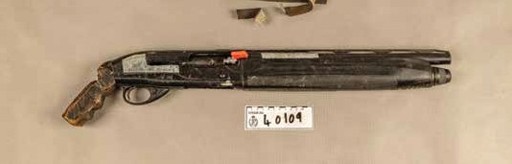
Source: NZ Police
Tikka T3 300 WSM, purchased on 13 July 2012.
Tikka T3 300 WSM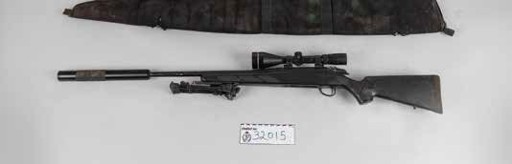
Source: NZ Police
Tikka T3 .223 rifle, purchased on 11 April 2015.
Tikka T3 .223 rifle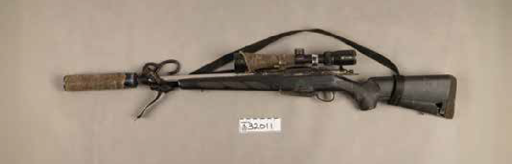
Source: NZ Police
Ruger Precision Newport-NH-USA, purchased on 28 December 2019.
Ruger Precision Newport-NH-USA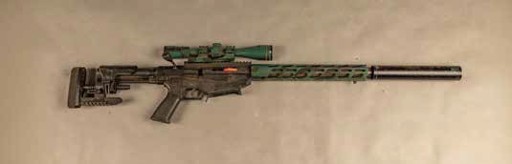
Source: NZ Police
Firearm gifted to Tom Phillips
969 The firearm gifted to Tom Phillips is the Rossi .44 magnum, purchased by a family member on 29 September 2001, and gifted many years before the disappearance:
Rossi .44 magnum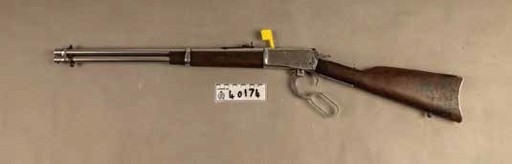
Source: NZ Police
Firearms stolen or otherwise acquired
970 The firearms that Tom Phillips stole, or otherwise acquired, from another family member are:
a. Norinco JWT5A 22LR that Tom Phillips reportedly stole from the family member during the second disappearance,
Norinco JWT5A 22LR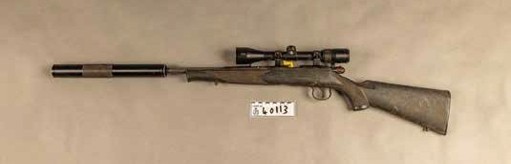
Source: NZ Police
b. Ruger M77 Mark II .270 WLN, purchased under a family member’s firearms licence from a licensed dealer on 14 August 2003 and acquired by Tom Phillips in circumstances unknown to Police,
Ruger M77 Mark II .270 WLN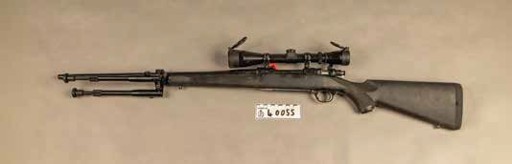
Source: NZ Police
c. Modified .22 pistol, originally purchased under the family member’s firearms licence from a licensed dealer on 24 February 2006 and acquired by Tom Phillips in circumstances unknown to Police. According to Police, this firearm was almost certainly used during the aggravated robbery of the ANZ bank at Te Kūiti on 16 May 2023.
Modified .22 pistol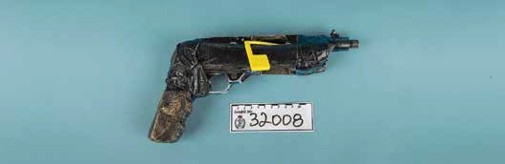
Source: NZ Police
Police knowledge of these weapons during the second disappearance
971 For the first 18 months or so of the second disappearance, Police did not investigate what or how many firearms were held by Tom Phillips. That approach changed after the 16 May 2023 armed robbery in Te Kūiti was eventually linked to Tom Phillips as set out in Chapter 4.4.
972 In July 2023, following enquiries with a licensed dealer, Police concluded that Tom Phillips appeared to possess two firearms bought from that dealer. These were the Ruger Precision Newport-NH-USA and the Tikka T3300 WSM .
973 By December 2024, Police were certain that Tom Phillips possessed at least three firearms including a cut down semi auto shotgun, a cut down rifle (possibly a .22), and a suppressed centrefire rifle.
How did Tom Phillips obtain ammunition during the second disappearance?
974 The next question for the Inquiry to answer under the terms of reference is how did Tom Phillips come to hold ammunition during the second disappearance?
975 Following recovery of the children, Police located a significant quantity of ammunition at two of the sites known to have been occupied by Tom Phillips and the children. According to Police, it is “more likely than not” that Tom Phillips had more ammunition than that recovered.
976 The calibre of the most common rounds was .223, .308, and .22LR. The majority of the ammunition was located at the last campsite occupied. The table below sets out the detail of what Police recovered. As is apparent, the type, calibre and brandn is very broad. The total number of rounds exceeded 1,300.
Ammunition Table
|
Ammunition |
Number/rounds |
|---|---|
|
.22 ammunition |
36 |
|
.22 Long Rifle ammunition |
408 |
|
.22 Winchester ammunition |
20 |
|
.223 REM ammunition |
59 |
|
.270 ammunition |
10 |
|
.308 WIN ammunition |
49 |
|
.44 REM MAG |
46 |
|
12.7 calibre round of ammunition |
1 |
|
300 WSM |
13 |
|
4 boxes of Federal Ammunition Primers |
4 |
|
4 x rounds of Winchester Buck Shot and 3 x rounds of Gamebore Buffalo Slug 70mm (shotgun ammunition) |
8 |
|
44 MAG |
40 |
|
5 x rounds of 223 Remington ammunition |
5 |
|
9 rounds of Buffalo slug 70mm and 1 round of |
10 |
|
ADI 12 ammunition |
127 |
|
ADI 14 and 15 ammunition |
55 |
|
ADI T 4 ammunition |
25 |
|
Ammunition containing 12 x rounds of Winchester |
1 |
|
Box of various ammunition, batteries and 10 empty |
34 |
|
G.F.L 9mm Luger ammunition |
99 |
|
G.F.L. 223 REM ammunition |
100 |
|
Shotgun ammunition – 2 ¾ IN – 70mm |
4 |
|
Shotgun cartridges |
7 |
|
Starline .308 WIN |
83 |
|
Winchester .270 |
59 |
|
Winchester 300 WSM |
80 |
977 More ammunition was found at a campsite used by Tom Phillips during the second disappearance, and a smaller amount at the scene on Marokopa Road where he was fatally shot.
978 According to Police, almost all of the ammunition found corresponds with the eight firearms that Tom Phillips held, the only significant exception being the 99 x Luger 9mm rounds. This supports Police’s view that he had access to firearms that have not been recovered.
979 Police have looked into how Tom Phillips might have acquired the ammunition. These enquiries have so far proved fruitless. One challenge is that the majority of the ammunition he stored was not in its original packaging, making it “impossible” to identify the manufacturer or batch number. This was also complicated, at least in part, by the law at the time. Unlike now, it was then not mandatory for those selling ammunition to inform the Firearms Registry about the identity of purchasers and the type and quantity of ammunition sold.134
Findings
Tom Phillips obtained and renewed his firearms licence in the usual way
980 The Inquiry finds that Tom Phillips obtained a firearms licence, and renewed it, by applying in the usual and ordinary way. There were some errors by Police in the vetting process but none that would have likely affected the outcome.
Maintaining a firearms licence: Police did not take all practicable steps to respond to allegations by former spouse about gun safety
981 As to maintaining his licence, Police did not adequately respond to allegations made in early 2021 as to whether Tom Phillips was a fit and proper person. This is because Police did not take all practicable steps to respond to Ms Smith’s allegations in 2021 that Tom Phillips possessed prohibited firearms and was not securely storing them.
982 The allegations were taken seriously by the officer to whom they were made. He acted promptly. Within 30 minutes of Ms Smith’s disclosure he had made a formal statement recording the allegations. He went further. He elevated it to local Police in Ōtorohanga. And later, he followed up with his colleagues to check what had been done with the information. Plainly he appreciated the significance of the allegations, and the risks posed with unsecure firearms in a family home with children. These actions were commendable.
983 Less impressive is how other officers treated those concerns after that point. While it was understandable for Police to take into account the fact that Ms Smith’s disclosures were made against the background of a parenting dispute, it was not reasonable to effectively dismiss them to the extent that they were.
984 The fact that some officers may have mistrusted Ms Smith’s motives does not justify the degree of inertia which followed. The officer who personally dealt with Ms Smith considered her disclosures were sufficiently concerning to elevate to local Police, and then follow up twice. Further, sight should not be lost of the fact that this was not the first time Ms Smith had alleged that the children were at risk from Tom Phillips’ firearms.
985 Had Police taken additional steps, and found that he was not storing firearms securely, they might have seized his firearms and any ammunition, and revoked his licence. In so doing, they may well have identified one or more of the many firearms that Tom Phillips used during the second disappearance.
986 Accordingly, the Inquiry finds that in early 2021, Police ought to have addressed allegations made against Tom Phillips concerning whether or not he was a fit and proper person to maintain a firearms licence. The Inquiry further finds that, had these allegations been properly addressed, this may have led to suspension of his firearms licence, and uplift of firearms that were possessed during the second disappearance.
Police did not, and should have, served suspension notice sooner, and identified and seized firearms on licence suspension
987 After suspending his firearms licence following the first disappearance, in September 2021, Police did not, and should have, promptly served the suspension.
988 In addition, after Police suspended Tom Phillips’ licence in October 2021, they did not take all reasonably practicable steps to ensure they had identified and seized all his firearms. Had Police taken such steps, they may have at least reduced the number of firearms that Tom Phillips possessed, including, perhaps, one of the firearms that was used in the Te Kūiti armed robbery.
989 Significantly, Police had recognised the likelihood that, despite seizing some of Tom Phillips’ firearms, during the first disappearance, there might be more. Further, at the time of the suspension Police had specific information available to them that they had not yet seized all of Tom Phillips’ firearms. A family member had identified at least one of Tom Phillips’ firearms that had not been located: the Tikka T3 .223n rifle. That firearm was not among those that Police seized on 15 September and 1 October 2021.
990 And, it is noteworthy that just a few months earlier, Ms Smith told Police that Tom Phillips had at least 12 guns that Police did not know about, stored all over the place, including on the family farm. Police should have been alert to the possibility of finding firearms at that scale.
991 The officers who served the suspension notice in December 2021 should have ensured Tom Phillips’ firearms were seized at the same time. They were instructed to do so. Their omission to do so was, apparently, the result of a miscommunication. This was exacerbated by the unacceptable delay of almost two months in serving the suspension notice.
992 In addition, and unlike the present position, in October 2021 there was no central registry of firearms held by licence-holders. The Firearms Registry was created on 24 June 2023.135 However, prior to that, there were some limited processes in place to record how many of some types of firearms a licence holder possessed. These were contained in the Vetting Guide. When Tom Phillips renewed his licence in 2013, Police did not record the number of sporting configuration firearms he held, despite that being a mandatory field in the Vetting Guide.136 Had that exercise been undertaken it may have assisted Police as a starting point for their later firearms enquiries in 2021.
993 The Inquiry finds Police could and should have ensured that, after suspending Tom Phillips’ licence, they had uplifted all of his firearms.
Police should have considered Tom Phillips’ access to other firearms in the home where he was required to reside
994 Following suspension of his firearms licence, Police should have identified and addressed whether Tom Phillips had access to firearms owned by any other person at the family farm, where he was required to live after the first disappearance.137
995 This was a significant omission. Three of the firearms in his possession during the second disappearance had originally been purchased under a family member’s firearms licence. One of those was almost certainly a weapon used during the Te Kūiti armed robbery on 16 May 2023. This same firearm was located at the scene where Tom Phillips died.138 The Inquiry finds Police could and should have:
a. considered the security of any other firearms in the home, and reviewed Tom Phillips’ access to those firearms,
b. considered temporarily suspending any other family member’s licence if it was “reasonably likely” that Tom Phillips might be able to obtain a firearm,139 or
c. considered imposing a condition on any other family member’s licence requiring storage of their firearms elsewhere. The Inquiry was told that this is common practice in appropriate cases.
Tom Phillips likely purchased firearms and ammunition himself or obtained them from family members
996 The eight firearms held by Tom Phillips were obtained in a combination of ways: four were obtained by his lawful purchase from licensed dealers prior to the first disappearance; one was gifted by a family member years earlier; one was allegedly stolen from another family member during the second disappearance; and two were obtained from that family member in circumstances which remain unknown to Police.
997 Police have not been able to determine how he acquired the ammunition that was found.
Findings
37 Tom Phillips obtained and renewed his firearms licence in the usual way
38 Maintaining a firearms licence: Police did not take all practicable steps to respond to allegations by former spouse about gun safety
39 Police did not, and should have, served suspension notice sooner, and identified and seized firearms on licence suspension
40 Police should have considered Tom Phillips’ access to other firearms in the home where he was required to reside
41 Tom Phillips likely purchased firearms and ammunition himself or obtained them from family members
Recommendations |
|---|
|
The Inquiry is not to inquire into legislative, administrative, and policy settings for the New Zealand firearms licensing system. |
|
9. The Inquiry recommends that Police ensure that: 9.1 concerns raised by former spouses to Police as to gun safety are actioned promptly and in accordance with Police process, and 9.2 on suspension of a firearms licence, Police exercise the discretionary power to check safety and security of other weapons, where held by other licence holders, in the home. |
7. Concluding comment – interagency coordination
998 A central and recurring theme in the Inquiry’s findings is that if core agencies – most notably Police, Oranga Tamariki, and NZDF – had at various times communicated and coordinated more, the children’s welfare would have been better protected.140
999 The response to Tom Phillips’ actions did not fit squarely or solely within the usual business of any one agency. Each possessed different capabilities, resources and powers. Each had its own knowledge and understanding. And each brought a unique perspective to solving the complex and evolving situation which faced them.
1000 The Inquiry has found that agencies could have worked better together.
1001 Police and Oranga Tamariki worked together prior to the second disappearance, but for a very narrow period only. Had Police and Oranga Tamariki worked more closely together, in September 2021 to December 2021, this may have prevented, or made more difficult, Tom Phillips’ taking the children into the bush a second time.
1002 The response after the second disappearance was, appropriately, Police-led. And, at various points, the agencies worked well together. However, opportunities were missed for better communication and coordination. Had agencies taken these opportunities, the risk of harm to the children would have been identified earlier, and actions taken to locate the children in a more timely way.
1003 Both before and after the second disappearance, agencies could and should have met regularly to share their special knowledge and expertise. This would have provided multiple benefits.
a. Knowledge sharing and building: each agency had different knowledge of what happened both before and after the second disappearance. Interagency and multi-agency meetings would have filled knowledge gaps to better understand and address the ongoing risks and harm to the children.
b. Broader capabilities: each agency has different capabilities, lenses, and tool-kits for appreciating the risks to the children and the recovery of them. A multi-agency approach would have enabled a greater sharing of these skills and capabilities.
1004 Prior to the second disappearance, Police and Oranga Tamariki held different knowledge and information about the children’s situation and risk. Importantly, they also had different tools at their disposal: Police had investigative skills and resources as well as community policing skills; and Oranga Tamariki had the ability to gather information and assess risk through its report of concern processes, and involvement in, and access to, the Family Court.
1005 After the second disappearance, Police should have established and led a multi-agency working group, involving appropriate personnel within Police, NZDF and Oranga Tamariki, and other agencies where relevant, to develop and coordinate a response strategy. This would have enabled a shared understanding of the reasons for urgency in locating the children, and the range of possible strategies available to recover the children. [See diagram below]
1006 Staff we spoke to from all three agencies agreed that a multi-agency approach was missing and could have been useful.
1007 An Oranga Tamariki staff member who spoke to the Inquiry noted that “[t]here was never a common accepted understanding of a level of concern” between Oranga Tamariki and Police prior to the second disappearance. She also stated that “in hindsight…preferably we would have kept that case open [after the second disappearance] and worked it under a MDT [Multi-disciplinary Team] type arrangement. … We need to all keep a join[ed]-up communication plan until such time as they are located.”
1008 A senior NZDF officer the Inquiry spoke to also agreed that there would have been value in approaching this task in a multi-agency manner, as is commonly employed in emergency responses. He said:
..upon reflection, I think, that lead agency approach applying an emergency response framework at the national level [led by Police]...to bring in the parties may have elicited some key capabilities or different approaches to how the planning might have unfolded. Because, you know, no single government agency is going to have the answers to all their problems. But as a lead agency, you bring in the players and see what the team have got.
1009 When asked whether a multi-agency forum would have helped Police think outside of their investigation techniques, a senior officer observed:
I think so, because as Police…we may not just appreciate that other agencies have some different thinking, that diverse thinking, so it can only help.
1010 These comments from all three agencies confirm that a multi-agency response would, in hindsight, have been helpful. The Inquiry cannot but agree.
Government agencies: Practicable steps that should have been taken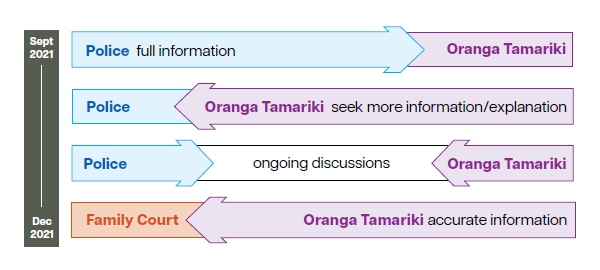
Contribute to: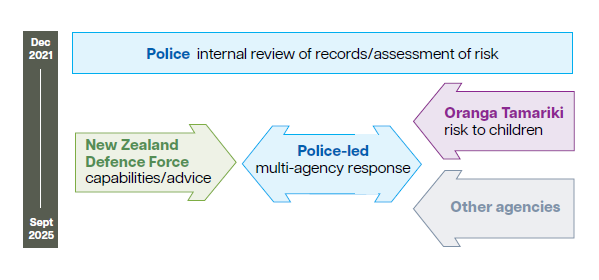
8. Recommendations
1. The Inquiry recommends that Police review their existing policies and practices regarding making reports of concern to Oranga Tamariki to ensure that:
1.1. Police fully explain their concerns and the reasons for them, and establish a shared understanding of concerns. This should include meeting if appropriate and possible to do so, and
1.2. Police and Oranga Tamariki have ongoing and regular discussion and disclosure of relevant information, particularly where there is an ongoing Police investigation or involvement into matters that are related to the report of concern or that may be related to the child’s safety, including a parent’s conduct.
2. The Inquiry recommends that Oranga Tamarikireview the role and operation of s 132 reports, in terms of scope, guidance, and facilitation of its interaction with the Court. This should include:
2.1. a particular focus on developing guidance and training for staff, to ensure staff are well-equipped to recognise exclusion and alienation behaviours when they arise, and take these into account in s 132 reports provided to the Family Court.
2.2. raising staff awareness, where needed, of the use of proceedings to exclude, isolate or alienate a parent,
2.3. guidance to ensure consideration is given to the requirements of section 5 of the Care of Children Act 2004, including section 5(e) that it is the child’s welfare and best interests to have a relationship with his or her family group, whānau, hapū or iwi, and this should be preserved or strengthened.
3. The Inquiry recommends that in its ongoing policy implementation and updates, Oranga Tamariki ensures:
3.1. Police reports of concern – Police concerns and evaluations are understood, rather than listed; and that there is a pathway for Oranga Tamariki and Police to take a joint or collaborative approach to reports of concern where there is an active Police investigation into matters directly relevant to the report of concern,141
3.2. sibling reports of concern – parental and sibling exclusion and alienation is identifiable as a form of harm under s 14 of the Oranga Tamariki Act,
3.3. ongoing training and support is provided to staff, where needed, to better understand and identify the causes for distress of notifiers; including that Oranga Tamariki encourages and supports staff to engage effectively, preferably in person, with distressed family members to understand the full context and dimension of their concerns,
3.4. staff consider making referrals for mental health assessment when concerns about mental health of a parent have been raised in the context of safety to children.
3.5. reporting to the Family Court – that when reporting to the Family Court about reports of concern, Oranga Tamariki makes the Family Court aware of all concerns raised by the relevant parties, including unresolved concerns by family members, and the fact of any ongoing and related Police investigation.
4. The Inquiry recommends that the Ministry of Education requires additional information when considering applications for, or reviewing, exemptions from enrolment
4.1 The Inquiry recommends the Ministry continues to progress its review of law and policy to address the information gaps in the exemption application and review process. The Ministry should consider:
4.1.1 requiring additional information about the parent proposing to home educate their child to assess any safety and wellbeing concerns,
4.1.2 establishing policies and processes to obtain information from other agencies, including Oranga Tamariki and Police, regarding applicants and home educators, and any current wellbeing concerns relating to the children,142 and
4.1.3 ensuring home educators are subject to regular review to provide an opportunity for education and wellbeing issues to be reviewed after the exemption is granted.
5. The Inquiry recommends that the Ministry of Education requires consent from all parents and guardians
5.1 The Inquiry recommends the Ministry considers review of s 38(1) of the Education and Training Act 2020 to require the consent of all parents or guardians to an application for exemption.
6. The Inquiry repeats the findings from chapter 3.2, and further recommends Oranga Tamariki uses the insights arising from this Inquiry to strengthen its practice guidance and training. This should include:
6.1 ensuring staff understand how to recognise, where possible, parental exclusion and alienation, and adult mental health issues,
6.2 ensuring its view and assessment of harm is expressed clearly to, and understood by, Police, and that it understands Police concerns of harm. Further, that there is continuing communication with Police when there is ongoing, and unresolved, concerns with respect to the wellbeing of children, and
6.3 accurately informing the Family Court as to the concerns expressed by family, and any ongoing and unresolved concerns raised by Police of which it is aware.
7. The Inquiry recommends early operational planning by NZDF and the requesting agency
7.1 Interagency operational planning should occur between NZDF and the requesting agency as early as practicable. If possible, it should occur prior to lodging a formal request for specific or general NZDF capabilities. This requirement could usefully be incorporated into the MOU between NZDF and Police, which the Inquiry understands is under review.
8. The Inquiry recommends further review of the aspects of section 9 of the Defence Act 1990 may be appropriate
8.1 Section 9 of the Defence Act does not specifically provide for NZDF to assist Police in non-emergency situations. Nor does section 9 address the arming of NZDF personnel, or the powers and protections of NZDF personnel, in such situations. The Inquiry heard that section 9 is being reviewed and that the Ministry of Defence considers that it is currently fit for purpose. The Inquiry considers further review of the aspects of section 9 described above may be appropriate.
9. The Inquiry recommends that Police ensure that:
9.1 concerns raised by former spouses to Police as to gun safety are actioned promptly and in accordance with Police process, and
9.2 on suspension of a firearms licence, Police exercise the discretionary power to check safety and security of other weapons, where held by other licence holders, in the home.
Appendix
Glossary of terms used in the report of the Public Inquiry into the Disappearance of the Phillips Children
|
Term |
Meaning |
|---|---|
|
AOS |
Armed Offenders Squad |
|
CDF |
Chief of Defence Force |
|
CIB |
Criminal Investigation Branch |
|
ERO |
Education Review Office |
|
HQ JFNZ |
Headquarters, Joint Forces New Zealand |
|
NZDF |
New Zealand Defence Force |
|
NZSAS |
New Zealand Special Air Service |
|
OGA |
Other Government Agencies |
|
Operation Curly |
This was the name of the Police-led efforts to locate and recover the children. The investigation involved assistance from a range of internal specialist groups within Police, as well as external agencies. The investigation continued until the children were found in September 2025. |
|
Operation Rora |
This was the name for the Police investigation into the aggravated robbery of the ANZ bank at Te Kūiti in May 2023 |
|
Operation Marokopa |
This was the name for the Police-led search and rescue operation conducted during the first disappearance of Tom Phillips and his children for 18 days in September 2021 |
|
Operation Sella |
This was the name of the Police-led investigation and recovery operation that promoted a reward for information during June 2024 |
|
SAR |
Search and Rescue |
|
SCE |
NZDF National Headquarters, Strategic Commitments & Engagements branch |
|
SDW |
Surveillance Device Warrant |
|
STG |
Special Tactics Group |
|
TOG |
Technical Operations Group |
Terms of reference
Inquiries (Public Inquiry into Disappearance of Phillips Children) Order 2025 | New Zealand Legislation
Extract taken from the Gazette 27 November 2025
1 Background
(1) This inquiry centres on whether government agencies took all practicable steps to safeguard the safety and welfare of the Phillips children (the children).
(2) Since 2018, the children have been the subject of proceedings in the Family Court about their care and contact arrangements.
(3) Mr Phillips disappeared with the children in September 2021 and, despite searches, was not located. After reappearing, Mr Phillips was the subject of criminal charges.
(4) In October 2021, the Family Court varied an existing parenting order to include conditions that Mr Phillips was to reside at a specified address.
(5) On or about 9 December 2021, Mr Phillips left the address with the children and disappeared. A nationwide search to locate him and the children followed.
(6) In August 2023, the Family Court made an order under the Care of Children Act 2004 placing the children in the guardianship of the Family Court and appointing the Chief Executive of Oranga Tamariki—Ministry for Children as agent for the Family Court.
(7) On 8 September 2025, after Police encountered Mr Phillips and one of the children, Mr Phillips shot and seriously wounded a Police officer. Mr Phillips was subsequently fatally shot by Police. The remaining children were located later that day.
(8) On 9 and 15 September 2025, the Family Court made several orders in respect of these events, including orders prohibiting the publication of information about the children.
(9) Subsequently, on 26 September 2025, the Family Court released a judgment declining to release any of the other judgments of the Family Court.
2 Purpose of inquiry
The facts of this case are exceptional, if not unique. However, the Government has decided that a public inquiry into what role government agencies played and could have played in these events is needed to establish whether government agencies could take steps to prevent or resolve similar situations more quickly and effectively in future, and if so, how.
3 Matter of public importance
(1) It was apparent from occasional reported sightings of Mr Phillips and the children over the period from December 2021 until September 2025 that they were still in the Marokopa area, and that the children’s safety and welfare remained at risk, especially given the time that had elapsed since they had first disappeared.
(2) The matter of public importance that the inquiry is directed to examine is whether—
(a) government agencies took all practicable steps to protect the children’s safety and welfare, including steps to prevent the children’s disappearance; and
(b) government agencies responded appropriately and in a timely way to locate the children once they had disappeared.
4 Scope of inquiry
(1) In establishing this inquiry, the Government is concerned to ensure that the welfare of the children is not further threatened, and directs the inquiry to conduct its investigation and reporting having regard to this central principle.
(2) The inquiry is directed to inquire into—
(a) the nature and extent of the involvement government agencies had with Mr Phillips and the children before and after their disappearance, including—
(i) legal options available to government agencies and the actions taken by government agencies relating to the care of the children, including whether and how such agencies engaged with the Family Court both before and after September 2021, and whether more effective engagement might have occurred:
(ii) what government agencies knew about Mr Phillips and his activities both before and after his disappearance in September 2021 until he was encountered by Police in September 2025 and, based on that knowledge, what steps (if any) it would have been reasonable for government agencies to take, or that government agencies could or should have taken, to prevent the disappearance of Mr Phillips and the children or bring it to an end sooner:
(iii) whether there are any practicable steps that government agencies should take to prevent similar situations from happening again or to protect children caught in such a situation:
(b) how Mr Phillips obtained and maintained a gun licence, weapons, and ammunition.
(3) For the purposes of this inquiry, government agencies includes New Zealand Police, Oranga Tamariki—Ministry for Children, and any other public sector agency that—
(a) had an actual or potential role to play in proceedings before the Family Court in respect of the children; or
(b) had an actual or potential role in locating the children after their disappearance; or
(c) otherwise had a role or responsibility in respect of the children’s safety or welfare during the period from 2018 until they were located.
5 Matters outside scope
(1) The inquiry is not to inquire into government agency involvement with the children after they were located on 8 September 2025.
(2) There has been extensive litigation in the Family Court involving the children and that litigation is ongoing or under appeal. There is also unresolved litigation brought by the news media seeking to challenge court-imposed restrictions on publication of matters relating to the children.
(3) Given the importance of the matters in issue and the need for a timely report on those matters, the Government has decided that the inquiry should commence and report promptly. Some of the litigation referred to above may still be unresolved while the inquiry is underway or before it reports.
(4) In undertaking its work, the Government expects and directs the inquiry to respect the independence of the courts and not comment on or inquire into judicial decisions concerning the children, including suppression orders made in respect of the children.
(5) The inquiry is not to inquire into legislative, administrative, and policy settings for the New Zealand firearms licensing system.
(6) In accordance with section 11 of the Inquiries Act 2013, the inquiry has no power to determine the civil, criminal, or disciplinary liability of any person but may, in exercising its powers and performing its duties, make findings of fault or recommendations that further steps be taken to determine liability.
6 Conduct of inquiry
(1) In the course of its work, the inquiry will consider available and relevant documentation from government agencies and will obtain necessary evidence from agency officials and other relevant witnesses.
(2) In order to ensure the privacy and welfare of the children is not harmed and to respect court suppression orders, the inquiry is directed to undertake its inquiry in private and not to conduct public hearings.
(3) The Government does not expect that the inquiry will need to obtain evidence from overseas or from expert witnesses. If such evidence is required to address the terms of reference, for example, in order to assess government agencies’ response to the disappearance, the inquiry may seek evidence from overseas but will do so without travelling itself and by seeking and obtaining such evidence in writing or via video conference.
(4) The inquiry will restrict access to inquiry information (including evidence, submissions, rulings, hearing transcripts, and the identity of witnesses or other persons) where such steps are required—
(a) to protect the privacy and welfare of the children; or
(b) to protect the identity of witnesses or other persons; or
(c) to avoid prejudice to the maintenance of the law, including the prevention, investigation, and detection of offences; or
(d) to ensure that current or future criminal, civil, disciplinary, or other proceedings
are not prejudiced; or
(e) for any other reason the inquiry considers appropriate.
(5) The inquiry may take account of the outcome of any other investigation or review into these matters, to the extent it is relevant to the inquiry’s terms of reference, including any relevant report of the Independent Police Conduct Authority, but is not bound in any way by the conclusions or recommendations of any such investigation.
(6) The inquiry may consult with other agencies or entities, including the Independent Police Conduct Authority, if it considers such consultation will assist it to deliver
its report.
7 Findings
The inquiry should make findings about whether government agencies took all practicable steps to protect the privacy and welfare of the children, including whether agencies—
(a) engaged appropriately with the Family Court; and
(b) took all practicable steps to find and recover the children.
8 Recommendations
(1) The inquiry should make recommendations about practicable steps that government agencies should take in future situations of a similar nature.
(2) The inquiry should make recommendations about whether there are appropriate powers and authorities in place that might prevent or improve the response to similar situations in future.
(3) To avoid doubt, recommendations may concern legislation, policy, rules, standards, or practices relevant to the terms of reference.
(4) The inquiry report and recommendations will respect the privacy and welfare of
the children, and relevant court decisions including suppression orders.
9 Inquiry member
The Honourable Justice Simon Moore, KC is appointed as sole member of the inquiry.
10 Commencement of work and reporting requirements
(1) The inquiry commences the day after the establishment of the inquiry has been notified in the Gazette and may begin considering evidence on 21 January 2026.
(2) The inquiry must deliver its final report by 21 July 2026.
11 Relevant department
(1) For the purposes of section 4of the Inquiries Act 2013, the Attorney-General is the appropriate Minister and the Department of Internal Affairs is the relevant department for the inquiry and responsible for administrative matters relating to
the inquiry.
(2) The inquiry will assist the relevant department in its role by providing administrative and financial reports as required.
Clerk of the Executive Council.
Footnotes
-
1 Inquiries (Public Inquiry into Disappearance of Phillips Children) Order 2025, Terms of reference, cl 1(1).
-
2 According to 2023 Census data: Stats NZ “Aotearoa Data Explorer” (7 March 2023).
-
3 Names including the children’s mother and sisters have been changed for privacy..
-
4 Tom Phillips had one prior conviction for careless driving causing injury, for which he pleaded guilty on 16 December 2004.
-
5 Police were unable to find a key to Tom Phillips’ gun safe during this first search on 13 September 2025, so no firearms were removed. They subsequently located the key on 15 September 2021, and successfully uplifted the firearms and ammunition.
-
6 As with the Ōtorohanga home, contemporaneous photos taken by Police showed the very basic and poor condition of the cabin. Photos also showed unsecured firearms.
-
7 Generally, when Police seek to evidentially interview a child to respond to actions or behaviour that may constitute a criminal offence (such as physical abuse, sexual abuse, neglect, or family violence), a referral is made to Oranga Tamariki for a “specialist child interview”. Under the Child Protection Protocol operating between the agencies, Oranga Tamariki and Police can also collaboratively decide to refer a child for a specialist child interview. Oranga Tamariki is the agency then responsible for determining whether or not there is a need for a specialist child interview and whether such interview is appropriate. Importantly, consent is needed from the child and an appropriate whānau member for an interview to occur. See Oranga Tamariki and New Zealand Police “Child Protection Protocol: Joint Operating Procedures” (December 2021); and Oranga Tamariki “Specialist child interviews” (23 March 2025) Oranga Tamariki Practice Centre.
-
8 The charging documents were subsequently filed on 12 October 2021.
-
9 Arms Act 1983, s 60A(1)(a). Police cited the reasons listed under s 24(1)(a): “the person is charged with or has been convicted of an offence in New Zealand or overseas that is punishable by a term of imprisonment (including, but not limited to, an offence involving violence, drugs, or alcohol)”; s 24(1)(e): “the person has inflicted, or is inflicting, family violence against another person and that other person has grounds under the Family Violence Act 2018 to apply for a protection order in respect of that violence; s 24(1)(h): “the person shows, or has recently shown, symptoms of a mental or physical illness or injury that may adversely affect their ability to safely possess firearms”; and s 24(1)(i): “the person abuses alcohol, or is dependent on alcohol, to an extent that affects detrimentally their judgement or behaviour”.
-
10 Police contacted Tom Phillips’ lawyer on 21 October 2021 in an attempt to arrange service.
-
11 Bail Act 2000, s 21. Police bail is available where a defendant is charged with an offence and is arrested without a warrant.
-
12 See, for instance, New Zealand Police “Police instructions: Arrest and detention”.
-
13 Oranga Tamariki Act 1989, s 17.
-
14 Oranga Tamariki Act 1989, s 66C.
-
15 Oranga Tamariki Act 1989, ss 4 and 7. Numerous other roles exist for Oranga Tamariki under this Act; only those relevant to this Inquiry have been noted.
-
16 Oranga Tamariki Act 1989, s 15.
-
17 Care of Children Act 2004, s 132.
-
18 Care of Children Act 2004, ss 31(1)(b) and 32(1)(c)(i).
-
19 The Deputy Chief Executive interviewed by the Inquiry also holds the role of Chief Social Worker.
-
20 Care of Children Act 2004, s 5(e).
-
21 Oranga Tamariki Act 1989, s 15.
-
22 As explained in the section ‘Reading this report’, these are fictitious names for privacy.
-
23 Oranga Tamariki Act 1989, s 17(1)(a). An investigation may proceed under one of two potential pathways, the Child Protection Protocol (CPP) pathway — a joint pathway with ongoing Police involvement — or a child and family assessment (CFA) pathway. The CPP will only apply if the report of concern alleges behaviour that may constitute a criminal offence, and there is a role for both Oranga Tamariki and Police in responding to it: Oranga Tamariki and New Zealand Police “Child Protection Protocol: Joint Operating Procedures” (December 2021). Oranga Tamariki opted for the CFA pathway in this case. This meant that the formality of the CPP, requiring monthly contact with Police, did not apply going forward.
-
24 Oranga Tamariki “Overview of the intake decision response tool”, (23 February 2025) Oranga Tamariki Practice Centre.
-
25 Oranga Tamariki “Report of concern response timeframe”, (23 February 2025) Oranga Tamariki Practice Centre.
-
26 The Family Court granted the Inquiry leave to refer to this content of this transcript in this report under s 11B of the Family Court Act 1980.
-
27 The Inquiry has listened to an audio recording of this call.
-
28 Oranga Tamariki “Report of concern response timeframe”, (23 February 2025) Oranga Tamariki Practice Centre.
-
29 Oranga Tamariki “See and engage tamariki”, (8 November 2017) Oranga Tamariki Practice Centre.
-
30 Currently Police and Oranga Tamariki have a joint protocol for responding to reports of concern where there may be potential criminal offending against children such as neglect. However, the Inquiry’s findings illustrate the benefit of a more collaborative approach when the investigation is into related matters not involving offending against children.
-
31 On 25 March 2020, New Zealand entered Alert Level 4 in response to the COVID-19 outbreak, requiring all schools nationwide to shift to online learning.
-
32 Ministry of Education “Home Education Policies and Procedures Manual” at [69]–[70].
-
33 Education and Training Act 2020, s 468.
-
34 Education and Training Act 2020, s 35.
-
35 Education and Training Act 2020, s 38(1).
-
36 Education and Training Act 2020, s 38(1).
-
37 Ministry of Education “Home Education Policies and Procedures Manual”, at [176]–[177].
-
38 Ministry of Education “Home Education Policies and Procedures Manual”, at [185].
-
39 Ministry of Education “Home Education Policies and Procedures Manual”, at [193].
-
40 Education and Training Act 2020, ss 466–469.
-
41 The Ministry must also have made reasonable efforts to get all of the relevant information and considered a report on the matter from the Chief Review Officer: Education and Training Act 2020, s 38(5).
-
42 Care of Children Act 2004, s 16(1) and (2).
-
43 Care of Children Act 2004, s 16(5). This is an established principle, as affirmed recently in Mable v Rangi [2024] NZHC 3803 at [27]: “Section 15 of COCA defines guardianship as having, in relation to the child, all duties, powers, rights and responsibilities that a parent of the child has in relation to the upbringing of the child as well as every duty, power, right and responsibility vested in the guardian of a child by any enactment. These duties, powers, rights and responsibilities include providing day-to-day care for the child, contributing to the child’s intellectual, emotional, physical, social, cultural and other personal development, and determining for or with the child, or helping the child to determine questions about important matters affecting the child. Important matters affecting the child are stated to include the child’s name, changes to the child’s place of residence, where and how the child is to be educated, and the child’s culture, language and religion. A guardian must act jointly with any other guardians of the child in exercising their duties, powers, rights and responsibilities as a guardian, except when providing day-to-day care.”
-
44 These are functionally equivalent to those required for workers in schools, under ss 31 and 32 of the Children’s Act 2014, and consistent with r 5 of the Children’s (Requirements for Safety Checks of Children’s Workers) Regulations 2015.
-
45 This may include, for example, routinely requesting disclosure from Oranga Tamariki, under s 66C of the Oranga Tamariki Act 1989.
-
46 Inquiry’s interview with Police Area Commander.
-
47 And not the Te Awamutu CIB, which had led the “Operation Marokopa” investigation two months earlier into the first disappearance (as discussed earlier in Chapter 3.1).
-
48 These examples are taken from a variety of sources.
-
49 Ms Smith also told the Inquiry that Police informed her they were “waiting for him to rejoin civilisation in his own time”.
-
50 And as are usual responses when a person is reported missing: the Inquiry heard that ordinarily missing persons reports go to the Criminal Investigations Branch (CIB) for review after 3 days.
-
51 It is noted that these discussions were informal and not recorded.
-
52 MSD suspended the benefit by 14 January 2022.
-
53 By May, it had gathered over 1000 signatures.
-
54 Even though his firearms had been seized, all officers the Inquiry spoke to indicated that this was likely, particularly as they considered he would need to be hunting
for survival. -
55 Ms Smith had previously reported this behaviour to the Police in November 2018 and in February 2021.
-
56 They also tried to obtain CCTV footage from relevant locations, but it had already been deleted.
-
57 This work was done in conjunction with Neighbourhood Support, Civil Defence and Rural Support Trust. Rural properties in Kinohaku, Te Waitere, Taharoa/Te Anga areas were sent fliers. Motorists passing through the Te Anga/Marokopa/Taharoa Road intersection were provided a flier, and they were delivered to nearby addresses.
-
58 Police made enquiries into the use of two cell phone numbers, two bank accounts, a Flexi Q card, and a social media account.
-
59 A Detective Senior Sergeant told the Inquiry he requested additional staff to assist him to conduct enquiries and his request was declined.
-
60 Ten 7 Aotearoa “Case 1: Feature Case – Phillips Family”, https://www.police.govt.nz/stolenwanted/ten7/2022/case-1-feature-case-phillips-family (12 May 2022) New Zealand Police.
-
61 Nearly one month later, on 8 June 2022, Police contacted the friend. They said that he did not know where Tom Phillips was.
-
62 In October 2022, Police noted that there had been no access to Tom Phillips’ bank accounts in the time he had been gone.
-
63 On the same day, a report of concern was made to Oranga Tamariki. According to the Oranga Tamariki record, Police advised that they believed they had found the children and intended to retrieve them that night.
-
64 There is no evidence that the investigation team reconsidered an offer of a reward at this time based on the expert’s suggestion.
-
65 A profile was obtained two years later in October 2024.
-
66 Akula Sharma “Family offer $10,000 reward for information on missing Marokopa children” New Zealand Herald (8 December 2022).
-
67 These included improved record-keeping, map analysis with a view to making another request for support from NZDF, obtaining production orders for further information relating to Tom Phillips, surveillance of persons of interest, and reviewing the offences considered to have been committed for the purpose of opening
up surveillance warrants. -
68 Contrary to s 117(e) of the Crimes Act 1961, which provides: “Every one is liable to imprisonment for a term not exceeding 7 years who … wilfully attempts in any
other way to obstruct, prevent, pervert, or defeat the course of justice in New Zealand or the course of justice in an overseas jurisdiction.” -
69 An operation was planned but postponed on 13 July 2023, as a result of new information that Tom Phillips potentially possessed prohibited firearms that had
not been uplifted in the suspension. Police subsequently confirmed that Tom Phillips had handed those firearms back during the buy back scheme. On that basis
Police assessed the risk level of a search as “low”, but revised that assessment when considering the statement made by Tom Phillips to his father. -
70 The Acting Inspector leading the team undertaking the area enquiries noted the time involved and the toll the enquiries were having on his staffing levels.
-
71 The other practical effect was that the relevant investigation had to be regularly reported to senior officers. The District Commander explained to the Inquiry
that he sought this designation in part because it meant that “once a week it [the file] was put in front of the District leadership team”. -
72 Tent equipment, food and clothing were also found. This campsite has not been attributed to Tom Phillips.
-
73 On 5 August 2023, lights and activity were noted at the hut. AOS cleared the hut in the following days and noted motorcycle tracks.
-
74 We note Ms Smith told the Inquiry that she was disappointed with the level of reward offered. We have not been able to find any comparative examples of rewards offered in missing persons cases and consider it unhelpful to compare it with amounts offered in unsolved homicides.
-
75 The Unit considered this would be too difficult because of the range of potential persons.
-
76 The Inquiry was told that doing so required Police to design, build and trial bespoke equipment specifically designed and built for this task.
-
77 The plan also included that consideration be given to further searches of the area of interest, noting the need for consultation with STG given that “[t]his is considerably a higher risk and likely to be more overt”.
-
78 The company also made a proposal in the second part of 2024 regarding the use of satellite imagery, which Police considered at that time.
-
79 Police have announced that this will be subject to a separate internal review of the processes around the management of this documentary, and considering
whether Police need to reassess the protocols for handling such projects. -
80 The New Zealand Government is obliged at international law to give consideration to the best interests of the child, including their privacy, in all actions concerning children. See United Nations Convention on the Rights of the Child, arts 3 and 16: “In all actions concerning children … the best interests of the child shall be a primary consideration”; and “No child shall be subjected to arbitrary or unlawful interference with his or her privacy…”
-
81 As set out fully in Chapter 4.6, there was some limited surveillance, including interception of phones and UHF radio, from April 2025.
-
82 The District Commander told the Inquiry that he personally went to drive around the area at least 10 times. He also said the Assistant Commissioner was regularly informed and interested in the progress, and himself visited the area around three times.
-
83 See Chapter 4.5.
-
84 As discussed in Chapter 5.2, NZDF largely dealt with the investigation team’s requests for support by addressing them in the unduly narrow and specific terms in which they were made.
-
85 For example, investigations run by Police’s National Organised Crime Group (NOCG) commonly involve coordination between Police units and other agencies.
Police describe NOCG as having “an extensive multi-agency focus”. Its mission is to “collaborate with, and enhance co-operation between, law enforcement and
other relevant agencies in planning and conducting operations, both nationally and internationally”. There is also a “cross-agency” Organised Crime Senior Managers Forum which provides strategic direction to NOCG priorities and activities: New Zealand Police, Careers — National Organised Crime Group. (NZ Police website) -
86 Other than the Te Anga Road sighting detailed in Chapter 4.3.
-
87 See “Fugitive Marokopa dad linked to Te Kūiti bank robbery” 1 News (5 September 2023); Richard Walker “‘The street was full of money’ when a Te Kūiti bank was robbed” Stuff (7 September 2023); and Tom Taylor “Local describes encounter with bank thief believed to be Tom Phillips” Radio New Zealand (6 September 2023).
-
88 There were some discrepancies, but only to estimated ages of Tom Phillips and the children.
-
89 A summary of sightings provided to the Inquiry records only four reports between February 2023 and the sighting on 28 May 2023, and no further reports until late July 2023.
-
90 The mother-in-law’s husband made a statement to media following Tom Phillips’ death that indicated the families knew each other.
-
91 The Inquiry acknowledges that some witness descriptions of the male offender were not entirely consistent with Tom Phillips: for example, one witness described the offender as in their teens, Māori and of a medium build.
-
92 “Watch: Police speak after reported sighting of father of missing Marokopa children” Radio New Zealand (3 August 2023).
-
93 As set out in Chapter 4.6, Police told us they were working on surveillance device warrants even before this event, and believed they had enough to apply on the basis of the offence of perverting the course of justice. However, the more serious offence of aggravated robbery made this easier, as demonstrated by the speed at which these were able to be obtained following the charge being laid.
-
94 However, there had been an earlier credible sighting of all four in May 2023 – see Chapter [4.3].
-
95 On 7 November 2024, Police confirmed his designation from the previous year as a “Staff Safety Person of Interest”.
-
96 Police told the Inquiry that the Civil Aviation Authority was helpful and responsive in their dealings.
-
97 Although the sighting of Tom Phillips in May 2023 occurred well before the October 2024 sighting, its significance was neither fully nor widely understood by Police
until later: see Chapter 4.3. -
98 For example, the strong recommendation of the Police psychologist that Police should not confront Tom Phillips in the bush with his children.
-
99 On 1 May 2026, Police announced that Operation Cranmere, the investigation to identify anyone who may have supported Tom Phillips, had concluded. Police advised that, based on current admissible evidence, Police would not be filing any charges: New Zealand Police “Conclusion of Operation Cranmere” (1 May 2026).
-
100 “Watch: Police speak after reported sighting of father of missing Marokopa children” Radio New Zealand (3 August 2023).
-
101 Sam Sherwood “No charges to be laid in Tom Phillips case against those who possibly helped him” Radio New Zealand (1 May 2026).
-
102 If Police carry out search and surveillance outside of the parameters of this law, then any evidence gathered may be inadmissible in Court, and Police may be liable
for a breach of the New Zealand Bill of Rights Act 1990. -
103 See Search and Surveillance Act 2012, ss 7–32.
-
104 Search and Surveillance Act 2012, s 72.
-
105 Search and Surveillance Act 2012, s 45.
-
106 Care of Children Act 2004, s 78.
-
107 Crimes Act 1971, s 117(e).
-
108 The investigation team refined and prioritised this request through ongoing communication with TOG.
-
109 These burglaries occurred on 25 August 2023 and 24 January 2024.
-
110 The request also related to the installation of trail cameras, as discussed in chapter 4.
-
111 As part of this phase, there were also periods of phone and UHF radio interception from April 2025.
-
112 Other elements of the offence are that the failure is likely to cause suffering, injury or adverse effects to health and is a major departure from the standard of care to be expected of a reasonable person: Crimes Act 1961, ss 152 and 195.
-
113 R v Lunt [2004] 1 NZLR 498 (CA) at 504–505.
-
114 Crimes Act 1961, s 195(1).
-
115 Crimes Act 1961, s 210. The offence requires that: a person unlawfully takes away or entices away or detains the young person; and they do so with intent to deprive a parent or guardian or other person having the lawful care or charge of a young person of the possession of the young person.
-
116 Tom Phillips’ mother reported this to Oranga Tamariki in the following days.
-
117 Also on 25 February, the Tuituia report was modified to reflect the change in custody arrangements, noting there were no safety concerns for the children in the care of their grandparents. The report and assessment record recording “no further action” were approved by the social work supervisor on 28 February 2022. On 29 March 2022, the intervention phase outcome was recorded as complete.
-
118 Care of Children Act 2004, ss 31 and 33.
-
119 Oranga Tamariki Act 1989, s 5(1)(b)(iv).
-
120 See Oranga Tamariki Act 1989, s 15; and Oranga Tamariki “Recording decision responses” (9 February 2026) Oranga Tamariki Practice Centre.
-
121 Oranga Tamariki “Initial assessment phase” (10 February 2026) Oranga Tamariki Practice Centre.
-
122 Oranga Tamariki Act 1989, ss 4, 4A, 5 and 13.
-
123 Defence Act 1990, s 11(2).
-
124 Defence Act 1990, s 11(1).
-
125 Defence Act 1990, s 9(1)
-
126 In particular, by providing survivability assessments. See Chapter 4.6.
-
127 Arms Act 1983, s 20(1).
-
128 Arms Act 1983, s 24(1), as it was at the time of Tom Phillips’ application for a licence in 2003 and again in 2013. There are now further requirements in s 24(1) relating to the secure storage of firearms and ammunition.
-
129 Arms Act 1983, s 24B(1)(c) and (d).
-
130 Arms Act 1983, s 60A(1)(a).
-
131 Arms Act 1983, s 60B(2).
-
132 Arms Act 1983, s 60B(3).
-
133 Arms Act 1983, s 72A(2)(a).
-
134 Arms Regulations 1992, reg 42(3).
-
135 See Arms Act 1983, ss 93–95.
-
136 See paragraph [931 (a)].
-
137 See paragraph [994] and [995].
-
138 See paragraph [970 (c)].
-
139 Arms Act 1983, s 60A(1)(c)(iv).
-
140 The comments made by the Inquiry in this chapter are set out in diagram form in chapter 7
-
141 Currently Police and Oranga Tamariki have a joint protocol for responding to reports of concern where there may be potential criminal offending against children such as neglect. There is likely benefit from a more collaborative approach when the investigation is into related matters not involving offending against children.
-
142 This may include, for example, routinely requesting disclosure from Oranga Tamariki, under s 66C of the Oranga Tamariki Act 1989.
