Services › Local Elections › Local Authority Election Statistics 2025
Background
The Department compiles voting statistics from local authority elections (local elections), which are held every three years. In this context, local authorities include city, district and regional councils, community boards, local boards, and trusts (such as licensing trusts). However, the results for city council elections in this analysis do not include Tauranga City Council, as they held their local election in 2024 following the end of the Crown appointed Commissioners’ term and the return to elected members.The 2025 local election was the thirteenth local election since the restructuring of local government in 1989. The 1989 local election is the base year for comparisons.
The Electoral Commission provides information on turnout at General Elections.
2025 Local Authority Election Statistics
The 2025 local elections statistics are sourced primarily from a questionnaire sent to all electoral officers. Information for each electoral issue includes the number of eligible voters, number of actual voters, number of special and invalid votes, number of candidates, number of sitting members seeking re-election, number of female candidates, and number of women elected.The statistics are provided as open data, in the form of spreadsheets. Releasing the statistics in this form makes the information more accessible to, and usable by, interested parties (such as government agencies, councils, and researchers).
The prepared statistics represent the official record of voter turnout for local elections. To ensure accuracy, the data was carefully reviewed and checked. However, due to the volume and number of sources involved in the data collection, there may be some errors which are beyond our control.
The Department thanks all electoral officers for providing the data.
2025 Local Authority Election Trends
Voter turnout (turnout) and the representation of women as candidates and elected members are analysed. Corresponding brief descriptions of these statistics are in the form of proportions, identifying and comparing these across local elections.Voter turnout
The Voter Turnout axis represents the percentage of total voters in total electors on the roll.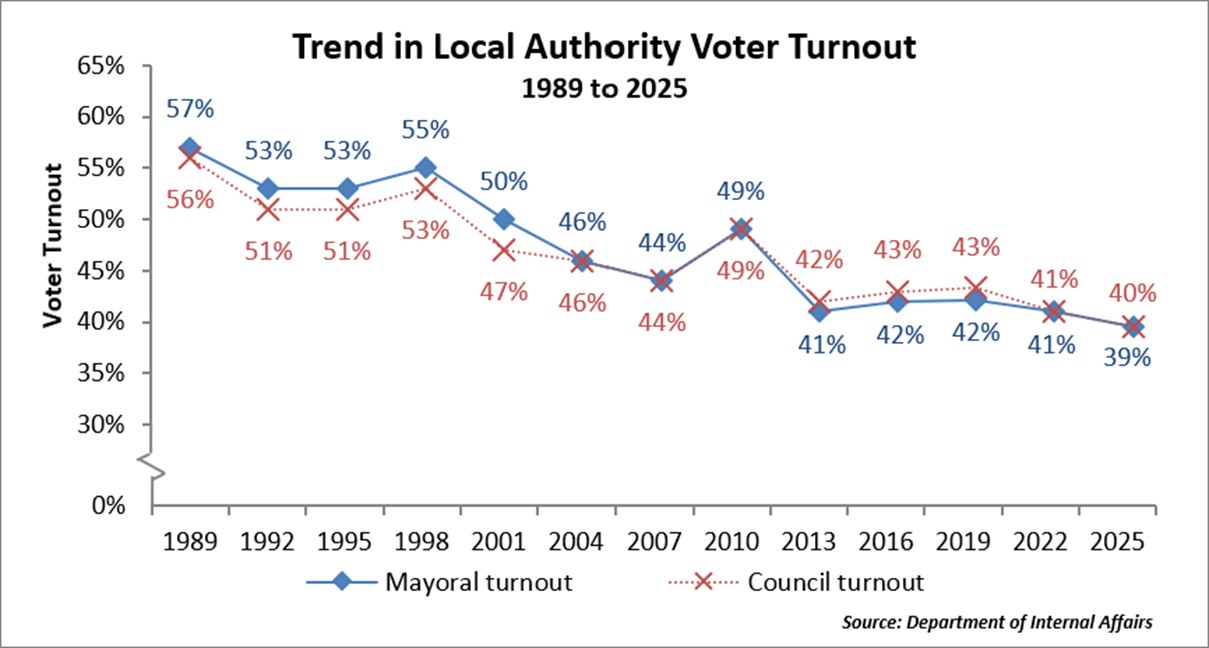
Note: Mayoral turnout includes contested elections of mayors for city and district councils. Council turnout covers contested city and district council elections. Uncontested elections are not included in this statistic.
Turnout has been relatively stable since 2013. Turnout was 40 percent in 2025, slightly decreasing from 41 percent in 2022. Turnout has declined since 1989, when local government reform contributed to turnout peaking at 56 percent.
Turnout in 2025 is the lowest level in this series. The downward trend in 2025 turnout is driven by the low turnout for Auckland Council, which decreased from 35 percent in 2022 to 29 percent in 2025. Due to the significant size of Auckland Council compared to all other councils, any decrease in turnout for this council will influence the overall turnout. If the result from Auckland Council is excluded from the national figure, council turnout would be 45 percent.
The temporary increase in turnout in 2010 is partly attributed to increased local voting for the first Auckland ‘super city’ election and in Christchurch following the 2010 Canterbury earthquake.
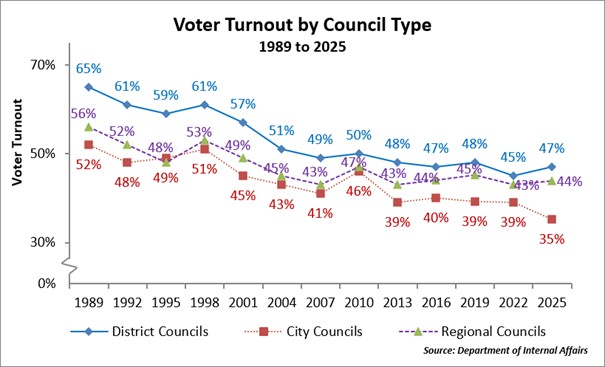
Note: Voter turnout based on councillor elections for city, district, and regional councils.
Turnout has generally declined across all council types since 1989. District councils have continued to have the highest turnout (47 percent in 2025). In 2025, turnout for district and regional councils recorded small increases, while turnout for city councils fell from 39 percent to 35 percent. The downward trend in the city council turnout is also driven by the low turnout for Auckland Council. If the results from Auckland Council is excluded, the city council turnout would be 43 percent.
Representation of women
For the representation of women as candidates and elected members, the proportion axis shows the percentage of female candidates and elected members in all candidates and elected members respectively.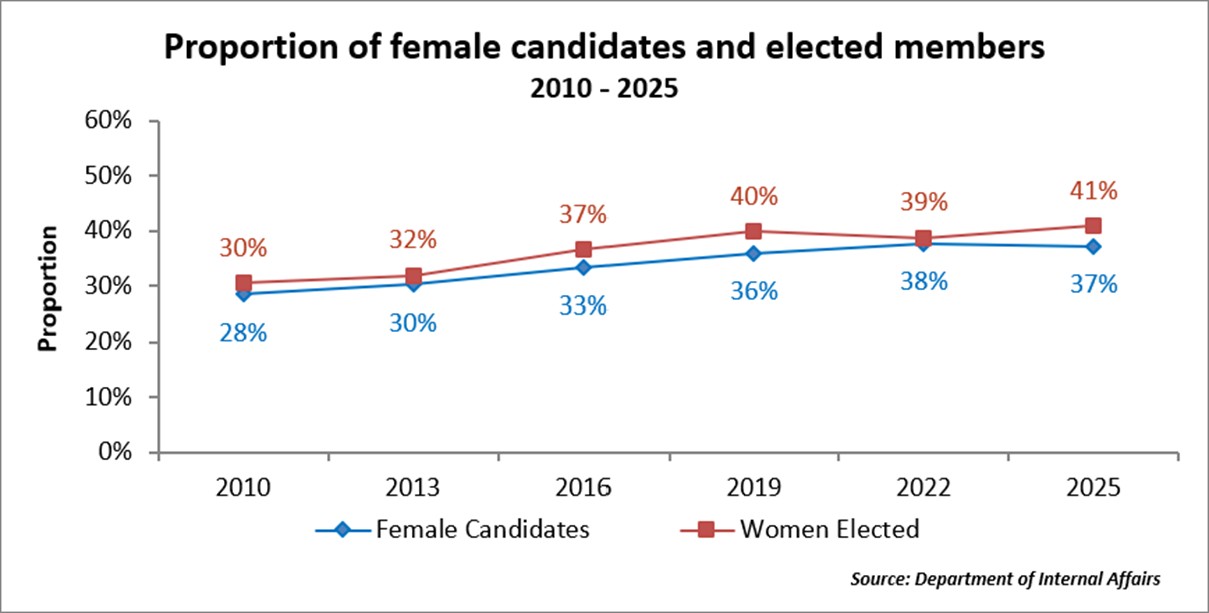
Note: This chart covers the local authority elections examined in this report, including mayoralties, councils, community boards, and local boards.
Overall, the proportion of women elected to local authorities’ seats has trended upward over time, other than a small dip in 2022. The 2025 result showed the highest percentage of female elected members out of the total group of elected members in the last 16 years. In 2025, women made up 41 percent of elected members and 37 percent of candidates
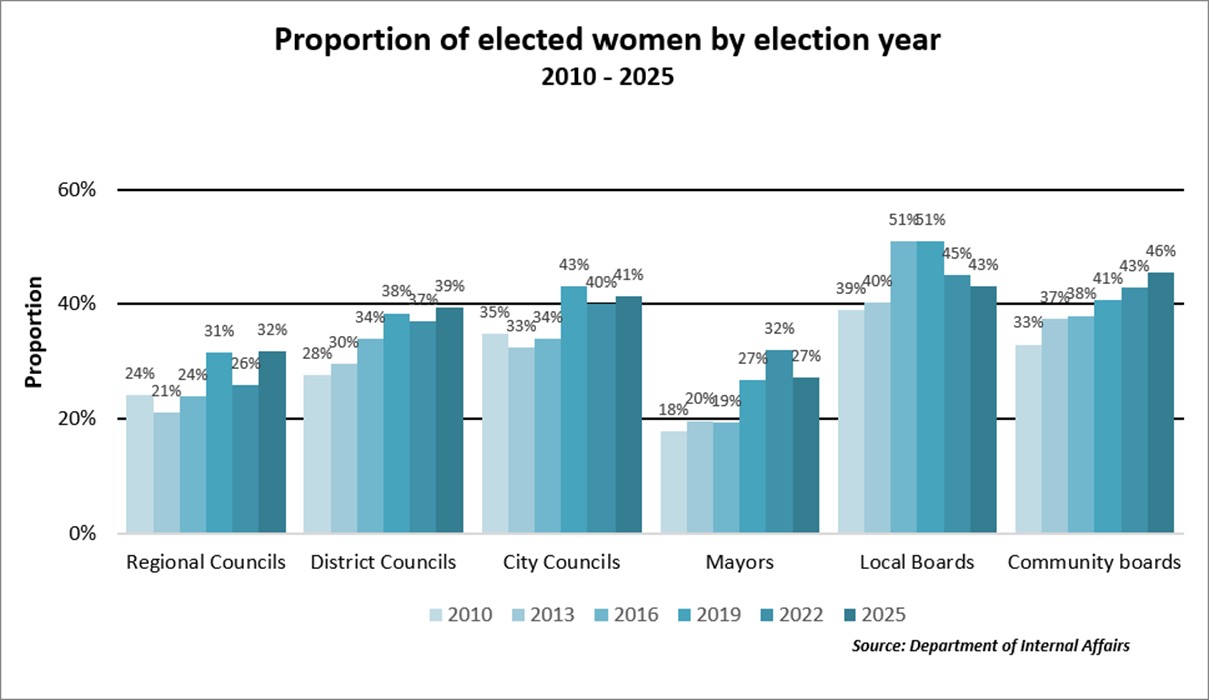
The proportion of women elected to most local government seats has generally increased since 2010, although for local boards the proportion has decreased slightly in recent years.
The 2025 local elections saw an increased proportion of elected women in all seats, except for mayoralties and local boards. The largest changes from 2022 were in regional councils (up six percentage points to 32 percent, equivalent to eight more members) and mayoralties (down five percentage points to 27 percent, three fewer mayors). Community boards currently have the highest representation of elected women, with close to half of positions held by women following the 2025 local elections (46 percent).
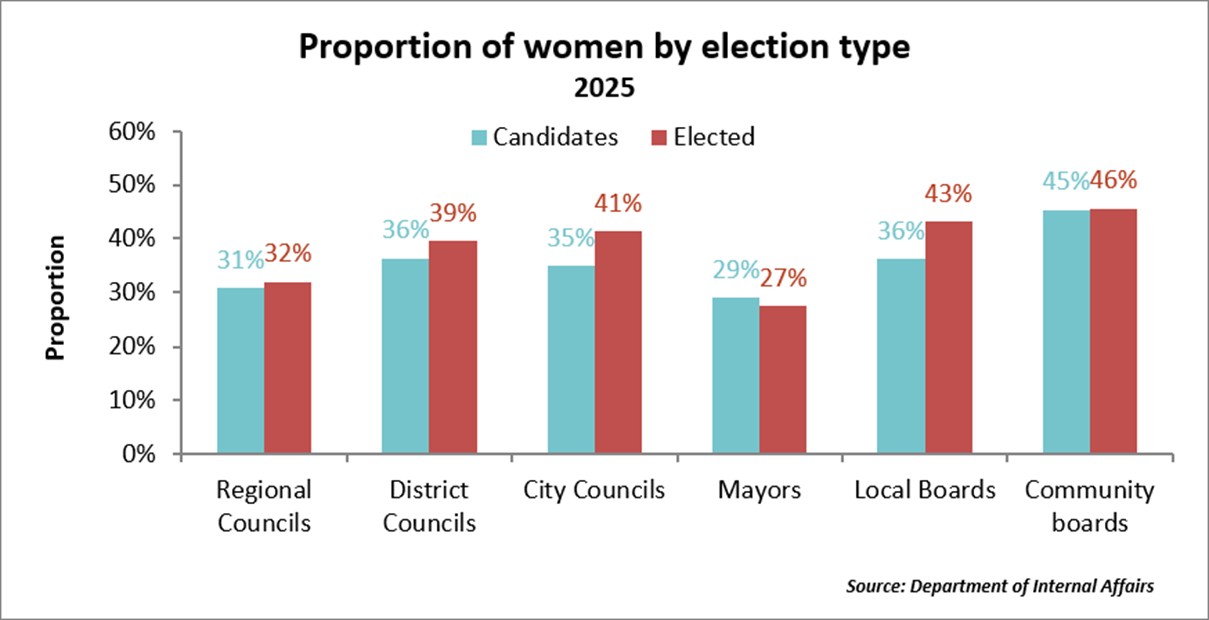
Comparing candidates with election outcomes shows where women were elected at higher (or lower) rates than their participation as candidates. The largest gap is for local boards: although women made up 36 percent of candidates, they won 43 percent of positions. In most examined areas, women comprised a higher proportion of elected members than of candidates in 2025, with mayoralties the exception.
The full data set, including the above graphs and 2025 local elections statistics, can be downloaded as an Excel file by clicking the following link:
- Local Authority Election Statistics 2025 (Excel, 369 kb)
- 2025 Local Authority Election Data (CSV, 120 kb)
Previous Local Authority Election Statistics
Data
The 2022 data set, including graphs and the 2022 local elections statistics, can be downloaded as an Excel file by clicking the following link:- Local Authority Election Statistics 2022 (Excel, 336 kb) - updated April 2026
- 2022 Local Authority Election Data (CSV, 116 kb)
- 2019 Local Authority Election Data (CSV, 134 kb)
- 2016 Local Authority Election Data (CSV, 1.6 mb)
- 2013 Local Authority Election Data (CSV, 189 kb)
- 2010 Local Authority Election Data (CSV, 202 kb)
Reports
Prior to the 2013 local elections, the Department produced detailed reports analysing results at both national and regional levels. These can be accessed below.- Local Authority Election Statistics 2022
- Local Authority Election Statistics 2019
- Local Authority Election Statistics 2016
- Local Authority Election Statistics 2013
- Local Authority Election Statistics 2010
- Local Authority Election Statistics 2007
- Local Authority Election Statistics 2004
- Local Authority Election Statistics 2001
